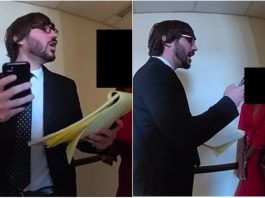
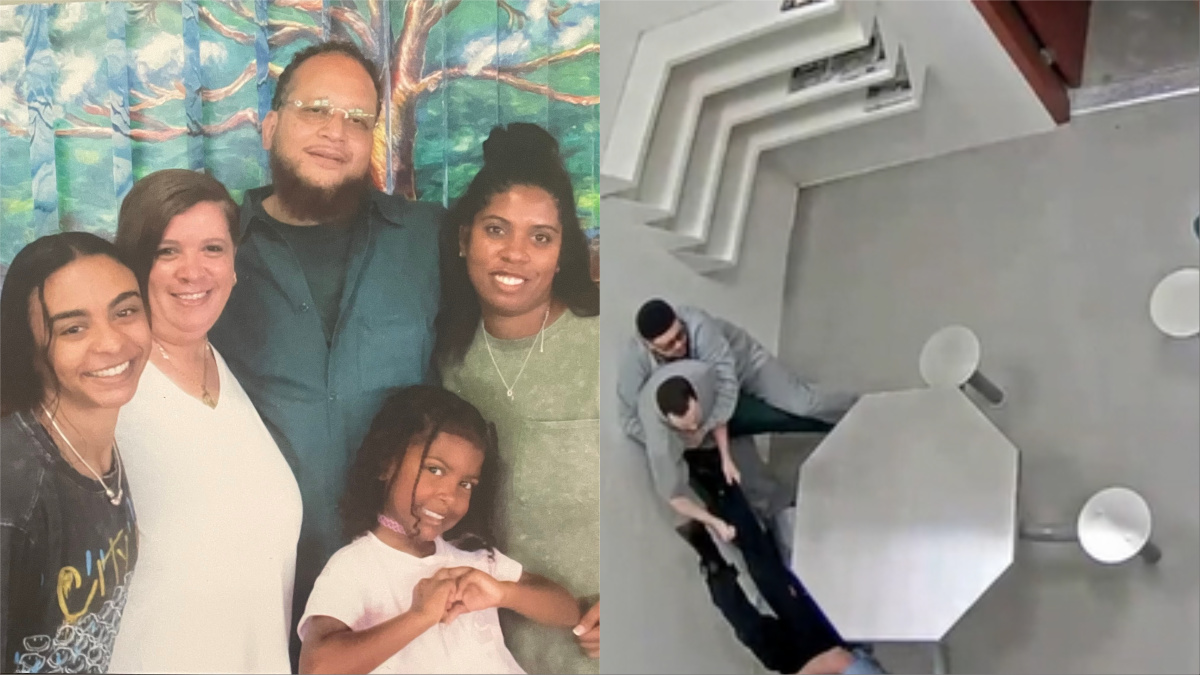
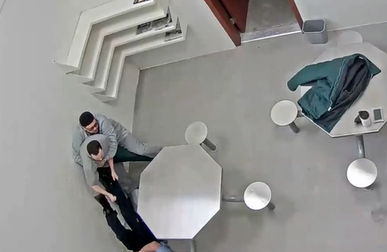
There’s no question that Derek Williams did something very good while behind bars. In 2019, he saved the life of a Wisconsin prison guard who was being stabbed by another inmate with a sharpened pen, risking his own life by intervening. Parole records indicate that Williams placed the attacking inmate in a bear hug, preventing him from killing the correctional officer. The intervention is on video; the guard was injured, but he escaped death due to Williams’ actions, which put his own life in jeopardy.
Video shows the rescue. First, here is a scene showing the other inmate attacking the guard while Williams was on the phone in the corner. Then, you can see Williams behind the attacking inmate, pulling him off of the guard.

There’s also no question that, 30 years ago, at age 21, Williams did something very bad. 12 times. Williams was convicted of 12 armed robberies. Corrections records indicate that they happened over a two-day time span. Williams and two co-actors were masked and armed with guns. The robberies were dangerous and traumatizing. “Saying sorry is an understatement,” Williams says now, age 52 and still incarcerated seven years after saving the guard’s life, despite being given a chance for immediate parole as a result of it.
“I wish there is a way I could make it up. The fear I instilled in them at that time, I had no right.”
There’s also no question that Williams received a sentence far longer than many murderers.
The judge, Diane Sykes, ran the charges consecutively, giving Williams (and a co-actor) a whopping 180 years in prison way back in 1997. The robberies were egregious, to be sure, although no one suffered bodily injury. “Put the keys back in if you don’t want to get popped,” the robbers told a couple before stealing their car at gunpoint. They robbed grocery stores and a man of his truck near a garage. And it all occurred in a time frame with heightened concern over soaring violent crime rates in Milwaukee.
There’s also no question that Williams and his co-actor James Evans deserved significant time; even he admits that. But he’s already paid a big price for those actions, as has Evans: He’s spent nearly 30 years behind bars of what is now a 90-year sentence, reduced from 180 years due to his actions in saving the guard’s life. And Evans is still serving 180, with parole eligibility in 2042.
As Williams’ stepdaughter Jazzmine Johnson wrote the state commutation board, Williams has already served “10,220 days – 245,280 hours, 14,716,800 minutes, and 883,008,000 seconds – 28 years. That is the length of time Derek Williams has had to reflect on a decision he made at the age of 21, a decision that has resulted in nearly three decades of incarceration.”
Laura Yurs, a legal fellow at UW-Madison Law School who provided Williams with representation, wrote, “Decades from the recklessness of his youth, Mr. Williams is now in his fifties.”
Williams has some high-profile supporters who believe that it’s time to release him. State Sen. Dora Drake wrote, “I write to offer my full support for Derek M. Williams.” She said his parole has been delayed several times. The former Milwaukee television anchorwoman Beverly Taylor wrote, “During a status conference on sentence modification in December 2023, prosecutor Paul Dedinsky rightly stated that Derek’s crimes necessitated an ‘enormous amount of incarceration, but we believe that end has been met.’…Derek takes responsibility for the actions that got him in prison. He has paid for his crime.” Dedinsky is no bleeding heart liberal; he is a tough conservative prosecutor respected by all I know. Court records bear Taylor’s account out.
“He was recently married, a high school sweetheart. He’s got family. He’s got a faith community, it sounds like,” Dedinsky said in court. “He’ll be eligible to request parole, he’ll still be under community supervision, if that is granted in the future.” In part because prosecutors did not object, a judge in 2023 cut Williams’ sentence in half – from 180 years to 90, which would give him a chance to be released on parole immediately due to old law rules. That modification was granted because he saved the guard’s life, although Dedinsky later opposed a further request for additional modification.
Williams’ mandatory release date is now 2058. But it gives him an immediate chance at parole (his co-actor, who didn’t save a guard’s life, still sits on a matching 180-sentence for the same crimes.)
And yet he still sits, as parole action has been deferred and deferred, while the system has instead freed a series of sadistic murderers, which we previously exposed during the 2022 governor’s race.
Williams’ timing was poor; the outrage over the parole of the murderers – including a cop killer – led to paroles almost grinding to a halt. Many won’t find that bad; there isn’t much public support for freeing sadistic killers, nor should there be, and Tony Evers’ appointee to the Parole Commission freed some of the worst murderers in state history. Yet a case like that of Derek Williams is far more complex, and it’s one worth also exploring.
“To be honest, the best way I could put is that I was 21 when I committed these crimes,” Williams told Wisconsin Right Now from prison. “I don’t blame my upbringing. I don’t blame no one. I made a bad decision, an immature, ignorant decision. I paid dearly for it. I’m 52 now. I am no longer that person. The environment I grew up in, I didn’t look at consequences. What I did was horrendous.”
At the same time, he notes, “I have seen people who committed murder and rape go home, come back and go home again before I was considered.” He has lost count how many rapists and murderers he’s seen over the last three decades who received less time than he did. He said he is currently entrusted to work in the prison gatehouse, seeing visitors.
Thirty years is a long time. “I lost my grandparents, my parents, my brother, everyone in my immediate family were lost over time, from natural causes, an accident, it’s the only way I know how to grasp this time. The change of technology.”
Why Are We Writing About Derek Williams’ Case?
I previously told you about the case of Pastor James Graham, a 63-year-old Milwaukee man who received such a long sentence for two Family Dollar robberies (one an attempt) that it amounts to almost a life sentence. After a review of the court file, I’m far from convinced that he did one of them, as there was solely a lone eyewitness who got his weight wrong, and another eyewitness who didn’t pick him out of the lineup. A 41-year sentence was cut by three years. Graham has 14 more years to serve. He does not qualify for parole because he was sentenced after truth in sentencing. It struck me as wrong that robbing a Family Dollar store, as egregious as that is, would amount to essentially a life sentence, and there also seemed to be concerning comments made by a judge and presentence writer about Graham’s Christian relgious beliefs.
Unlike Graham, Derek Williams was sentenced before truth in sentencing so he qualifies for parole. Inmates like Graham, sentenced after 2000, have no chance for parole at all.
Both men have applied for commutations under Gov. Tony Evers’ new process, which the governor announced in April, and Williams also has a shot at parole this summer due to the modification.
I stumbled on the cases of Graham and Williams while researching the inmates who have applied for commutations in Milwaukee County. The list of 55 people as of mid-May included 28 killers, and at first I focused my attention there as they shock the conscience. But the two cases of armed robbers serving so much time jumped out at me as worth scrutinizing as well. And then Williams’ wife, Rikki, saw the killers’ story and wrote, imploring me to look into his case, and explaining how he saved the life of the guard.
“Let my husband come home,” she said in an in-person interview with WRN. “Let him be the man he could have been years ago.”
Evers, who ignited a commutation process for the first time since Gov. Tommy Thompson (who only commuted seven), made the guidelines so expansive that they even include the state’s worst homicide offenders serving life terms, even cop killers, as long as they’ve served 20 years (he apparently didn’t learn from public outrage over the previous freeing killers spree). Williams has already served longer than that, and the robberies, while egregious, did not cause bodily harm. Indeed, he’s watched from behind bars as sadistic killers obtained freedom from the then-Evers’ appointee running the Parole Commission.
Perhaps his case mostly illustrates how random the court system can be: Killers get freedom, but the armed robber sits.
We are continuing to report on the homicides. In fact, we recently obtained an updated list from Waukesha County, and there is an extremely egregious homicide offender seeking release on it. There’s concern that Evers will fast-track dangerous releases after the November election. However, I also felt an obligation to explore all of the range of cases. And the fact is, that when it comes to parole and commutations, there is a range.
Wisconsin Right Now historically focuses on the stories the other media won’t do. It’s easy to find sob stories about inmates or prison reform in the legacy media, which tends to ignore the other extreme end of the spectrum, including the homicide offenders we’ve written endlessly about. Yet, I don’t want to do the opposite. On the other end of the range stands James Graham. Standing near him on that range, but a bit closer to the middle perhaps is a person like Derek Williams. Williams’ case is more severe and complex than Graham’s, to be sure. His prison history is more problematic, and he committed more offenses. However, he was also a much younger man than Graham when he did his crimes, only 21.
Both men committed armed robberies that, while certainly very serious, did not result in bodily harm, as noted. And both have already served extensive time: Williams almost 30 years, Graham 23. Both have many, many years to go. The sentences were unquestionably harsh. No one argues the men didn’t deserve a lot of time. The question is how much.
The question, I think, for society to wrestle with, is this: Should armed robberies, even multiple of them, warrant what is essentially a life sentence? Is 30 years enough time to pay for that? How about 20? 40 or 50? Certainly, it’s dangerous for a politician (or armchair quarterbacks) to undo the judgment of a sentencing judge, who was privy to the details and body language in court at the time. However, the system is comprised of humans, and sometimes they get it wrong.
Does society benefit by forfeiting the lives of these two men? Do taxpayers? And how much credit should Williams get for saving a life? Those are questions above my pay grade, but I think it’s worth society wrestling with them.
‘What’s Left For Him at 60?’
Let’s start with Judge Diane Sykes. She gave Williams and his co-actor James Evans an absolute rocket ride. This is not overly surprising. Sykes, who went on to become a state Supreme Court justice and federal judge, was known for tough sentencing. Perhaps not substituting on her sealed Williams’ fate.
The state took a tough stance too, recommending parole eligibility in 35 to 40 years. Armed robberies of this sort are exceptionally dangerous, the kind of thing that can easily turn into murder, and society was drawing a red line in the sand. Denis Stingl, the prosecutor, called the offenses an “urban nightmare.” He described the effect on the victims, who have not registered any objection with the parole board, and stated that the defendants didn’t show remorse, at least back then (Williams does now, and we have not spoken to Evans).
Evans’ mother addressed the court and blamed her son’s issues on her own drinking sprees. She said he was the first of 13 kids. “I don’t condone what my son has done,” she said at the sentencing hearing. “He was a victim a long time before he victimized people. James has had to as a child take care of six and seven children while I be out on my drinkin’ sprees.” She described a bizarre story of asking her son to pick up a dead baby. She accused the system of treating cases differently and trying to send Evans away for life.
“What’s left for him at 60?” she asked. “There won’t be anything left for him.”
Williams tells a similar story. His mother was a “bad alcoholic.” His father wasn’t around. His grandparents took him in. They tried, he said. “I literally didn’t have a choice of the block I grew up in. I renounced all gang affiliation in 2001.”
Williams’ lawyer, Michael Chernin, told the court, “Is it a case that calls out for a life sentence? I suggest to the court that it does not.”
When Williams spoke to the judge, he revealed he tried to hang himself after being convicted, but the lace snapped. He lied to the court that he hadn’t committed the crimes (he has since admitted that he did and taken responsibility.) He expressed concern that the third co-actor was given less time. “I know I’ll be sentenced into the next millennium,” he said whereas a third co-actor would be free in “several months.”
Sykes called the robbery spree extremely aggravated with many victims. “You blanketed the entire community with your crime spree,” she said, highlighting the emotional and psychological toll on the victims. She cited the defendants’ limited education and records. She added, “Both of you are extremely dangerous individuals who need to be separated from the community for if not all of your remaining lives, at least the greater part of them.” She then ran the sentences for both Evans and Williams consecutively, reaching 180 years, of which they could seek parole in one-fourth – 45 years, when both would be about 68.
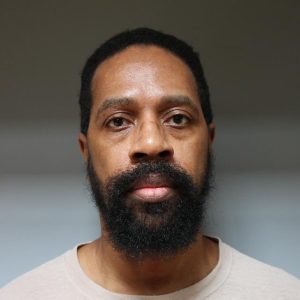
Indeed, Evans, today 51, won’t be eligible for parole until 2042, corrections records say. Williams, though, as fate would have it, had a chance to save a guard, and so he’s up for parole now, and has been for three years.
Why Isn’t Derek Williams Paroled?
For three years, Williams has been caught in a vortex whereby the different arms of the system don’t appear to be working together. The Parole Board chairman wants him to do well on work release first, to see how he does. So they keep deferring his release. That seems reasonable. Let him ease into freedom. Let him prove he can do it, gradually.
But the warden hasn’t placed him on it despite the clear intentions of the Parole Board.
An email from DOC’s Robert Miller explained why: Holidays and vacations of staff were delaying his review; it could be challenging to place him during winter; he had to wait until June for further evaluation. The new Parole Commission Chairman at the time told Yurs that Williams was doing “everything right.”
A lawsuit filed by Williams to no avail indicates some of the Parole Board’s rationale for being cautious; in that lawsuit, Williams noted the killers that were freed by Evers’ former Parole Commission Chairman John Tate. In January 2026, Williams had a third review before the parole board.
The Parole Commission noted that Williams was already on parole when he committed the robberies almost 30 years ago. He spent 25 years at the maximum level of prison supervision, but has progressed to medium now, and has spent almost a year in minimum supervision. Progressively, his level of supervision has lowered as he has done better inside prison for six years now. The Parole Commission Chairman opted to defer Williams’ parole so he could be placed on work release to see how he would do with that lower level of supervision – again, reasonable, but it hasn’t happened.
Records show that Williams explained to the Parole Commission, “I try not to make excuses. How I was raised, the environment I grew up in, at the end of the day, it was my choice, my decision.” He said the robberies were the “dumbest thing I could have done.”
A 2025 report from the Parole Commission says that Williams has taken responsibility for his actions and expressed remorse.
He had a juvenile record dating back to age 11 and time at Ethan Allen and two other armed robbery counts from 1990 that had him on parole at the time of the spree. That raises concern.
He obtained his GED behind bars and completed lots of training in prison. That provides optimism.
The Commission notes that he’s had minor and major disciplinary issues behind bars, such as for disobeying orders. Some of it is disturbing. He was caught masturbating in front of staff years ago. His last major conduct report was in 2019. Williams explained his improved behavior by saying the lengthy sentence he received was a factor – looking at 180 years depressed him and led to bad conduct because he had nothing to live for – but his wife’s influence helped him enormously. Over 30 years, his disciplinary history included weapon possession, threats, and soliciting staff. Obviously not good. Williams says some of the reports are for things as minor as unbuttoning his shirt in the visiting room because he was hot and for having chips, which were considered contraband. He said the weapons offense came from a blade being separated from a razor and claims he didn’t intend to use it as a weapon.
Williams said he believes the system has been harsher on his desire for release because he had a relationship years ago with a prison psychologist who took her life while under investigation. Court records show that a psychiatrist found that the prison psychologist “initiated a sexual relationship with him, even though she was ethically obligated not to have sexual contact with her patients. Williams was afraid to say no” to her advances. That report says he has had multiple mental health diagnoses. He became depressed after her suicide and cut his wrists and throat in 2011. He was accused of being manipulative within the prison system.
He admits, “I think I was on a verge of a nervous breakdown. Everything was blank, I felt I was at the end.”
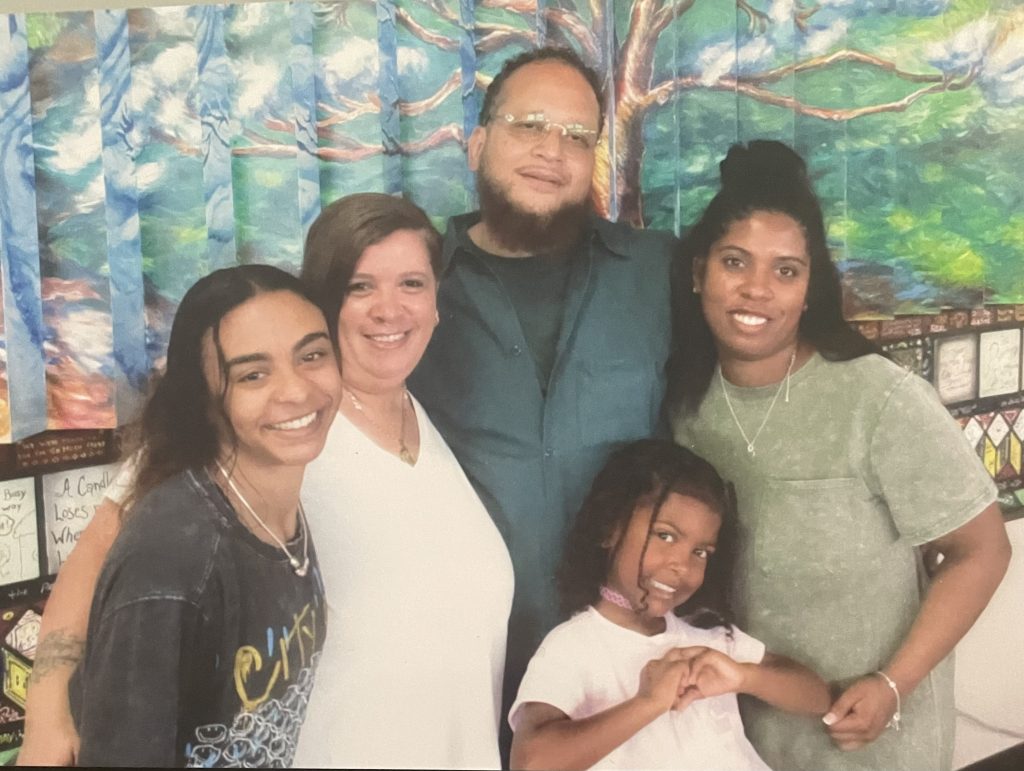
Getting married to his wife, who he knew as a child, while in prison several years ago changed him, he says. So too has having some light at the end of the tunnel, at last. “Rikki, her daughters, the granddaughter, what they pour into me, it’s amazing. It made me change in ways I never thought I would change. It made me know I am human, I can be a good person,” he says.
Williams says the fact Evers is opening up commutations “spread like wildfire” in the prison system. “Lots of people are filing for it, people who got six months are filing for it, people with all types of cases.” He thinks allowing killers to qualify goes too far in most cases.
He added, “Evers is going to get backlash because of the murders. I grew up in the ’90s, I know those crimes, I was around during that era. I know the people killed.” As for armed robbers still incarcerated from that era, he said, “There are only a few of us still around.”
 He has had a positive work evaluation inside the prison and held numerous jobs.
More time was needed behind bars so as not to depreciate the seriousness of the offenses, the Parole Commission decided.
He has worked inside the prison in many capacities. Documents show that he has worked as a tutor, and received positive evaluations. “One of my best tutors ever!” reads one. “Always doing extra work without being asked,” says another.
And now comes the chance for commutation.
Williams’ stepdaughter, Maya Fields, wrote a letter to Evers seeking a commutation for Williams. “Because of his encouragement, I made the decision to leave home and attend Howard University out of state for college,” she wrote. “While I am aware of his past mistakes, the person I know today is not defined only by them.”
His wife Rikki, a social worker, cited the saving of the guard’s life in her letter. “This moment reinforced for me how much Derek has changed. It demonstrated courage, selflessness, and a strong moral compass even in a highly dangerous environment. He has evolved from a young man with poor judgment into someone who is accountable, reflective and committed to doing better – for himself, his family, and his community.”
Table of Contents