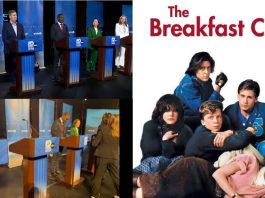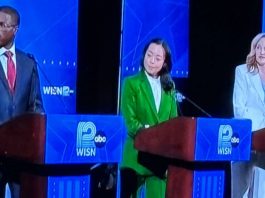
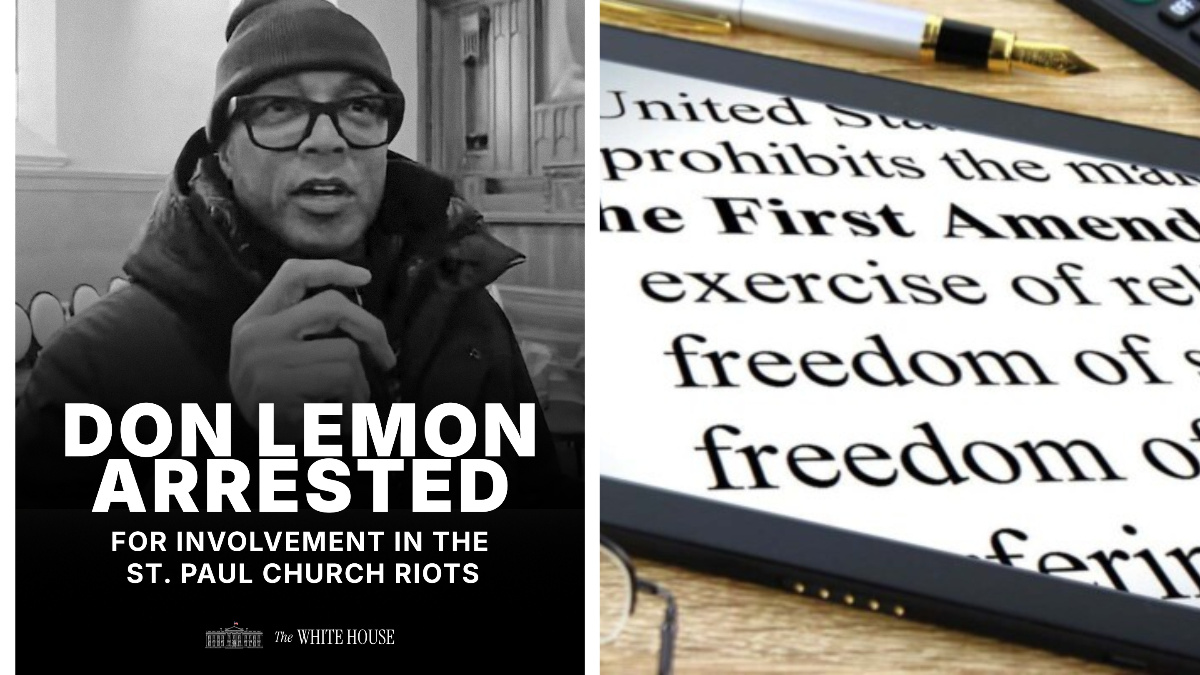
Should Don Lemon have been arrested? What about Georgia Fort?
Short answer
Lemon crossed the line through alleged overt actions and statements that transformed him from a journalist to an unlawful participant. Thus, the government is within its bounds to charge him. The First Amendment doesn’t give journalists free rein to break laws, and it doesn’t give them the right to interfere in other people’s exercise of their constitutional rights, including the practice of religion. His behavior was simply wrong.
It was a church. The indictment contains fewer overt comments and actions by Fort, so the case outlined against her in the indictment is a weaker one, but there’s an argument for it.
However, I don’t believe the case against Lemon (or Fort) is as simple as many conservatives are making it, and I don’t believe the case for them is as simple as many liberals are making it. As someone who cares deeply about the free press, I am going to take some time here to grapple with the nuances (this will be long because the government arresting a journalist is a big deal), and I hope you keep reading.
But was the government wise to charge Lemon and Fort?
I want the government to give wide latitude to independent journalists for reasons I will explain below. Furthermore, I believe that the public overall wants the government to focus on arresting illegal immigrant child molesters and other criminals, not journalists. These decisions have ramifications for the midterms. Thus, I have mixed feelings about the government’s decision to file these charges, although I don’t find their decision to do so outrageous. Lemon’s behavior was outrageous (whether it’s criminal is a deeper analysis.)
Hypocrisy, hypocrisy everywhere
Hypocrisy abounds everywhere we turn. Independent journalists were charged after January 6, and I don’t recall very much news coverage or consternation on the left or in the media over it. As with this case, though, I believe the details matter. All of the J6 independent journalists charged were not the same. For example, Steve Baker, a conservative journalist for Blaze News, was criminally charged with unlawful entry (to a PUBLIC building, the US Capitol, not a PRIVATE church). He stayed for 37 minutes and then left. He recorded what was happening.
“I didn’t assault police officers. I didn’t damage any property. I didn’t do anything other than just take video,” Baker said, after he was pardoned by President Trump.
Where was the outrage for Steve Baker?
On the other hand, John Earle Sullivan called himself an “independent journalist” after being charged on J6. He used a megaphone to urge, “Get in that s—, let’s go! Move, Move, Move! Storm that s—!” and “Let’s burn this s— down,” the government alleged, adding that he entered through a smashed window, ignored law enforcement officers’ commands, and “told the officers to stand down so they would not get hurt.”
Sullivan was not acting as a journalist. You can’t just let anyone claim they’re a journalist to get out of criminal charges. Baker was acting as a journalist. The cases are different. Baker shouldn’t have been charged. Sullivan is a different matter, although I don’t want to diverge into some lengthy discussion of J6 in this post.
But those cases are instructive for this reason, and it will be clearer by the end of this analysis: I see Lemon’s behavior as falling somewhere in between, but heading toward the Sullivan side of the spectrum. Fort’s as well, but she’s tilting more toward Baker’s side. I think that matters.
Then there’s the FACE act hypocrisy (Lemon and Fort were charged with violating it). The Freedom of Access to Clinic Entrances Act of 1994 was signed into law by Bill Clinton, and it was used in the past to go after peaceful anti-abortion protesters accused of obstructing entry to abortion clinics. The law also protects people trying to enter a church or other house of worship “to exercise the First Amendment right of religious freedom.”
The same media and liberals who are upset about the Lemon charges were often silent when PEACEFUL abortion protesters were charged by the Biden administration.
At the same time, anti-abortion activists have previously argued that the FACE act was unconstitutional abridging of their free speech and assembly rights. The courts have upheld it, but it hasn’t been tested before the U.S. Supreme Court.
Let’s get a few foundational points out of the way first. Bear with them, please. I think they are important. Then, I will explain my decision on Lemon and Fort in greater detail.
What are my credentials?
I have been a journalist for 30 years. I have experience in both corporate and independent media and in all genres (print, online, broadcast). I have a large social media following. I co-founded one of the largest independent news sites in Wisconsin. I have taught journalism full-time for 21 years (my opinions are my own and don’t represent the institution where I work). I have won national and state reporting awards, including recent gold awards from the Milwaukee Press Club for the best investigative, public service and news reporting in Wisconsin. I have also won awards for “opinion journalism,” column writing, critical review writing, and podcasting.
Is Don Lemon a journalist?
Yes. He obviously worked for corporate media, including in prominent roles (CNN, etc.) He is now an independent journalist with a YouTube channel. Is Georgia Fort a journalist? Yes. Same analysis. She’s won awards for it. She created a non-profit broadcast journalism center; non-profit funded journalism is a recognized modern journalism model.
Does it matter that they share their opinions sometimes? Does that mean they aren’t journalists anymore?
No. The modern media ecosphere includes different models of journalism. There is the traditional “objective model,” but there is also “advocacy journalism,” its cousin, “civic journalism,” and “opinion journalism.” Critics come on my social pages and laugh at the idea that there is “opinion journalism.” Where have they been?
Are they forgetting the great columnists of old? Mike Royko, Charles Krauthammer, Maureen Dowd, how about Mark Twain, Walter Winchell, and H.L. Mencken? Editorial boards share opinions. Podcasters do. Movie reviewers do. Talk radio hosts do.
The Founding Fathers did not champion an “objective model” for the press. People forget this. Alexander Hamilton started the New York Post in 1801 to champion the views of the Federalist Papers, “and criticize Thomas Jefferson.” Benjamin Franklin owned a newspaper, and it was not “objective.” In fact, his Pennsylvania Gazette ran what is widely recognized as the first American editorial cartoon in 1754, “Join, or Die.” It featured a severed snake, urging the colonies to unite.
The objective model of journalism emerged with the penny press in the mid-1800s in New York, driven by mass-market production and audience; Horace Greeley first created a firewall between news and opinion on the pages of the New York Tribune.
Today, both models exist side-by-side in the media ecosphere, which is constantly evolving, and, in the age of influencers and podcasters, sometimes both exist within the same site or person (ie, Nick Shirley isn’t objective, but he’s doing reporting. I think he’s a journalist.) Hometown, family-run newspapers often advanced their owners’ views.
There’s also the question of whether anyone can be truly “objective.” We all have opinions. Bias exists in what people don’t report as much as in what or how they do. I think some reports are fairer than others. Conservatives don’t believe the elite legacy media are truly “objective.” Ask anyone who has been covered by them. Personally, I like a robust, competing, free-market media ecosphere that offers multiple perspectives and approaches.
Thus, the fact that Lemon and Fort have expressed opinions or may have been sympathetic to the agitators’ or protesters’ cause doesn’t necessarily mean they are no longer journalists, in my mind.
The importance of a free press
Of course, the Founding Fathers extolled the importance of a free press (they just didn’t mean it had to necessarily be an objective model one). And that must be discussed in this analysis.
The free press is a critically important foundation of our democracy. I once presented media scholarship at an international journalism educators conference in Africa. I spoke to Nigerian journalists who told me they couched political commentary in humor and satire so the government wouldn’t shut their broadcasts down. We must always protect the free press; don’t take it for granted. Most people don’t have it. Free speech, as well.
Thomas Jefferson said, “Were it left to me to decide whether we should have a government without newspapers or newspapers without a government, I should not hesitate a moment to prefer the latter.” George Washington said, losing free speech would be “like sheep to the slaughter.” They didn’t think freedom of the press was without challenge. James Madison said, “Some degree of abuse is inseparable from the proper use of everything, and in no instance is this more true than in that of the press.” But they fervently believed in its importance. So do I.
The Biden administration’s exertion of pressure on big tech to censor speech was an outrage. If people expressed no concern about the latter but are jumping off the cliff over Lemon’s arrest, you should question their agendas.
Who is a journalist?
Final foundational point. How do you define a journalist? There is a LOT of hypocrisy on this point when it comes to the Lemon charges. People on the right are quick to say, “Lemon is not really a journalist!” because he no longer works for a corporation, but they wouldn’t want that definition applied to Nick Shirley. People on the left would never call Shirley a journalist, but they think Lemon is because he picked up a camera and once worked for a corporation. I prefer a broad definition that would include Shirley AND Lemon.
Thus, for the purposes of this analysis, I am stipulating that Lemon and Fort are journalists.
These days, what a journalist is can be tricky to define, but I will give it my best shot. To me, journalists are people who are documenting, recording, and preserving the rough draft of history. Some are podcasters, some corporate, some independent. I am not particularly wedded to format, but rather the ethos of content. Can you prove what you are saying? Social media platforms are basically people’s front pages these days; they offer very large audiences. The people analyzing the news with regularity and consistency (versus a few comments here or there) are opinion journalists.
I think it’s easier these days to explain how I do NOT define a journalist, i.e. what rules one out.
People who aggregate other people’s stuff aren’t journalists. There are influencers who do this in Wisconsin and elsewhere; they claim they are journalists. They’re not. If all you or they are doing is taking other people’s documents or screenshotting other people’s reporting, to engagement farm on social media, you’re an aggregator, not a journalist.
Just because you’re on social media doesn’t mean you’re not a journalist, though. I use social media to grow an audience for my journalism and things I care about. Some of what I post on social media is not journalism. Some of it is. But just because I sometimes post a photo of my dog on social media doesn’t mean that I am not a journalist in other respects and at other times/platforms.
If you get facts wrong a lot because you don’t check people’s rhetoric, don’t file open records requests, and don’t take due diligence to make sure your sources are credible and accurate, you might be trying to do journalism, but you’re probably bad at it.
For example, if you post a random comment or claim without proving that it’s true, that’s not journalism. Some modern influencers are not trained in journalism, which at its best requires some verification and sourcing, and they get a lot wrong as a result. I tell my students to always ask, “How do you know this is true?” And then be transparent about that with readers.
I prefer to also have a professionally trained press corps, but I am not threatened by having gutsy independent journalists operating alongside it. I care about accuracy and rigor of source vetting, not format or corporate employment. I don’t print what I can’t prove. Overall, I want more voices and approaches in the media, not fewer.
What journalists can’t do: why the charges are not out of bounds
Journalists are not exempt from the law.
As a journalist, you do not have the right to violate criminal laws. Freedom of the press guarantees you freedom from government suppression of your speech. It doesn’t give you freedom to violate the law.
For example, you don’t have the right to trespass on private property. A journalist wouldn’t have a special right to barge into a celebrity’s living room and demand they answer questions.
Journalists don’t have the right to impede law enforcement operations.
Journalists can’t hack into someone’s phone (as some in the British press found out, although that’s not the case here.)
Journalists can’t steal property. You don’t have a right as a journalist – and this matters here – to stop other people from exercising their rights.
A church is private property.
Let’s be clear. There’s no question that the other agitators deserved criminal charges. They are a different question from the people who say they were operating as journalists.
However, there is some complexity regarding the journalists, and I am sure Lemon’s legal team will explore them. For example, whether the church is private property can depend on “whether the church’s Sunday service was open to the public,” experts told the Los Angeles Times, which added the church had called for people to “join” them.
So, just entering the church isn’t likely the issue.
But the church didn’t call for people to “disrupt it,” nor do journalists or anyone have a right to do so.
Although people don’t have a right to interrupt a Sunday service even if it was open, the indictment doesn’t accuse Lemon or Fort of chanting or engaging in some of the other egregious behaviors exhibited by other agitators.
Rather, they are accused of interviewing the pastor once they got inside. An interview is a journalistic act, which complicates things, albeit it was a leading and fairly hostile one.
But Lemon did more than just that interview. And here’s where the strongest case for the charges comes. For starters, Lemon is accused of standing in the door, supposedly blocking people from leaving. Fort is accused of interviewing an agitator in front of a minivan of kids.
Thought exercise
Let’s say Lemon stumbled on this scene. Let’s say he had never met the agitators before and had just seen them rush into the church. Let’s say his only role was to follow them in and document what they were doing.
I would be more inclined to support the charges in that scenario. Is he trespassing by documenting their trespassing? Yes. But intent matters. Frankly, we know more about what happened inside that church (and it’s very bad for the agitators) because Don Lemon took his camera inside. Journalists document the rough draft of history, and I want the government to give them broad latitude when they document contentious, rapidly unfolding scenes, even when criminality is occurring.
For example, independent journalists on both sides performed a critical role in documenting the criminality and arson unfolding during the Kenosha riots, and without their video, Kyle Rittenhouse may not have been acquitted.
There was recently an interesting documentary on the Kia Boyz, a car theft ring in Milwaukee. Documentarians often embed within unsavory groups to expose their realities (and misbehavior). Should they be criminally charged if they are standing there when criminal mischief is discussed? Is there a value in knowing what the Kia Boyz are really up to? When should the journalist extricate themselves from such a situation, and when should they report it? These can be complicated questions. Let’s not pretend they aren’t.
But that’s not all that Lemon did.
Where Don Lemon really crossed the line
But Lemon didn’t exactly follow the scenarios described above, according to the government (and he’s innocent until proven guilty).
According to the indictment, he made several other overt comments/actions that moved him from a journalist documenting agitation to becoming PART OF THE GROUP and its planning (conspiracy).
This is really important.
He was accused of conspiring to “injure, oppress, threaten, and intimidate multiple persons” at the Cities Church, who were engaging in their First Amendment right of religious freedom.
According to the indictment:
Lemon, Fort, and the organizers/agitators met together at a “pre-op briefing” at a shopping center to discuss the operation. They were provided instructions on how the operation would be conducted.
Lemon admitted on video that he was with the organization and “took steps to maintain operational secrecy by reminding certain co-conspirators to not disclose the target of the operation and stepped away momentarily so his mic would not accidentally divulge certain portions of the planning session.”
Through those acts, Lemon allegedly became part of the planning and conspiracy – part of the group he was covering.
He thanked a lead agitator for what she was doing and assured her he was “not saying… what was going on,” the government says.
He was allegedly provided details about how it would unfold and said he would see the organizer there.
Lemon was accused of instructing two people, “don’t give anything away,” and told his audience, “We can’t say too much. We don’t want to give it up.”
Once he got into the church, Lemon is accused of physically occupying the church.
His behavior inside the church was somewhat separate from the group. The behavior overall was repugnant. Another defendant disrupted the service by chanting, “This ain’t God’s house. This is the house of the devil.” A person screamed Nazi in congregants’ faces and asked child congregants, “Do you know your parents are Nazis? They’re going to burn in hell,” the government says.
Lemon, at this point, was documenting and describing the frightened children’s reactions, admitting they were traumatic and uncomfortable. I believe he was documenting at times, but especially in the planning stages he morphed from a journalist into something else.
And that’s why he’s being charged.
Before his interview with a pastor, he allegedly stated to another defendant/agitator, “Who is the person that we should talk to? Is there a pastor or something?” which implies he was taking direction from agitators, rather than operating as an independent journalist.
He and Fort then approached the pastor and “largely surrounded him” while Lemon peppered him with questions. I see this as an interview, albeit an inappropriate and obnoxious one.
He and the other defendants also ignored the pastor’s request to leave the church, which was private property. This also crosses a line.
Other agitators blocked the stairs leading to the church’s childcare and “made it difficult and hazardous for parents to retrieve their children.” Let’s not sanitize how outrageous this was.
Lemon allegedly posted himself at the main door and “confronted some congregants.” He is accused of physically obstructing them as they tried to exit the church building to challenge them with “facts” about US immigration policy.
He did not have the right to obstruct people from leaving the church.
Conclusion
As with Sullivan, Lemon allegedly made overt acts and comments that moved him from journalist to alleged lawbreaker. Fort, less so. Thanks for reading.
Table of Contents