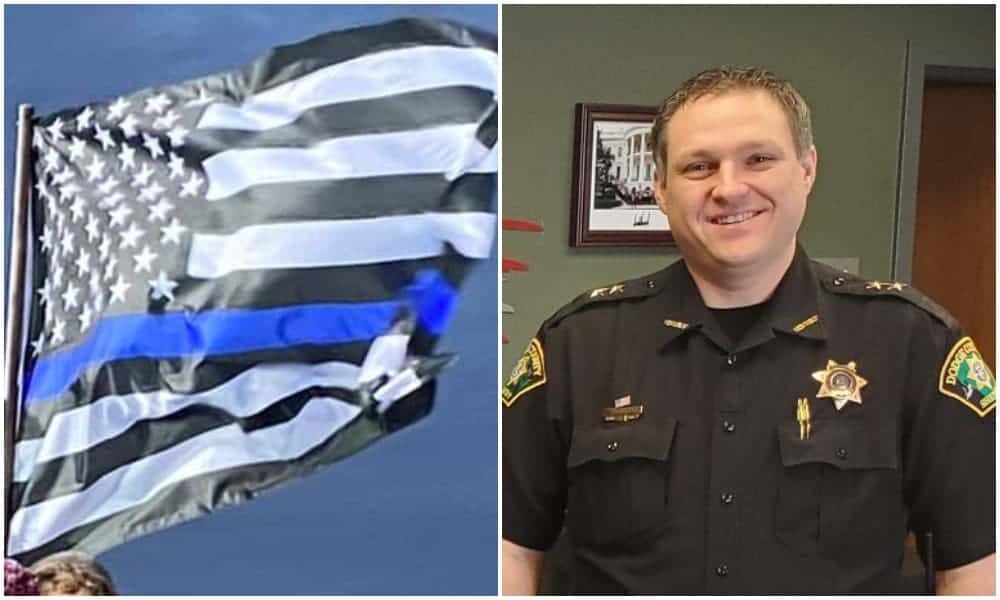
“I have authorized ‘Thin Blue Line’ flags to be displayed on all Dodge County Sheriff’s Office squad cars” -Dodge County Sheriff Dale Schmidt
Dodge County Sheriff Dale J. Schmidt has posted a statement of strong support for the thin blue line flag just days after UW-Madison’s police chief, Kristen Roman, banned it. He said the department will not bow to the “whims of extremists,” and he authorized use of the flag by his officers.
In his “January Sheriff’s Column,” posted to the department’s Facebook page, the Wisconsin sheriff wrote, “I encourage all citizens and law enforcement to feel free to display the “Thin Blue Line” flag with pride because supporting and being a part of law enforcement is nothing to be ashamed of. It is one of the world’s oldest and most noble professions and I am proud to stand side by side with so many outstanding men and women who put on the uniform because they have one thing in mind, serving and protecting the citizens of our great nation.”
Read his post in full here.
Wisconsin Right Now was the first site to break the story of Roman’s thin blue line flag ban. You can read our original story here. Although Schmidt doesn’t specifically mention her, the timing of his post reads almost as a rebuke – and certainly as a counter argument.
Over the last couple of years, the “Thin Blue Line” flag “has become very popular,” explained Schmidt.
“For those of you who are not aware, the ‘Thin Blue Line’ refers to the concept of the police as the line which keeps society from descending into violent chaos. Recently a new spin has emerged which has painted the ‘Thin Blue Line’ flag as advancing ‘hateful ideologies’ being pushed by ‘extremists’ and as a result we must reject the flag altogether,” wrote Schmidt.
“I counter that argument by asking, should we abandon our American Flag because other ‘extremists’ are using it to promote their misguided ‘hateful ideologies’ as well? This is an absurd thought and it is infuriating. I am aware of 2 law enforcement executives in Wisconsin who have decided to ban the flag in their agencies. To me, this sends the wrong message to citizens and law enforcement.”
Here’s the rest of his post:
The “Thin Blue Line” flag has been a symbol of support for law enforcement by a very large number of United States citizens. Those who display it typically support law and order. They support waiting for all facts before casting judgment on any incident. They support law enforcement officers knowing that the vast majority are good people who genuinely want to make their community a better place. They understand that contrary to the false narrative of the media, law enforcement is overwhelmingly color blind as it relates to the law. They also understand that if you break the law, there are consequences regardless of the color of your skin.The Dodge County Sheriff’s Office will never bow to the whims or false narrative of extremists who hate law enforcement. I am proud of the work my staff does every day. I am proud our citizens support the work we do. I am proud we have a symbol in that of the “Thin Blue Line” flag that is positive and unifying even though those who hate law and order and law enforcement are hateful toward the flag. To me, the “Thin Blue Line” flag represents that we in law enforcement are the last line of defense for law and order and we will stand up for what is right in the face of adversity. We will stand up for the Constitution of the United States and everything the American Flag represents.
I wear a “Thin Blue Line” flag pin on my uniform every day. I have authorized “Thin Blue Line” flags to be displayed on all Dodge County Sheriff’s Office squad cars. I have a “Thin Blue Line” flag flying below my American Flag on my front lawn.
Of course, everyone has the right to their own opinion on this matter, and I respect everyone’s constitutional right to their freedom of speech. However, no one has the right to trample on anyone else’s right to free speech if they choose to display the “Thin Blue Line” flag and support our brave men and women in law enforcement. I will defend that constitutional right to support law enforcement, just as any other right that has been afforded to the citizens of our great nation. Thank you for supporting us and thank you for allowing us to work hard toward making Dodge County a safe and enjoyable place to live, work, and visit.

The Wildly Blue Wisconsin County and It’s Not Milwaukee or Dane: Menominee County’s Unusual Democrat Tilt
Mandela Barnes Doesn’t Know What a Musky Looks Like, Fishing Bobbers, and the Rural Vote
Mike Alfonso, George Washington, Jessi Ebben’s Signature Gambit, and the Audacity of Duffy Inc.
Old McDonald Had a Farm, But Tom Tiffany Really Grew Up on One
Sylvia Ortiz-Velez’s Lawyer Blasts Democrat Insider Effort to Kick Her Off Ballot
Sylvia Ortiz-Velez & Francesca Hong: Democrats Go WILD on Free-Thinking Minority Women. It’s a Political ‘Witch Burning’
Justice Rebecca Bradley Calls Courts’ Map Review Doing ‘Bidding of political masters’
(The Center Square) – A conservative Wisconsin Supreme Court justice called the courts’ decision to hear a case challenging the state’s congressional maps doing the “bidding of its political masters” rather than a proper decision.
The court sent an order stating that it would hear an appeal of a three-judge panel’s ruling not to hear the case but said that it would not hear the case on a requested expedited schedule.
“The Democratic Party bought multiple seats on this court to achieve yet another outcome unobtainable democratically,” Justice Rebecca Bradley wrote in dissent.
Bradley joined Justice Annette Ziegler in dissent against hear the case from the Wisconsin Business Leaders for Democracy that a three-judge panel dismissed on April 28.
“It is indeed rare that I feel compelled to object to hearing a case,” Ziegler wrote. “But here, I have concluded this is too important to stand silent. The public should be informed of the requests afoot and it should have the opportunity to stay abreast of these proceedings.
“And, of course, the briefing and arguments could cause me to conclude that this appeal was proper and relief should be granted. We shall see.”
The majority of judges took offense at Bradley’s insinuation that the decision to hear the case was politically motivated, calling the dissent “false, inappropriate, and disingenuous charges.”
“Deciding to hear a case does not reflect any weighing of the merits of any party’s claims, let alone prejudgment about who will prevail and why,” Justice Rebecca Dallet wrote. “We do not prejudge cases, and for that reason, we do not comment at this early stage on the parties’ legal theories, or try to develop arguments in favor of one side or another.”
Ziegler wrote that it was “shocking” the case would be reviewed without analysis of the jurisdiction of the case, if there is a proper claim or if there is even a right to appeal the ruling of a three-judge panel. She pointed to four other times that the Wisconsin Supreme Court had determined that the current congressional map would not be reviewed.
Republicans Push Back Against UW System Tuition Increase Proposal
(The Center Square) – Several Republican lawmakers are upset with the University of Wisconsin System’s proposal to increase tuition by 2% a year after a 5% increase.
Sen. Patrick Testin, R-Stevens Point, went as far as saying that a pair of trustees “lied to all our faces” in committee testimony when they said that tuition would not be raised again this soon.
“Unfortunately, students and their families are the ones who will be paying the price for this dishonesty,” Testin said in a statement. “At least we now know that we can no longer take the UW Board of Regents at their word.
“My Joint Finance Committee colleagues and I certainly will not forget this betrayal when the regents and UW officials come begging to us for more money during next year’s state budget deliberations. This is simply unacceptable.”
The 2% increase for resident undergraduate tuition would be effective this fall. The university said in a press release that the increase is below the current inflation rate. The increase also includes a 3.5% increase in segregated fees, which are for student services, activities, programs, and facilities. In all, it would be a 2.5% average increase across tuition, segregated fees and room and board.
“We recognize Wisconsin families are managing rising costs in every part of their lives, and that reality informed this proposal,” Universities of Wisconsin Interim President Renée Wachter said in a statement. “This is a measured increase that helps our universities continue providing strong student support and high-quality academic experiences while keeping a UW education among the most affordable in the Midwest.”
Sen. Eric Wimberger, R-Gillett, pointed out that, over the past 10 years, the system has added 2,400 non-faculty staff positions while educating 16,000 fewer students.
Wimberger said that, if the system would “eliminate their administrative bloat,” it would free up $750 million.
“UW’s leadership is continuing to pass its payroll expenses onto students and their families, when it should be cutting its massive bureaucracy and reinvesting its funds to create a more valuable student experience,” Wimberger said in a statement. “No amount of money will ever be enough for satisfy these bureaucrats, and the bright students who attend our universities are only left with a worse education.”
Tony Evers Drops TRUTH BOMBS on Sneaky Senate Democrat Leader Dianne Hesselbein
Mt. Pleasant Trustee Gina Paulick Launches Assembly Campaign Focused on Small Business, Strong Schools
Dan Knodl: Order Matters, and Victims Deserve Their Voices to Be Heard on Commutations
Rebecca Cooke Would Make Western Wisconsin a ‘Magnet’ for Illegal Immigration: Van Orden
Democrat Bulls Identify as Cows & Dianne Hesselbein Takes a Shiv to Taxpayers With a Silken Smile
On Anarchist Francesca Hong’s ‘Rehabilitation Services’ and a World Without Prisons
Kevin Warsh Has His Hands Full | UP AGAINST THE WALL
The Great Media Pile On Tom Tiffany & The Phenomenon of ‘Campaign Bros’
Compromise Shouldn’t Be a Dirty Word in Wisconsin Politics
Republican Lawmakers Ask For Pause in Evers’ Commutation Plans
(The Center Square) – More than three-dozen Wisconsin lawmakers want Gov. Tony Evers to pause his plan to cut sentences short for some criminals in the state.
Rep. Jim Piwowarczyk, R-Hubertus, released the letter to the governor, saying crimes victims in the state need more time and more of a voice in the process.
“Many Wisconsinites are stunned that convicted cop killers are even being considered for commutation. Cases like Ted Oswald's murder of Waukesha Police Captain James Lutz are exactly why so many families believed Wisconsin's truth-in-sentencing laws finally brought certainty and finality for victims and their loved ones," the lawmakers wrote.
Evers announced in April he is ending a pause in commutations in Wisconsin, and he is reviewing thousands of requests.
“It’s time for Wisconsin to join red and blue states across our country and finally move our justice system into the 21st Century by reforming our criminal justice and corrections systems to improve public safety, reduce the likelihood that individuals will reoffend when they enter our communities, and save taxpayer dollars in the long run,” the governor said in a statement.
Piwowarczyk said the governor's announcement not only caught families off-guard, but has created a problem for what he called "overwhelmed" state and local prosecutors who are required to abide by Marcy's Law that has protections for crime victims and their families.
“Victims and their loved ones deserve certainty, transparency, and respect from our justice system,” Piwowarczyk said. “Instead, families are being blindsided by commutation applications through social media posts and news reports. That is unacceptable. Wisconsin’s commutation process must put victims first, not reopen emotional wounds without proper notification or meaningful input.”
Piwowarczyk and the other lawmakers asked in their letter for a pause in commutations to allow lawmakers to:
● Create a robust public notification system and online tracking list for commutation applications;
● Extend victim notification periods to at least 90 days;
● Guarantee hearings that allow victims and families to be heard directly;
● Require full notification to district attorneys and sentencing judges;
● Remove all homicide offenders from eligibility for commutation consideration.
UW-Madison Denies Access to Payments, Contract With Economic Impact Consultant
(The Center Square) – The University of Wisconsin-Madison would not release any documents related to its contract or payments to consultant Tripp Umbach weeks after the university released a document that made claims regarding the university’s statewide economic impact.
The university claimed that it does not hold the contract and that it was denying access to what it called “draft documents” related to Tripp Umbach and payments to the firm.
“The university does not hold the contract, therefore there are no responsive records,” a public records custodian wrote to The Center Square in response to a public records request. “After a thorough search, the university has determined no record exists at the University of Wisconsin Madison related to your request.”
The Center Square also requested the documents from the University of Wisconsin system administration following the public records denial.
In April, the university released a 58-page document making claims that the university makes a $38.9 billion total economic impact on the state.
Universities across the country contract with Tripp Umbach for the firm to produce similar reports, which are then used in requests for public funding or donations to the college or university.
Tripp Umbach produces reports for health care and economic development organizations along with colleges and says on its website that “our work enables leaders to make informed decisions, secure support, and implement strategies that deliver measurable results.”
Economists regularly criticize economic impact reports produced by contractors such as Tripp Umbach for not following economic principles and only including revenue figures, along with invented multipliers, in order to produce larger numbers than the real economic figures.
Sports teams also use economic impact reports when they are seeking public funding for stadiums or large events in order to convince the public and politicians that those projects are worth large public funding figures.
UW-Madison athletics leaders used a 2022 consultant report that made economic impact claims to support sending $15 million annually to the University of Wisconsin athletics departments as part of a name, image and likeness bill ultimately signed into law by Gov. Tony Evers.