

Milwaukee Police Arrests Plummet 36% Since 2018 [PART 4]

spot_img

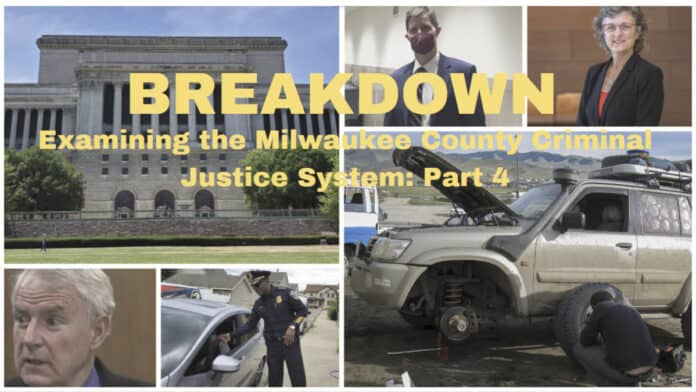
PART FOUR IN AN 11-PART SERIES. Read parts 1, 2, and 3. Milwaukee County’s criminal justice system has broken down at almost all levels. Although some of this can be attributed to the pandemic, all of it can not. Local officials’ questionable policy decisions and their failure to develop strategies to restore effectiveness also play a role, and it’s imperiling public safety.

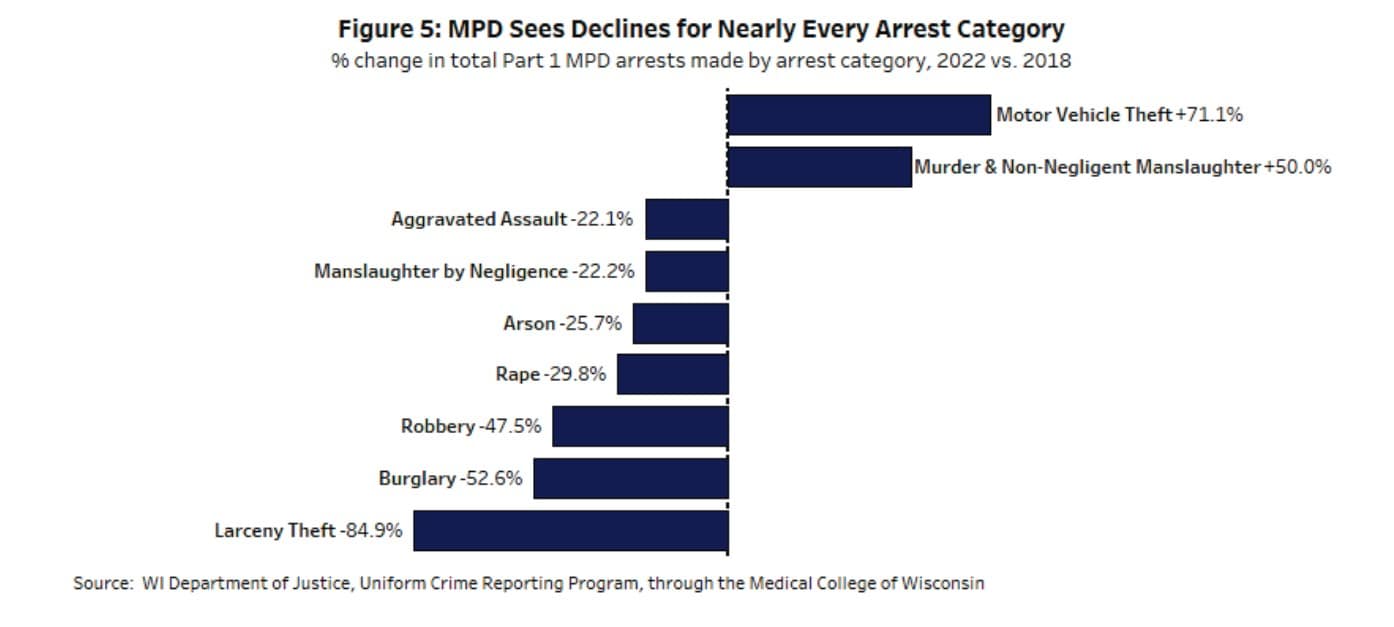
PROBLEM #4: Milwaukee Police arrests for serious crimes (Part 1 offenses) have plummeted dramatically, dropping 36.8% from 2018 to 2022. For less serious crimes (called Part 2 offenses), they dropped a whopping 61% even though the # of offenses in those categories rose 26%. Arrests continued to fall in 2022, well past the pandemic’s height.

MPD arrests for vagrancy, liquor law violations, and disorderly conduct have screeched to a near complete halt; those are so-called “Broken Windows” quality-of-life offenses that used to be the hallmark of Milwaukee’s policing strategy (and New York’s to great success in the Bill Bratton era. That theory holds that cracking down on lower-level disorder offenses prevents larger crimes from occurring by restoring social order.)

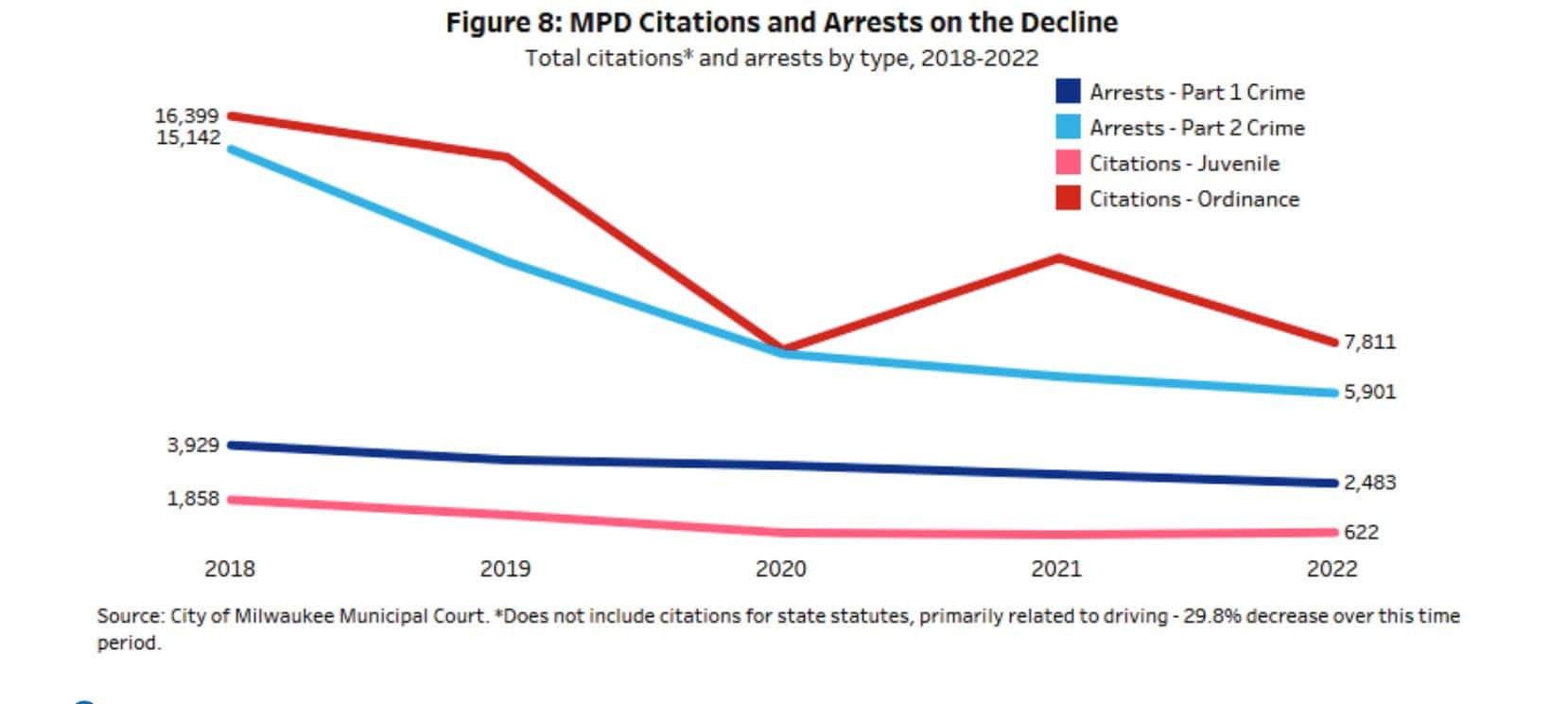
Weapons violation arrests by MPD have dropped 53% since 2018. In many cases, “declines are not fully attributable to the pandemic.” Municipal citations for ordinance violations and juvenile infractions also dropped sharply.
Milwaukee police arrests

Some suburban agencies have started to recover statistically since the pandemic, but MPD has not. In the City of Milwaukee, larceny theft arrests have plunged. Clearance rates have dropped since 2018, driven by the extremely low number of motor vehicle thefts that are solved. In 2022, of the 10,872 motor vehicle thefts reported, only 895 resulted in arrest. MPD only cleared 15.2% of all offenses from 2018-2022. Clearance rates for murder and manslaughter dropped from 67% to 50%.
Milwaukee police arrests

Milwaukee police arrestsTHE SERIES: 

We have taken the lead in exploring the problems in Milwaukee County’s Criminal Justice system since our site launched in 2020, breaking stories on Milwaukee police staffing declines (which started years ago), the DA’s high non-prosecution rate and new reliance on summonses, the 2018 ACLU Collins Agreement’s deleterious effect on proactive policing, new jail and police policies restricting bookings and arrests, and the massive court backlogs, which leave defendants on the streets longer to re-offend and provoke constitutional concerns. Milwaukee is at a crisis point, with record homicide numbers and a severe reckless driving crisis.

Now, a new August 2023 report from the Wisconsin Policy Forum has examined Milwaukee County’s Criminal Justice System in great detail, providing fresh data from 2018 (before the pandemic) to 2022. We are excerpting some of the key statistical findings in our 11-part series to further understanding of the problem. You can’t formulate solutions if you don’t understand the problem’s scope. The few news articles that emerged only superficially skimmed over the report’s findings. The report’s authors are Rob Henken, Ari Brown, and Betsy Mueller.

Although the report deals with the context of the pandemic, it also makes it clear that, in some respects, trends imperiling public safety started before it or have continued, even escalating in some cases, in 2022, after its height. In other words, you can’t blame everything on the pandemic. The report also indicates that, in a number of ways, some problems that escalated during the pandemic have not been resolved by officials even as late as 2022. In other cases, progress has been made.

“Overall, this report has revealed that multiple key points of the justice system pipeline in Milwaukee County are not functioning in the same way or at the same level as they were prior to the pandemic,” the authors wrote. “It is now incumbent upon justice system leaders and state and local policymakers to aggressively explore why that is, to what degree it may have impacted public safety, what progress is being made in remedying the identified challenges, and whether additional resources or other solutions are required to get the system back on track.”

In each article, which we will run over the next 11 days at 7 a.m. every day, we will outline the problems and present the research. After that, we will run a wrap-up article suggesting solutions. What happens in the state’s largest county has an effect throughout Wisconsin. The WPF report was commissioned by the Milwaukee-based Argosy Foundation and the Milwaukee Community Justice Council (CJC). Most of it is focused on useful data. In cases where we think aspects were left out, we will note that. In this series, we hope to get past simplistic rhetoric (“it’s the state Legislature’s fault!” on the left or “who cares what happens in Milwaukee!” on the right.)


PROBLEM #4: Plummeting arrests & clearance rates

Within the Uniform Crime Reporting system, crime is separated into two categories. Part 1 crimes, according to the FBI, are “serious crimes” that “occur with regularity in all areas of the country” and “are likely to be reported to the police.” These crimes include criminal homicide (all murder and manslaughter cases), forcible rape, robbery, aggravated assault, burglary, larceny theft, motor vehicle theft, and human trafficking.
Milwaukee police arrests

Part 2 crimes include all other offense types tracked by the UCR, including simple assault, forgery and counterfeiting, fraud and embezzlement, stolen property, vandalism, weapons, prostitution, sex offenses, drug violations, gambling, offenses against the family and children, driving under the influence, disorderly conduct, and others. While most law enforcement agencies collect arrest data on both Part 1 and Part 2 crimes, data on offenses are only reported publicly for Part 1 crimes.
Milwaukee police arrests

The report analyzed trends on offenses and arrests across the 21 Milwaukee County law enforcement agencies.
Milwaukee police arrests

According to the report:

    • Although serious crimes, other than motor vehicle thefts and homicides, generally stayed flat over the last five years, that’s not true of Part 1 arrests.
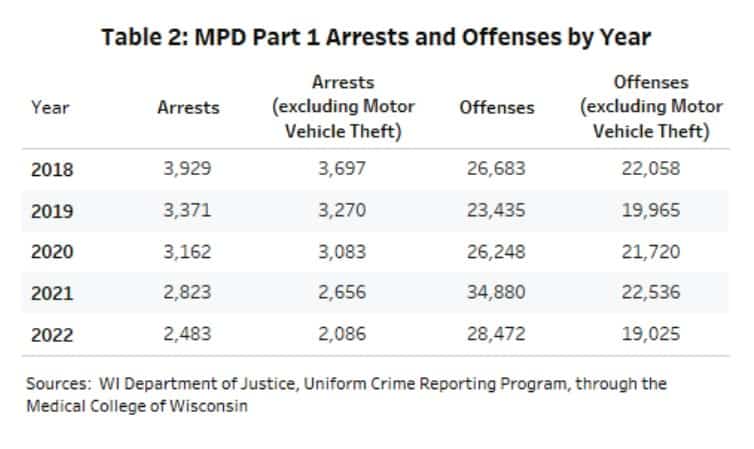
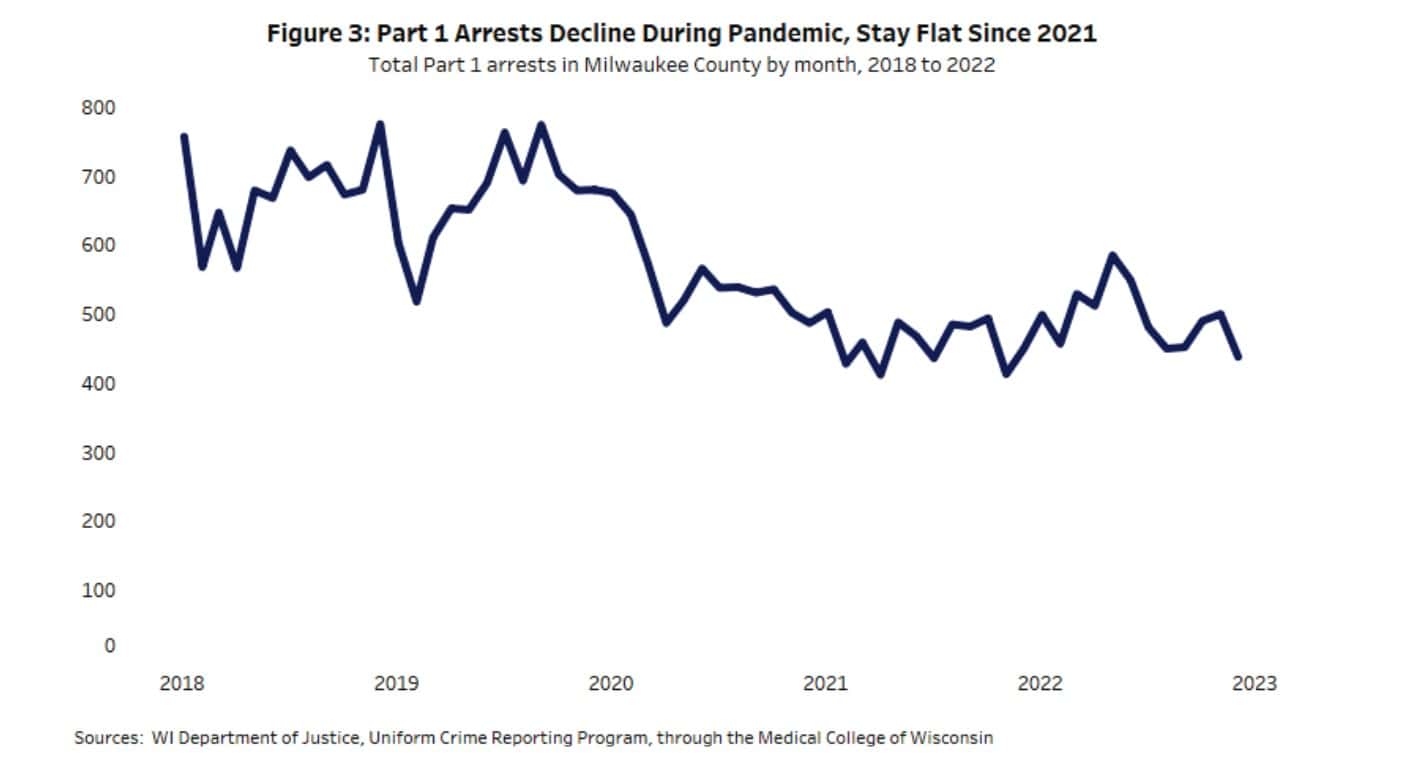
    • In both 2018 and 2019, the 21 Milwaukee county agencies made just over 8,000 arrests for Part 1 crimes. In 2020, Part 1 arrests declined to 6,598, with a huge drop in the early months of the pandemic. However, arrest numbers have not rebounded since that time, dropping again to 5,518 in 2021 and rising only slightly to 5,942 in 2022, 27.2% below 2018 levels.
    • MPD drives the numbers. Looking at just MPD, “we find that total Part 1 arrests fell at an even sharper rate than countywide, declining from 3,929 in 2018 to 2,483 in 2022 (36.8%),” the report found.
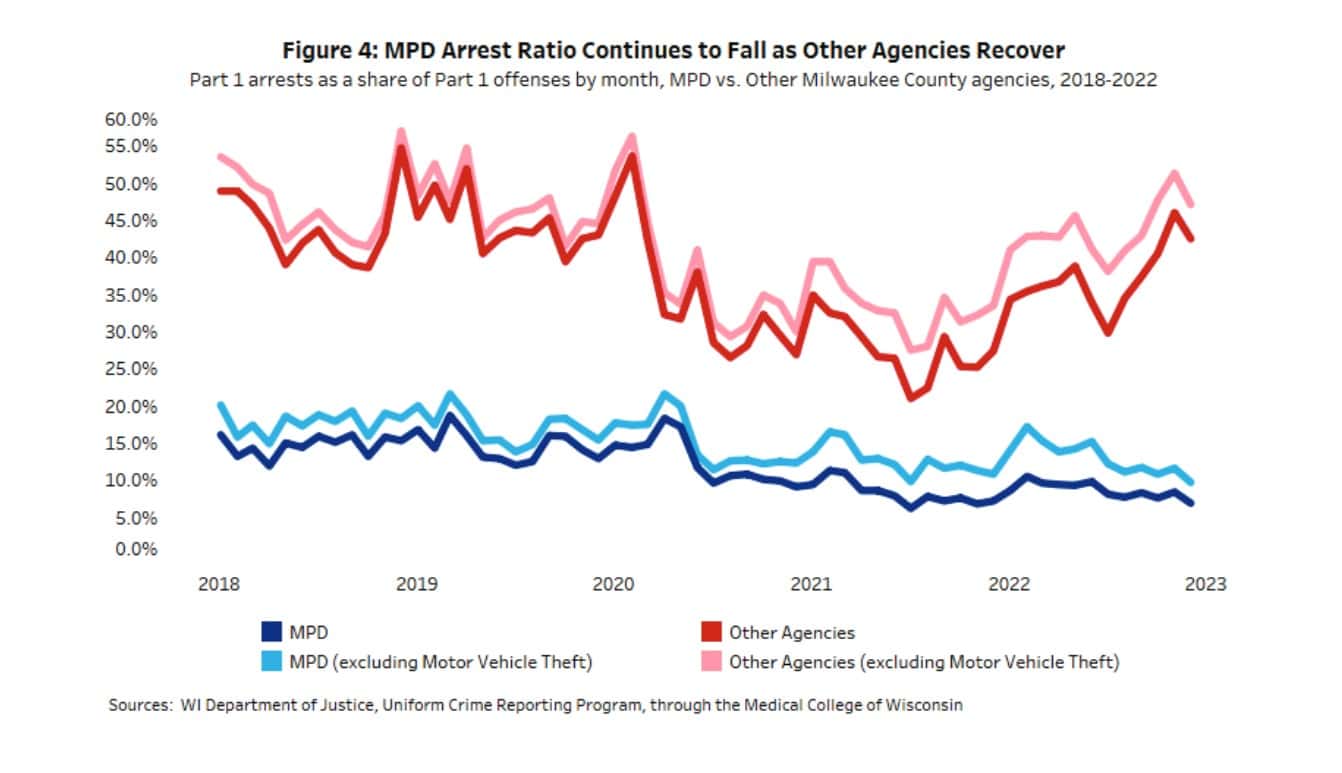
    • “Another distinction when comparing MPD Part 1 arrests to those of other agencies in the county is that while arrests as a share of offenses in the suburban agencies have recovered to near pre-pandemic levels, MPD’s 2022 ratio of 8.7% was still well below the 14.4% ratio in 2019.”
    • In 2018, MPD “made 935 arrests for larceny theft. That dropped to 549 in 2019, before falling to 168 in 2020 and staying below 150 in each of the two most recent years. The decline of 794 larceny theft arrests from 2018 to 2022 accounts for more than half of the total Part 1 arrest decline within MPD over those years.”
    • Four crimes constitute the vast majority of Part 1 arrests: aggravated assault, larceny theft, burglary, and robbery, the report says. In each year from 2018 to 2020, “those crimes constituted more than 90% of all Part 1 arrests, while in 2022 they accounted for 85.7%. Similar to the overall Part 1 arrest trend, arrests for these four crimes dropped – from just under 7,500 in 2018 and 2019 to just over 5,000 in 2022.”
    • Of these four categories, “only aggravated assault (+11.8%) saw an uptick in offenses from 2018 to 2022; arrests for the same period for that category declined by 20.7%. The drop in burglary arrests (- 46.0%) mirrors a similar drop in offenses (-48.0%). However, both larceny theft (-10.1%) and robbery (-29.1%) saw offense declines that were smaller than their arrest declines (-34.2% for larceny theft, – 38.4% for robbery).”
    • The decline in larceny theft arrests is perhaps the most notable, thee report says, as it made up a majority of all Part 1 arrests in three of the last five years (2018, 2019, 2022).
    • Arrests for rape “have declined in each year since 2018, from 269 in that year to 194 in 2022,” the report says.
    • “Both motor vehicle theft (+66.6%) and murder & non-negligent manslaughter (+47.8%) have seen significant increases in arrests since 2018 that correspond with a concurrent rise in offenses. The other Part 1 arrest categories – arson, human trafficking, and manslaughter by negligence – generally result in very few arrests each year,” the report says.

CLEARANCE RATES

Police department “clearances” refer to offenses that – after investigation – are “cleared” “by virtue either of an arrest or, per the UCR program, by ‘exceptional means,'” the report explains.

According to the U.S. Department of Justice, exceptional means refer to “elements beyond law enforcement’s control (that) prevent the agency from arresting and formally charging the individual,” it says.

“It is important to note that a case can be cleared by one or multiple arrests. Clearance rates refer to the ratio of clearances to offenses in a given year, and we examined these rates to determine if they offered a clue into the deviation between Part I offense and arrest trends in Milwaukee County,” the authors wrote.

They found:

  • In total, “22.4% of all offenses were cleared in 2018 and 24.5% in 2019, but the percentages dropped to 20.0% in 2020 and again to 16.1% in 2021, before rising to 19.5% in 2022,” the report says.
  • “While the reduced clearance rates are at least partially explained by the decline in arrests, the arrest decline is much sharper than the decline in clearance rates.”
  • “It is also worth noting that while the 2020 drop in clearance rates did seem to play out across most offense types, lower clearance rates in 2021 and 2022 seem to be driven by the rise in motor vehicle thefts Those offenses, in general, are cleared at a much lower rate than all other types of crime. If motor vehicle thefts are removed, then countywide Part 1 clearance rates for each of the five years of data are between 22% and 27%.”
  • “Over all five years and across every department for which data are available, three Part 1 offense types have shown clearance rates above 50%: human trafficking (61.3%), manslaughter by negligence (60.4%), and murder and non-negligent manslaughter (55.2%).”
  • “However, many categories in which offenses routinely total over 1,000 each year have much lower clearance rates, including aggravated assault (41.3%), robbery (26.8%), larceny theft (19.4%), burglary (9.5%), and motor vehicle theft (5.1%).”
  • “No single year since 2018 has seen a clearance rate above 10% for motor vehicle thefts; in 2021, just 429 out of 14,114 cases (3.0%) were cleared. However, while the number of motor vehicle thefts decreased significantly from 2021 to 2022 (10,872), the number of cases cleared more than doubled (895), leading to a clearance rate of 8.2%, by far the highest of any year of data.”
  • “MPD’s clearance rates are much lower than the other county agencies. Across all five years of data, 15.2% of all offenses were cleared by MPD, and 18.8% when not including motor vehicle thefts. Notably, the rates of clearance for burglary, larceny theft, and motor vehicle theft – which combined accounted for a majority of Part 1 offenses in 2022 – were all below 10% across the five years of data.”
  • “Clearance rates for murder and non-negligent manslaughter were 67.0% in 2018 and 64.9% in 2019, but with a rise in murders dropped to 54.2% in 2020 and 45.9% in 2021, before rebounding somewhat to 50.5% in 2022.”

Part 2 crimes

  • “One of our most striking findings in this report is the sharp (-61.0%) decline in Part 2 arrests in the city of Milwaukee from 2018 to 2022, despite the 26.4% increase in Part 2 offenses. In fact, every Part 2 arrest category was lower in 2022 than it was in 2018, including 13 categories that saw declines of at least 50%. The decline in Part 2 arrests in Milwaukee – from 15,142 in 2018 to 5,901 in 2022 – also greatly exceeded the notable 36.8% decrease in Part 1 arrests.”
  • “There were 235 arrests for vagrancy violations in 2018, but just 14 over the last three years.”
  • “There were 155 arrests for liquor law violations in 2018, compared to just one since the start of 2020.”
  • MPD “made nearly 2,300 arrests for disorderly conduct in 2018, but that dropped to 872 in 2019 and has not gone above 301 since.”
  • in 2018, MPD “made 3,428 arrests for simple assault – in most years, the largest Part 2
    arrest category – but that has declined each year and in 2022 stood at 2,292 arrests (-33.1%).”
  • Weapons arrests, “which totaled over 1,100 in 2018, stood at 516 in 2022 (-53.1%). In many cases, declines are not fully attributable to the pandemic, as the largest occurred from 2018 to 2019.”
  • “Indeed, MPD’s percentage decline in Part 2 arrests from 2018 to 2019 (-28.1%) was almost identical to the decline from 2019 to 2020 (-32.1%).”
  • The report studied whether citations were given instead of arrests due to the pandemic and found this was not the case. MPD citations related to ordinance violations and juvenile infractions “also declined sharply during the five-year period.) Traffic citations weren’t part of that analysis.
  • “A recent audit of citations conducted by the Milwaukee Comptroller found that 525 ordinance citations were not properly transmitted to the Municipal Court between January 2020 and April 2021. Those missing citations are not included in the data used for the figure but do not have a significant impact on the general trend.”
spot_img

Wisconsin Measles Outbreak Now Tops 90 Cases

(The Center Square) – Wisconsin’s measles outbreak continues to grow.

The state’s Department of Health Services said more people in southwest Wisconsin have tested positive for the measles.

“The Wisconsin Department of Health Services is reporting a significant increase in measles cases associated with the outbreak in Grant, Iowa, and Lafayette Counties – from 42 reported on Tuesday to 92 reported [on Friday]. This increase reflects ongoing transmission among people connected to previously identified cases,” DHS said in a statement.

Wisconsin is not alone in seeing measles cases this year.

The CDC said, as of Sunday, there were 2,903 confirmed cases in 47 states and Washington, D.C.

Most of those cases, 1,351, are among young people between the ages of 5 and 19 years old. The CDC said 94% of measles cases are in people who are not vaccinated.

Wisconsin's public health managers are not saying who is sick in the state, or where the measles outbreak began. DHS, however, said it continues to investigate the outbreak.

"While the increase in cases is significant, it does not necessarily indicate an increase in exposure risk to the broader public," DHS added. " Federal, state, and local public health agencies continue to investigate cases of measles to identify and notify close contacts, identify potential public exposure locations and will notify the public of possible exposure locations if needed."

DHS said all people in Wisconsin should update their vaccination status and is promoting its Measles Information Page that you can find here.

Reduces $464M Bond Leaked Trump's Taxes Michaela Murphy Shenna Bellows Kicking Trump Off 2024 Ballot Fake Electors Lawsuit Classified Documents Trial Donald Trump Poll Documents Trial Trump’s Poll Numbers Spike After Indictment

Trump Vows Retaliation After Iran Targets U.S. Base in Jordan

Following attempted missile attacks from Iran targeting a U.S. military base in Jordan, President Donald Trump vowed to retaliate.

The Islamic Republic launched several missiles targeting an American base in Jordan overnight after the U.S. reportedly targeted rocket launchers along the Strait of Hormuz. It has been reported that most of the missiles were intercepted.

In response, the president told Fox News Monday that Iran would be “hit hard” for the attack.

In a Truth Social post, Trump declared, “Iran is officially a failed nation. It is dead.”

In a separate post, the president posted what appears to be an AI-generated video showing Iran’s Kharg Island “being blown to smithereens” following Iran’s latest round of attacks.

The president added that Iran is dealing with 300% inflation and is unable to pay its military and police.

Videos circulating on social media claiming to be taken inside Iran show miles-long lines for gas, as the U.S. continues to enforce a full naval blockade on Iranian ports. The Trump administration claims the blockade is costing the Islamic Republic between $400 million and $500 million in economic losses a day, coupled with intense sanctions meant to squeeze the country financially.

The latest rounds come on the same day as the Pentagon announced a seven-year agreement with General Dynamics and Lockheed Martin to “accelerate” missile production.

The agreement would “triple” the Patriot Advanced Capability-3 Missile Segment Enhancement and “quadruple” the Terminal High Altitude Area Defense programs.

The overnight attacks come days after U.S. Central Command announced that U.S. forces had “successfully cleared sea mines” in the Strait of Hormuz, within the international shipping lanes that “were laid months ago by Iran’s Islamic Revolutionary Guard Corps.”

The Pentagon says it has spent nearly $40 billion on military operations in Iran, though many independent analyses estimate the true amount is at least double.

Field and Media Corps IDs For Illegal Immigrants Wisconsin Proposed Voter ID Rep Binfield wec

Wisconsin Elections Commission Waits on Milwaukee Documents

(The Center Square) – The Wisconsin Elections Commission plans to send a letter thanking the Milwaukee Elections Commission for its promised release of documents by this Friday related to an error at Milwaukee Central Count on the night of the recent primary.

On Friday, the MEC acknowledged that a team led by its deputy director mistakenly selected and downloaded an audit log instead of election results on five of nine tabulators at its central count facility on the state’s primary election night, leading to a delay in reporting unofficial results.

The WEC had planned to vote at its Monday meeting to approve a letter asking the MEC to release documents but the MEC preemptively sent a promise to release those documents.

The WEC plans to review the Milwaukee documents and see if further action is necessary. Those documents will include an audit log that will show if any action was taken on the machines between the first download of data and second download.

“I know I’m not supposed to make bets on voting but I bet anybody $100 that there will be a major problem with the November ’26 election at central count,” Commissioner Robert Spindell said during Monday’s meeting.

Commission Vice Chair Mark Thomsen, however, said that the hour delay in results on election night was simply a delay and he believes that all votes were counted, unlike an issue in Madison where nearly 200 ballots were not counted in the 2024 presidential election.

“The city has answered every question and it’s transparent and it’s there,” Thomsen said.

He added that he believes the WEC should not “unfairly attack people who have a very tough job.”

He was against the WEC sending its originally planned letter, saying that the MEC already had responded and that "crosses a line into witch hunting from investigation."

Dane County Sheriff REFUSED Immigration Hold for Suspect in UW-Madison Campus Sexual Assault of Transgender Victim

The Dane County sheriff refused a request by federal immigration authorities to place an immigration hold on one of the two suspects who is...
nolan jensen

Nolan Jensen Announces Race for Washington County Judge Against Evers’ Appointee; Top Conservatives Endorse Him

Nolan Jensen, a conservative lawyer who promises to apply the law as written and hold criminals accountable, announced that he is running for Washington...
cole covey

Public Defender Cole Covey Admits Making Up Allegation About Respected Sheriff’s Deputy, Racine Sheriff Says

The Racine County Sheriff is calling out a public defender named Cole Covey after the sheriff says a respected deputy was exonerated following false...
david crowley

David Crowley Celebrated Raising Taxes on Poor People With CAKE, and His ‘Free Stuff for Inmates’ Plan Goes Awry

Milwaukee County Executive David Crowley was once so gleeful about raising taxes on poor people that he celebrated by cutting a cake. There’s a photo...
Palestinian Refugees Tiffany Blueprint

Tom Tiffany Unveils 8-point Affordability Plan in Race for Wisconsin Governor

U.S. Rep. Tom Tiffany, the Republican gubernatorial candidate, on Tuesday announced his eight-point plan on affordability including lowering property taxes, sales taxes, gas prices and utility costs along with returning a state surplus.

Tiffany is running against Democrat David Crowley in the Nov. 3 general election.

Tiffany said he would end a 400-year property tax increase that was implemented with a partial veto from Gov. Tony Evers that allows for a $325 per student per year school funding increase for the next 400 years.

Voters will vote statewide on a constitutional amendment that will eliminate the governor’s partial veto power to “create or increase or authorize the creation or increase of any tax or fee” on the November ballot.

Tiffany vowed to cut state income taxes by 10% for families earning less than $150,000 annually along with eliminating taxes on tips and overtime and returning a state surplus to voters, both aspects of a plan that failed in the Wisconsin Senate this spring after Republican leaders of the Assembly and Senate and Evers agreed on a deal for both.

Tiffany also vowed to prevent state sales tax increases, to appoint commissioners to the Public Service Commission that will reduce citizen’s utility costs while embracing next-generation nuclear energy.

He also vowed to end Wisconsin’s minimum markup law and government-mandated higher prices on gas. The law, called the Unfair Sales Act, requires retailers to include a 9.18% markup on motor vehicle fuel.

"Wisconsin families work hard for every dollar they earn, but government at every level keeps taking more," Tiffany said in a statement. "Property taxes are too high, utility bills have soared, and everyday purchases cost more. Meanwhile, David Crowley has never met a tax hike he didn't like. He raised Milwaukee County’s sales tax by 80%, raised property taxes five times, and even voted against a 10% middle-class income tax cut. We cannot afford Tax Collector Crowley taking more of your paycheck just to spend more in Madison."

Tiffany also vowed to “lower taxes, cut red tape, speed up permitting, and reform occupational licensing” to create more good-paying jobs in the state.

Wisconsin Flat Tax Wisconsin's Social Security wisconsin charter schools

Wisconsin Lawmakers Looking for Errors, ‘Bad Actors’ With Food Stamp Audit

(The Center Square) – Wisconsin lawmakers plan to take their first hard look at the state’s food stamp program in more than a decade.

The legislature’s Joint Legislative Audit Committee authorized an audit of the FoodShare program.

"The biggest thing I'd look at is that the federal requirements have changed, and the state is in a position where there's close to a $300 million risk if we don't look at and have in place the things we need to do to comply with the [Big Beautiful Bill]," Audit Committee co-chair Rep. Bob Wittke, R-Caledonia, said at Tuesday's hearing.

President Donald Trump’s Big Beautiful Bill sets new requirements that punish states if error rates are too high. Any state with an over-payment or under-payment rate more than 6% will be fined by the federal government.

Wisconsin's Department of Health Services, which runs FoodShare in the state, said Wisconsin's error rate was 5.72% for fiscal year 2025.

"We collectively should be very proud of our state administration of FoodShare," DHS Secretary Kirsten Johnson told lawmakers Tuesday.

But it's not just errors. Lawmakers say Wisconsin last audited its FoodShare program in 2012.

"What I was seeing towards the end of my practice was the act of [a SNAP recipient] paying [a] drug addict, for instance, a dollar amount to go shop for them, or the drug addict going in and buying a bunch of meat and then selling it on the street. What are the mechanisms you use to stop that?" Sen. Eric Wimberger, R-Gillet, said during the hearing.

Wimberg also pressed DHS managers for a plan to deal with FoodShare abuse.

"For the bad actor who is going to do those methods to basically get money by allowing other people to get food, what do you have that stops that sort of behavior?"

There are nearly 700,000 people in Wisconsin who are enrolled in FoodShare, though that number could drop.

The Big Beautiful Bill requires people who are not parents, elderly, or who have developmental disabilities to work 20 hours a week, go to school, or enroll in a job training program to continue receiving benefits.

van wanggaard parole

Sen. Van Wanggaard Calls Out Conflict of Interest on Evers’ Commutations Board, as UW-Madison Dodges Questions About Advocacy for Killers

(The Center Square) – A Wisconsin lawmaker is raising concerns that one of nine members of Gov. Tony Evers’ commutations board has a conflict of interest as his work colleagues advocate for applicants being considered by the board.

Restorative Justice Director Jonathan Scharrer is one of nine members of the board that heard the arguments of 12 applicants on Friday. Scharrer’s colleagues are advocating for four of the 12 applicants, but he only recused himself from one of the four applicants, according the state Sen. Van Wanggaard, R-Racine.

Wangaard published the names of the 809 felons requesting commutations through Evers’ board.

A commutation shortens the sentence of an inmate. Applicants must have at least a year remaining and have served half of the full incarceration term or 20 years of a life sentence.

Those imprisoned for sexual assault, physical abuse of a child, sexual exploitation of a child, trafficking of a child, incest and soliciting a child for prostitution are not eligible for commutation.

“It is a rigged system!” Wanggaard said in a statement. “Board members are considering applications their close colleagues are urging. The supposed “consideration” of releasing killers early seems like a guarantee now.”

Wanggard said he has received 1,800 pages of documents from the governor’s office in a partial response to an Open Records Request related to application materials for those seeking commutations.

“As we combed through the documents, we realized the Law School’s Remington Center wrote a letter in support of 4 of the 12 applicants,” Wanggaard said. “Jonathan Sharrer is listed on the Remington Center’s letterhead. He is also a member of Governor Evers’ Commutation Board. If that’s not a conflict of interest, I don’t know what is.”

Wanggaard’s office said the senator is still seeking the records of the remaining 797 applicants.

josh kaul

Josh Kaul’s DOJ Funded ‘Abolish the Police’ Group That Trashed America, Bailed Out Madison Rioters, and Wrote, ‘F*ck the Pigs’

“F*ck the p*gs,” Freedom Inc. wrote. Josh Kaul’s agency has funded its efforts by funneling federal grants to the non-profit for years. The group...
josh kaul

Josh Kaul Listed as Keynote Speaker at ‘Immigration Summit’ Held By Leftist Group That Wants to Close Prisons and ‘Liberate’ Inmates

Attorney General Josh Kaul, who is supposed to be the state's "top cop," was listed as the keynote speaker at an "immigration" summit held...

Gov. Tony Evers Says Some Kids Aren’t Worth Fighting For: ‘Those Kids…Aren’t Ever Gonna Read Anyway’

In a viral video clip, Gov. Tony Evers said people should give up on some kids because "those kids that are struggling in those...

David Crowley SUED the Milwaukee Police Department, Accusing Officers of Racism, and Costing the City at Least $1.9 Million

“I used to be very proactive,” one officer told us. “Now, I act like a fireman. I sit and wait for a call, go...

Curtis Walker, Who Assassinated Milwaukee Police Officer William Robertson, Is Among More Than 800 Commutation Applicants to Gov. Evers

We asked Gov. Tony Evers for the list of commutation applicants since he restarted the process. There are more than 800... so far. See...
david crowley

‘Data Center’ David Crowley Fumbles KEY Issue After His Establishment Coronation

Data Center David Crowley is a name that might stick, as Tom Tiffany is now calling him. It has the same ring as “Diamond...

Liberal Pundits Hunt Desperately for a Single David Crowley ‘Accomplishment,’ and What They Picked Is Hysterical

It’s been humorous the last few days watching Wisconsin’s liberal intelligentsia turn themselves into Elastigirl in the Incredibles, bending and stretching and twisting, because...

David Crowley SUPPORTS DATA Centers and Won’t Ban Them; He Wants Wisconsin to be the ‘Data Hub’ for the World

Milwaukee County Executive David Crowley has expressed support for data centers and opposes banning them. He wants Wisconsin to be the "data hub" for...
sara godlewski

David Crowley, Wealthy Sarah Godlewski LAUGH at the Way Rural Wisconsinites Talk – and It’s on Video

Milwaukee County Executive David Crowley and wealthy Lt. Gov. candidate Sarah Godlewski laughed hysterically at the way rural Wisconsinites speak, and it's on video....
chris lawrence

Winners and Losers From Wisconsin Primary Election Night

We all know the top line results: Milwaukee County Executive David Crowley defeated socialist Francesca Hong to win the Democratic primary for governor, in...