

Statement From The Mount Holly Police Dept.
Table of Contents

Table of Contents
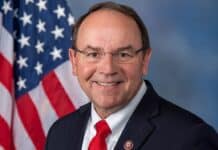
U.S. Rep. Tom Tiffany, the Republican gubernatorial candidate, on Tuesday announced his eight-point plan on affordability including lowering property taxes, sales taxes, gas prices and utility costs along with returning a state surplus.
Tiffany is running against Democrat David Crowley in the Nov. 3 general election.
Tiffany said he would end a 400-year property tax increase that was implemented with a partial veto from Gov. Tony Evers that allows for a $325 per student per year school funding increase for the next 400 years.
Voters will vote statewide on a constitutional amendment that will eliminate the governor’s partial veto power to “create or increase or authorize the creation or increase of any tax or fee” on the November ballot.
Tiffany vowed to cut state income taxes by 10% for families earning less than $150,000 annually along with eliminating taxes on tips and overtime and returning a state surplus to voters, both aspects of a plan that failed in the Wisconsin Senate this spring after Republican leaders of the Assembly and Senate and Evers agreed on a deal for both.
Tiffany also vowed to prevent state sales tax increases, to appoint commissioners to the Public Service Commission that will reduce citizen’s utility costs while embracing next-generation nuclear energy.
He also vowed to end Wisconsin’s minimum markup law and government-mandated higher prices on gas. The law, called the Unfair Sales Act, requires retailers to include a 9.18% markup on motor vehicle fuel.
"Wisconsin families work hard for every dollar they earn, but government at every level keeps taking more," Tiffany said in a statement. "Property taxes are too high, utility bills have soared, and everyday purchases cost more. Meanwhile, David Crowley has never met a tax hike he didn't like. He raised Milwaukee County’s sales tax by 80%, raised property taxes five times, and even voted against a 10% middle-class income tax cut. We cannot afford Tax Collector Crowley taking more of your paycheck just to spend more in Madison."
Tiffany also vowed to “lower taxes, cut red tape, speed up permitting, and reform occupational licensing” to create more good-paying jobs in the state.
(The Center Square) – Wisconsin lawmakers plan to take their first hard look at the state’s food stamp program in more than a decade.
The legislature’s Joint Legislative Audit Committee authorized an audit of the FoodShare program.
"The biggest thing I'd look at is that the federal requirements have changed, and the state is in a position where there's close to a $300 million risk if we don't look at and have in place the things we need to do to comply with the [Big Beautiful Bill]," Audit Committee co-chair Rep. Bob Wittke, R-Caledonia, said at Tuesday's hearing.
President Donald Trump’s Big Beautiful Bill sets new requirements that punish states if error rates are too high. Any state with an over-payment or under-payment rate more than 6% will be fined by the federal government.
Wisconsin's Department of Health Services, which runs FoodShare in the state, said Wisconsin's error rate was 5.72% for fiscal year 2025.
"We collectively should be very proud of our state administration of FoodShare," DHS Secretary Kirsten Johnson told lawmakers Tuesday.
But it's not just errors. Lawmakers say Wisconsin last audited its FoodShare program in 2012.
"What I was seeing towards the end of my practice was the act of [a SNAP recipient] paying [a] drug addict, for instance, a dollar amount to go shop for them, or the drug addict going in and buying a bunch of meat and then selling it on the street. What are the mechanisms you use to stop that?" Sen. Eric Wimberger, R-Gillet, said during the hearing.
Wimberg also pressed DHS managers for a plan to deal with FoodShare abuse.
"For the bad actor who is going to do those methods to basically get money by allowing other people to get food, what do you have that stops that sort of behavior?"
There are nearly 700,000 people in Wisconsin who are enrolled in FoodShare, though that number could drop.
The Big Beautiful Bill requires people who are not parents, elderly, or who have developmental disabilities to work 20 hours a week, go to school, or enroll in a job training program to continue receiving benefits.
(The Center Square) – A Wisconsin lawmaker is raising concerns that one of nine members of Gov. Tony Evers’ commutations board has a conflict of interest as his work colleagues advocate for applicants being considered by the board.
Restorative Justice Director Jonathan Scharrer is one of nine members of the board that heard the arguments of 12 applicants on Friday. Scharrer’s colleagues are advocating for four of the 12 applicants, but he only recused himself from one of the four applicants, according the state Sen. Van Wanggaard, R-Racine.
Wangaard published the names of the 809 felons requesting commutations through Evers’ board.
A commutation shortens the sentence of an inmate. Applicants must have at least a year remaining and have served half of the full incarceration term or 20 years of a life sentence.
Those imprisoned for sexual assault, physical abuse of a child, sexual exploitation of a child, trafficking of a child, incest and soliciting a child for prostitution are not eligible for commutation.
“It is a rigged system!” Wanggaard said in a statement. “Board members are considering applications their close colleagues are urging. The supposed “consideration” of releasing killers early seems like a guarantee now.”
Wanggard said he has received 1,800 pages of documents from the governor’s office in a partial response to an Open Records Request related to application materials for those seeking commutations.
“As we combed through the documents, we realized the Law School’s Remington Center wrote a letter in support of 4 of the 12 applicants,” Wanggaard said. “Jonathan Sharrer is listed on the Remington Center’s letterhead. He is also a member of Governor Evers’ Commutation Board. If that’s not a conflict of interest, I don’t know what is.”
Wanggaard’s office said the senator is still seeking the records of the remaining 797 applicants.