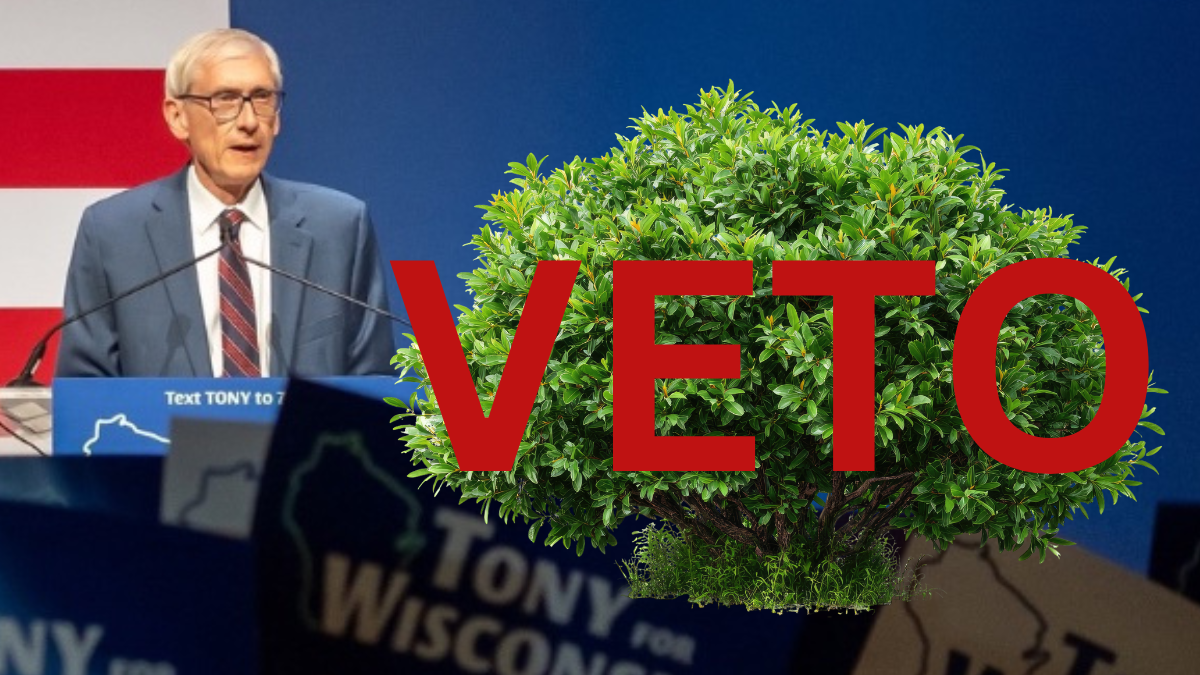
Gov. Evers doesn’t trust folks to remove vegetation obstructing signs they own without seeking permission from the state.
The bill was introduced by Senators Tomczyk, Jacque, Nass and Wanggaard; it was cosponsored by Representatives Maxey, O’Connor, Armstrong, Behnke, Goeben, Gundrum, Gustafson, B. Jacobson, Knodl, Melotik, Mursau, Penterman, Spiros, Steffen, Tucker, Wichgers and Doyle.
In his veto message on March 27, Evers complained that the bill would enable sign owners “to remove vegetation” obstructing their advertising signs without permission and supervision from the DOT.
The Legislative Reference Bureau explains:
Under current law, the Department of Transportation is responsible for maintenance of the highway right-of-way on highways under its jurisdiction. DOT must provide for the care, protection, and maintenance of trees and other roadside vegetation, including cutting, trimming, or removing trees and other vegetation as needed to provide safety to highway users. Current law generally prohibits a person from cutting, trimming, removing, or planting a tree or other vegetation within the right-of-way of a state trunk highway, including interstate highways, without DOT’s consent.
Under current law, “outdoor advertising signs (signs) viewable from a highway are regulated and subject to an annual permit fee payable to DOT (sign permit). A sign owner may also apply for a permit from DOT that authorizes the owner to maintain and remove vegetation obstructing the view of the owner’s sign along a state trunk highway, including an interstate highway (vegetation removal permit).”
Under current law, a vegetation removal permit authorizes sign owners to trim or remove vegetation approved by DOT for removal within a sign’s “viewing zone,” which is the final 1,000 feet along the highway when approaching a sign. The bill defines a “viewing window,” which is the final 500 feet of the viewing zone. Under the bill, a sign owner with a vegetation removal permit may clear cut all vegetation within a sign’s viewing window, including vegetation located in the median of a divided highway.
Under current law, a vegetation removal permit holder that removes trees with a diameter of two inches or more must compensate DOT for the removed trees. The bill eliminates the requirement that an arborist be employed and provides that compensation is due only if the trees were removed from a living snow fence. The bill defines “living snow fence” to mean vegetation that functions as a berm or barrier to inhibit the accumulation of snow on the highway during the winter season that is planted by the department in a highway right-of-way and the location of which is documented by the department. The bill increases the amount of compensation from $200 to $300 per tree and requires DOT to use the amounts collected to plant living snow fences.
Finally, the bill provides that a sign owner who was issued a vegetation removal permit on or after May 19, 2012, is not required to apply for subsequent permits for the same sign and may remove vegetation in the sign’s viewing window without additional approval or supervision by DOT. The sign owner must notify DOT prior to removal of any vegetation and must provide DOT with photographs of the sign site before and after the vegetation removal is completed.