This is the 3rd part in Wisconsin Right Now’s series exploring aspects of the Wisconsin online sports wagering controversy that aren’t getting much media attention.
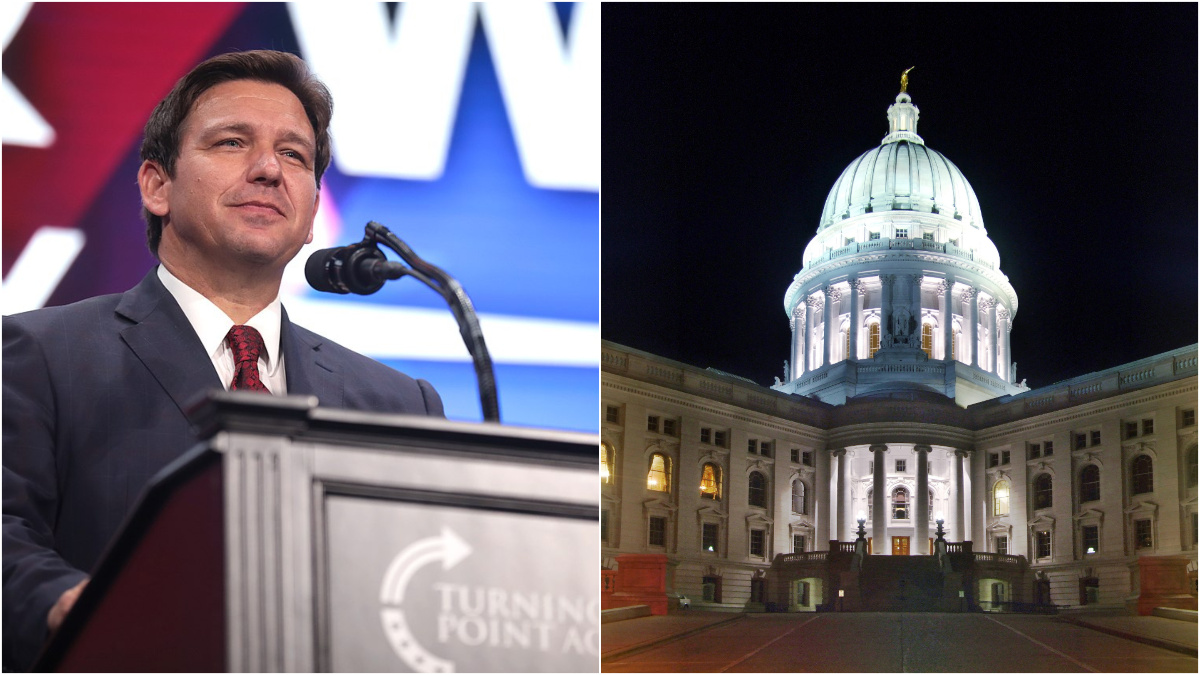
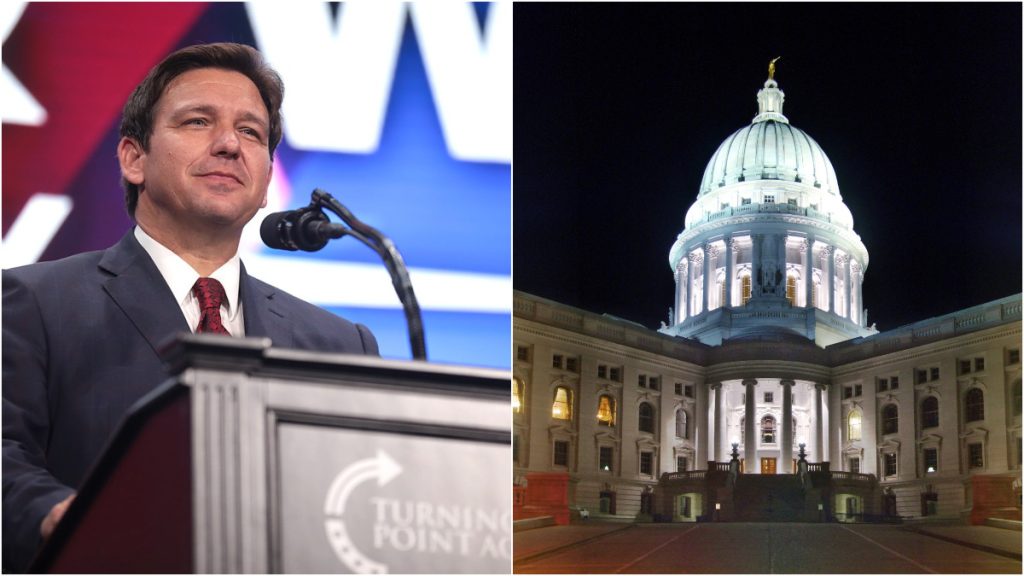
The online gaming bill is coming to a crucial point in the Wisconsin state Legislature. But while controversy brews in Wisconsin, it’s perhaps instructive to look at Florida, where a Republican governor, Ron DeSantis, approved a very similar model with his state’s Indian tribe.
Not only did DeSantis tout the “hub-and-spoke” model as beneficial to taxpayers, but it was upheld by a federal appellate court, and the conservative-controlled U.S. Supreme Court then declined to weigh in, letting that appellate decision stand.
The Florida governor’s words echo those of Republican legislative leaders in Wisconsin who are pushing a similar bipartisan bill in Wisconsin.
“Not only will this compact bring a guaranteed $2.5 billion in revenue over the next five years, but it also brings together Florida pari-mutuel businesses from across the state in a creative partnership with the Seminole Tribe, providing increased access to safe and transparent sports betting in Florida,” DeSantis said.
As with here, Florida’s approach gave Indian tribes the ability to run online gaming operations statewide if the servers were located on reservation land. And as with here, opponents raised arguments about a constitutional amendment, competition, and the Indian Gaming Regulatory Act. But ultimately, DeSantis’s approach passed legal muster, although some argue it’s limited in nature, and there are some differences with Wisconsin.
“This is about keeping Wisconsin competitive and protecting consumers. People are already
betting online through offshore or illegal sites and hundreds of millions of dollars a year are
leaving our state with zero regulation and no benefit to Wisconsin,” Republican Majority Leader Tyler August testified in Wisconsin. “By creating a clear, legal framework, we give our tribes and the state a path to keep that activity here, under Wisconsin oversight, and done the right way.”
How Much Money Did Florida Taxpayers Get? A Lot
What arguments did DeSantis, a hardcore conservative, make?
DeSantis said that the agreement, which was handled through compacts between the state and tribe, “increases the projected revenue to the State of Florida from the Seminole Tribe from no revenue to over six billion dollars over the next decade, with a guaranteed minimum of two and a half billion dollars during the first five years.”
The Florida governor added, “By some estimates, sports betting is expected to create over 2,200 jobs for Floridians.” He wrote that the deal was “approved following 45-day review by the United States Department of the Interior.” The Florida legislature ratified the deal.
What happened after that approval?
The U.S. Supreme Court Let the DeSantis/Seminole Approach Stand
In June 2024, the conservative-controlled U.S. Supreme Court “refused to take up a challenge” to the agreement that gave the Seminole Tribe “exclusive rights to handle online sports betting in Florida, dealing a blow to the deal’s opponents,” PBS reported.
PBS reported that the state of Florida is now expected to get an influx of $4.4 billion in revenue from the deal. A bipartisan-appointed federal appellate panel upheld the compact and hub-and-spoke model between DeSantis and the Florida tribe, ruling that they did not violate the federal Indian Gaming Regulatory Act, known as IGRA.
In the Supreme Court’s denial, Justice Brett Kavanaugh was an outlier of caution. He wrote, “I agree that the stay application should be denied in light of the D. C. Circuit’s pronouncement that the compact between Florida and the Seminole Tribe authorizes the Tribe to conduct only on-reservation gaming operations, and not off-reservation gaming operations.”
Kavanaugh made it clear the decision was limited; however, four justices were needed to “grant certiorari in order to take up a case,” and only Kavanaugh wanted to do so. Thus, the case did not even proceed to oral arguments. “Justice Brett Kavanaugh was shut down by his Supreme Court colleagues over a case challenging online sports gambling,” Newsweek reported, adding that Justice Ketanji Jackson did not participate.
In his press release in 2021, DeSantis insisted: “This historic compact expands economic opportunity, tourism, and recreation, and bolsters the fiscal success of our state in one fell swoop for the benefit of all Floridians and Seminoles alike. Our agreement establishes the framework to generate billions in new revenue and untold waves of positive economic impact.”
He added: “I would like to thank Seminole Tribe of Florida Chairman Marcellus Osceola Jr., Senate President Wilton Simpson, and House Speaker Chris Sprowls for their collective commitment to modernizing the gaming industry in the state of Florida and setting the bar for the rest of the nation.”
“The compact allocates hundreds of millions of dollars from the state’s gambling deal to land acquisition, wildlife preservation, and waterway protection,” Newsweek added.
The lawsuit was brought by West Flagler Associates and the Bonita-Fort Myers Corp., which “operate racetracks and poker rooms in Florida,” PBS noted, adding that the U.S. Supreme Court ruled that the plaintiffs “filed the wrong type of petition to challenge the 2021 compact between the Seminole Tribe of Florida and Gov. Ron DeSantis’ administration.”
In Florida, as in Wisconsin, “sports betting was illegal throughout the state…The Compact and related amendments to state law changed this, purporting to allow the Tribe the exclusive right to offer sports betting in the state, including online sports betting by individuals not physically located on the Tribe’s lands,” the federal court decision upholding the compact said.
The Dairyland Case in Wisconsin
Tribal, federal, and state gaming laws are very complex. But a Wisconsin state Supreme Court case also comes into play here.
In Wisconsin, proponents of the sports wagering bill argue that a 2006 Wisconsin Supreme Court case called Dairyland Greyhound Park, Inc. v. Doyle allows the hub-and-spoke model despite a 1993 ban on gaming because the state signed the compacts before that ban. They argue that the Dairyland decision allows unlimited amendment to the old compacts.
The Dairyland decision found that the compacts predated the ban, and it was anticipated that they would be amended over time. With a state Supreme Court controlled by liberals and Tony Evers joining Republican support for the new bill, it seems unlikely the state would deviate from the Dairyland principle.
In addition, supporters argue that the Indian Gaming Regulatory Act does not ban a compact from allowing gaming off Indian lands, the argument advanced by the appellate court that upheld DeSantis’s compacts. Furthermore, there is the question of how to define “Indian land,” with supporters arguing that positioning the servers on reservation land addresses this concern. There is legal dispute over these points, and it’s possible another challenge could make its way to the U.S. Supreme Court again.
The Florida deal required the tribe there “to enter agreements to market sports betting with pari-mutuels that will receive a 60 percent cut of profits generated by the marketing,” such as the Palm Beach Kennel Club; Hialeah Park Casino; and Ocala Gainesville Poker Club. In Florida, the terms of the deal “call for the Seminoles to pay at least $2.5 billion to the state over the first five years of the 30-year agreement,” WUSF reported.
In Wisconsin, the only registrant to publicly testify against the bill, an association representing major online gaming interests like FanDuel and DraftKings, said the 60% provision in Wisconsin’s bill would not make it financially worthwhile for those companies to partner with the tribes. However, those companies are not from Wisconsin. FanDuel is owned by a company based overseas, in Ireland. FanDuel and DraftKings have also run into a stew of controversies throughout the country, including fines from regulators in multiple states, as WRN previously explored. In Florida, FanDuel and DraftKings spent millions of dollars attempting to get a constitutional amendment on the ballot to legalize gaming for all.
In Florida, voters passed a constitutional amendment in 2018 that says “a citizen initiative is needed to expand casino gambling outside of tribal land,” echoing Wisconsin’s constitutional amendment barring the legislature from expanding gaming.
DeSantis and leaders in the Florida legislature argued that sports betting was different from “casino gambling.”
Divided Wisconsin
In Wisconsin, the online gaming bill has divided conservatives, with some remembering the “Diamond Jim” Doyle deals that expanded casinos in the state after a federal court decision essentially ruled that the state opened the door to tribal gaming by authorizing a lottery.
Republican legislative leaders and some top legislators have joined the Milwaukee Metropolitan Chamber of Commerce and the state’s major sports teams in supporting the bill to authorize it here. Some talk radio hosts and legislators oppose it. The Wisconsin Institute for Law and Liberty didn’t testify or register against the bill but did submit a critical informational legal analysis of it.
“Under the Wisconsin Constitution, except for explicit limited exceptions, ‘the legislature may not authorize gambling in any form,'” WILL noted, mentioning the amendment dating to 1993. Supporters of the Wisconsin bill allege that the Legislature would not technically be doing so because the bill simply decriminalizes a form of gaming, and the state executive branch, not the legislature, would have to decide whether to authorize it through compact amendments with the tribes. And they cite Dairyland and Florida.
History of Gaming in Wisconsin
The WILL memo outlines how Wisconsin slowly opened the door to gaming, starting with authorizing radio promotions in the 1960s, charitable bingo in the 1970s, and “pari-mutuel wagering and a state-authorized lottery” in the 1980s.
After the state of Wisconsin refused to enter compact negotiations with the tribes, a federal court decision came down in their favor, and the governor entered into compact negotiations with the tribe, which led to Indian gaming in Wisconsin. Republican Gov. Tommy Thompson extended the compacts, as did Doyle, but he made them “perpetual agreements” that would not expire. A court struck down the perpetual component. A remade Wisconsin Supreme Court eventually ruled in the Dairyland decision that the 1993 constitutional amendment did not apply to the compacts because they predated it, and it was anticipated they would be amended over time.
WILL also raises concern that the federal Indian Gaming Regulatory Act bans the hub-and-spoke sports wagering model, as plaintiffs raised in the Florida legal battle. The Wisconsin compacts already allow sports wagering on reservations at casinos.
WILL draws a distinction between the Florida bill and Wisconsin’s, writing, “The decision in West Flagler Associates does not conflict with this black-letter law. Instead, that decision avoided this issue by choosing to interpret the Florida compact as if it did not authorize online sports gaming off tribal lands.” In other words, WILL is saying that a new court battle could more directly attack whether the “tribal lands” provision is met if a server is on the tribal land, but the bettor is not. In other words, what controls: Where the bettor is located or where the server is located?
West Flagler is the plaintiff in the unsuccessful suit against DeSantis’s compacts.
The Florida federal court decision discussed the IGRA provision that IGRA “regulate[s] gaming on Indian lands, and nowhere else.”
“Thus, to be sure, an IGRA gaming compact can legally authorize a tribe to conduct gaming only on its own lands. But at the same time, IGRA does not prohibit a gaming compact—which is, at bottom, an agreement between a tribe and a state—from discussing other topics, including those governing activities ‘outside Indian lands,'” the federal appellate court ruled.
“In fact, IGRA expressly contemplates that a compact ‘may’ do so where the activity is ‘directly related to’ gaming,” the federal court continued, adding, “In 1987, the Supreme Court held that states are powerless to regulate gaming on Indian lands.” Through IGRA, Congress “sought to “balance state, federal, and tribal interests.”
The appellate court decision added, “West Flagler’s primary challenge to the Compact is that its online sports betting provisions unlawfully authorize class III gaming outside of Indian lands, in violation of IGRA.”
But the court disagreed, and, as noted, the U.S. Supreme Court later declined to weigh in, allowing that decision to stand.
The appellate court agreed that “[g]aming outside Indian lands cannot be authorized by IGRA, but it may be addressed in a compact…IGRA generally does not restrict or regulate tribal, or any other, activity outside of Indian lands.” However, Kavanaugh essentially noted that the Supreme Court review dealt with IGRA, not the decision that paved the way for Indian lands to be defined through the server placement, not the location of the bettor. He seemed to be inviting another challenge, although, again, no other justices, including the conservatives, lent their names to that stance.
Wisconsin Democratic state Sen. Kristin Dassler-Alfheim brought up these court decisions when she wrote the Legislature, saying, “A tribe interested in offering mobile sports betting would be required to work with the state of Wisconsin to amend their existing gaming contract, which would then have to be reviewed and approved by the Federal Bureau of Indian Affairs.”
She added: “There are already thirty-one states that have legalized mobile sports betting statewide. The legality of the ‘hub-and-spoke ’ model has been validated by the court case West Flagler Associates v. Haaland, in which a D.C. Court of Appeals found the model to be in compliance with federal law, a decision which the U.S. Supreme Court left standing.”
Table of Contents