
The administration of Gov. Tony Evers and Lt. Gov. Sara Rodriguez has vetoed a bill that would have required porn sites to verify the ages of users to ensure that minors don’t access harmful material.
In his veto message, Evers wrote that he believes the bill would intrude on porn viewers’ privacy rights. He argued that making porn viewers show an ID in order to prove they aren’t juveniles would be an “intrusive burden.”
Congressman Tom Tiffany, who is running for governor, wrote, “Another Good Friday veto from @GovEvers: He rejected AB 105, a bipartisan bill requiring age verification for porn sites. He called ID checks an ‘intrusive burden.’ Apparently for Democrats, we can’t require ID to protect children or ID to protect our elections nationwide.”
Daniel Degner, president of Wisconsin Family Action says, “It is shameful that the Governor of Wisconsin is choosing to parrot talking points from porn companies rather than acting to protect our kids. Gov. Evers hides behind a tired and disproven narrative to avoid the reality that he alone has put thousands of children at risk.”
The bill was introduced by Representatives Goeben, B. Jacobson, Penterman, Kreibich, Dittrich, Allen, Knodl, Wichgers, Murphy, Brill, Mursau, Behnke and Piwowarczyk, cosponsored by Senators Wanggaard, Jacque, Feyen and Nass. Referred to Committee on State Affairs.
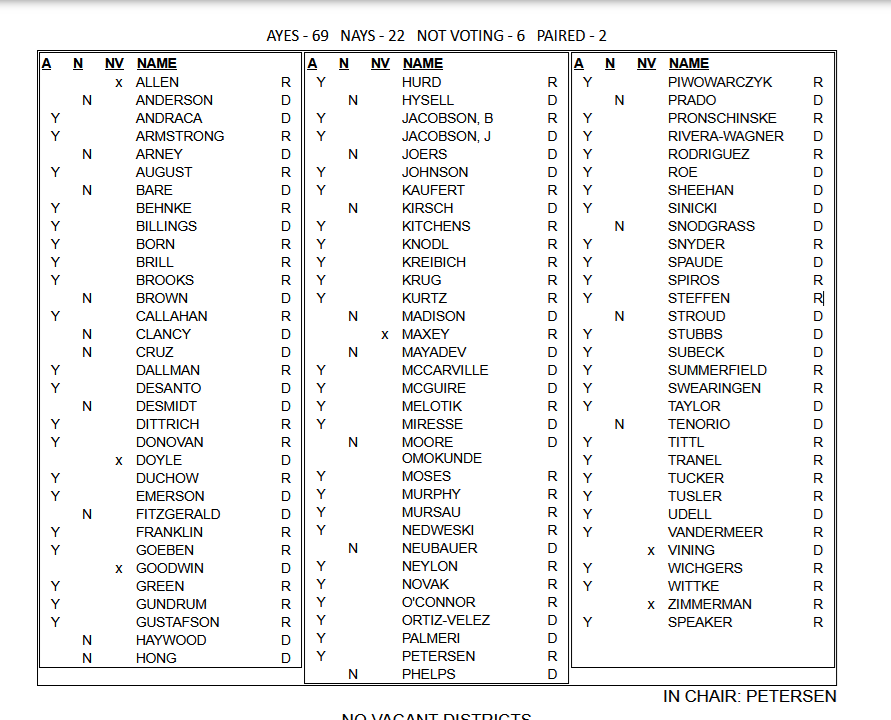
The bill had bipartisan support:
Analysis by the non-partisan Legislative Reference Bureau
“This bill prohibits business entities from knowingly and intentionally publishing or distributing material harmful to minors on the Internet on a website that contains a substantial portion of such material, unless the business entity performs a reasonable age verification method to verify the age of individuals attempting to access the website.”
“Material harmful to minors” is defined in the bill to include material “1) that is designed to appeal to prurient interests, 2) that principally consists of descriptions or depictions of actual or simulated sexual acts or body parts including pubic areas, genitals, buttocks, and female nipples, and 3) that lacks serious literary, artistic, political, or scientific value for minors.”
In the bill, a “reasonable age verification method” includes “various methods whereby the business entity may verify that an individual seeking to access the material is not a minor. Under the bill, persons that perform reasonable age verification methods may not knowingly retain identifying information of the individual attempting to access the website after the individual’s access has been granted or denied. The bill also requires a business entity that knowingly and intentionally publishes or distributes material harmful to minors on the Internet from a website that contains a substantial portion of such material to prevent persons from accessing the website from an internet protocol address or internet protocol address range that is linked to or known to be a virtual private network system or provider.”
In addition, this bill prohibits business entities “from knowingly and intentionally publishing or distributing obscene material or an obscene depiction of a purported child on the Internet.”
“Obscene material” is defined to mean a writing, picture, film, or other recording “that the average person, applying contemporary community standards, would find appeals to the prurient interest if taken as a whole, describes or shows sexual conduct in a patently offensive way, and lacks serious literary, artistic, political, educational, or scientific value if taken as a whole.”
“Obscene depiction of a purported child” is defined to mean “a visual representation that appears to depict an actual child in the form of a photograph, film, motion picture, or digital or computer-generated image or picture, that the average person, applying contemporary community standards, would find appeals to prurient interests if taken as a whole, describes or shows sexually explicit conduct in a patently offensive way, and lacks serious literary, artistic, political, educational, or scientific value if taken as a whole.”
A person that violates the provisions of the bill “may be subject to civil liability for damages and the payment of court costs and reasonable attorney fees. Sovereign immunity may not be raised as an affirmative defense to a civil action brought alleging a violation of a provision of the bill.”
Table of Contents