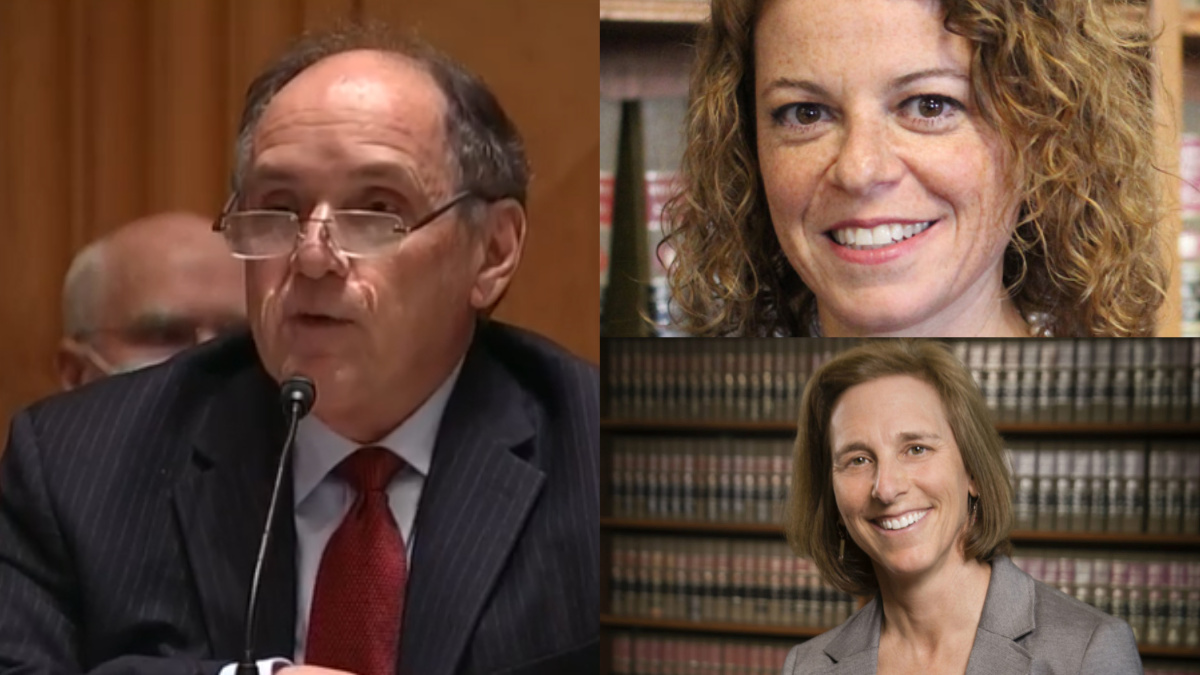
In a new motion, former judge and Trump attorney Jim Troupis is calling for the recusal of state Supreme Court Justices Jill Karofsky and Rebecca Dallet for their scathingly biased comments relating to him, including Karofsky allegedly accusing Troupis of wanting to “overturn this election so that your king can stay in power.”
“What you want is you want us to overturn this election so that your king can stay in power, and that is so un-American,” Karofsky said, according to a motion filed by Troupis, who was President Donald Trump’s election attorneyin Wisconsin. Troupis filed the motion on February 20, seeking both justices’ recusal.
“That’s how then Justice Karofsky described Troupis’s motives when he represented President Trump in an important election dispute,” the motion says. “In her view, Troupis’s conduct (filing the case) was ‘unheard of in American history’ and ‘smacked of racism.'”
Due to those comments and others, Troupis, a veteran attorney who is very well-known in conservative circles, is calling for Chief Justice Karofsky and Justice Dallet to “recuse themselves from this case. Judges must avoid even the appearance of bias. Because of their statements—on and off the bench—neither can comply with this standard while deciding a permissive appeal about Troupis and the very conduct they’ve repeatedly condemned,” he added.
“Their statements, spanning years, not only create the appearance of bias but also demonstrate actual bias against Troupis. Indeed, Chief Justice Karofsky went so far as to allege Troupis led a ‘slow-motion coup.’ And in the face of a serious judicial misconduct complaint, both justices doubled down.”
Democrat Attorney General Josh Kaul hit Troupis, another attorney and a campaign operative, with a string of felony charges over the alternate elector plan. The defendants argue the case belongs in federal court and say they were merely advancing a legal theory to protect Trump’s rights in the event he prevailed in court on his election claims. They also argue that Kaul lacked jurisdiction under Wisconsin law to bring the case against them because it’s election-related and, thus, should have been handled by county DAs under state law.
The Wall Street Journal wrote about the case over the weekend, saying, “Political lawfare continues to infect U.S. politics, and Democrats are still trying to destroy Republicans who advised President Trump on the 2020 election.”
Read the full recusal motion here: 26.02.20 – Recusal Motion.
Jill Karofsky Comments: ‘I Stand by What I Said’

Karofsky “continued to criticize Troupis’s character and professional judgment. Among other things, she went on a prominent podcast and stated: ‘I know I said it at the day of oral argument, and I will say it again: the lawsuit smacked of racism,'” Troupis wrote in his motion.
She also expressed her view that “when that Big Lie is being perpetuated, we need to stop it in its tracks,” the filing says. Four Years later, “in the face of a judicial misconduct complaint, she went on another podcast and stated: ‘I will repeat what I said then: the lawsuit smacked of racism and it did smack of racism. … And there were a lot of people who were upset by my comment. And I stand by what I said ….'”
Around this time, Troupis added, Karofky also issued a press release, writing, “The Judicial Code … does not require a judge to turn a blind-eye to dangerous, bad-faith conduct by a lawyer [i.e., Troupis] …. It is beyond reason to read the Code to require judges to be mouse-like quiet when parties are arguing in favor of a slow-motion coup.”
“She made these statements not only in the midst of the misconduct complaint but also during an ongoing civil lawsuit against Troupis for the very conduct she condemned. To the defense’s knowledge, she’s never publicly walked back any of her comments about Troupis’s character,” Troupis wrote.
The state Supreme Court previously explained: “A fair trial in a fair tribunal is a basic requirement of due process.” Simply put, Troupis wrote, “all judicial proceedings,” require a “fair, impartial, neutral judge.” That demand requires both: (1) “the appearance of justice,” and (2) “[the] absence of actual bias.” Either is a due process problem: “both the appearance of bias and actual bias violate due process principles,” he noted.
Rebecca Dallet Comments: A ‘Divisive’ Figure
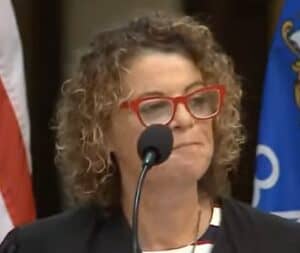
“Chief Justice Karofsky hasn’t been alone in disparaging Troupis’s integrity,” wrote Troupis. “Here’s a remark by Justice Dallet: ‘The only votes you wanna throw out are the votes in … the two most diverse non-white urban counties ….’ That is, Troupis had brought a racist lawsuit.”
He added, “Like Chief Justice Karofsky, Justice Dallet didn’t stop her criticisms when the lawsuit was over. Here’s a statement she made to the Capital Times more than two years after the case had concluded: ‘Troupis is a partisan who appears often in court and was just before us in a widely reported, highly controversial case, which resulted in an attempted weaponization of the disciplinary process against Justice Karofsky and me.”
For good measure, she added that Troupis is a “divisive” figure, he wrote. “Just to be clear, the disciplinary complaint referenced above wasn’t filed by Troupis but by a concerned citizen. And yet, Justice Dallet’s statement suggests the complaint was somehow Troupis’s fault and an attempt to ‘weaponize’ the law,” the motion adds.
The Standard
“The Court of Appeals has summarized the constitutional appearance of-bias test as follows: ‘the appearance of bias offends constitutional due process principles whenever a reasonable person—taking into consideration human psychological tendencies and weaknesses—concludes that the average judge could not be trusted to ‘hold the balance nice, clear and true’ under all the circumstances,” Troupis’s motion explained.
“In other words, the test isn’t about whether the judge thinks he or she is biased. It’s about what a reasonable person would think about the judge’s impartiality.”
Table of Contents