A lawyer who worked as a clerk for conservative Supreme Court Justice Antonin Scalia authored a memo to the state Legislature explaining why he believes the online gaming bill follows state and federal law.
WRN obtained a copy of the memo; the online gaming bill heads to the floor of the state Assembly on Friday. That bill has been in flux behind the scenes, and it would still need passage in the state Senate to become law, as well as a signature from Gov. Tony Evers.
“In my view, the Bill and associated compacts would not violate and provision of the U.S. Constitution, federal law, or the Wisconsin Constitution and should be upheld in any litigation,” attorney Ryan J. Walsh wrote in the memo, obtained from a source outside the Legislature by Wisconsin Right Now. It is dated November 16.
 In addition to clerking for Scalia, Ryan J. Walsh is a member of the conservative Federalist Society. He is a partner at Eimer Stahl LLP and previously served as Chief Deputy Solicitor General of Wisconsin under Republican AG Brad Schimel. Walsh is a graduate of Hillsdale College. Among his past cases: “Wisconsin Legislature v. Governor Evers and Department of Public Instruction (Dane Cnty.; Wis. Sup. Ct.) – Obtained unanimous victory for Legislature in closely watched separation-of-powers battle with the executive branch.”
“Attempts to block online wagering measures in Florida and Rhode Island have failed, and there is strong federal circuit court precedent sustaining state Indian gaming laws and compacts against equal-protection challenges,” Walsh wrote.
Read his memo in full here:
2025.11.16 Memo re Legality of Proposed WI Gaming Bill
The bill would open the door legally for the state to enter into compacts with Wisconsin Indian tribes to allow the tribes to offer statewide online gaming via servers positioned on their reservations. This is the same model that conservative Gov. Ron DeSantis authorized in Florida, and the conservative-controlled U.S. Supreme Court let a federal court decision upholding the concept stand in the Florida case. In exchange, Florida taxpayers received billions of dollars; Wisconsin taxpayers would also get a cut of the revenue if the “hub-and-spoke’ model went into place here. The Forest County Potawatomi retained Walsh to analyze the bill.
WRN previously wrote about a contrary memo from the Wisconsin Institute for Law and Liberty. WILL argues that the bill is on shaky legal ground. WRN has been scrutinizing angles in the controversy that have received little media attention. You can read WILL’s memo here. “These legal issues are significant. In our view, if passed, these bills would likely be struck down. Furthermore, litigation over these bills would result in intense judicial scrutiny of Wisconsin’s entire gambling apparatus, not just the subject matter presented by these bills,” wrote WILL.
Walsh makes a counterargument.
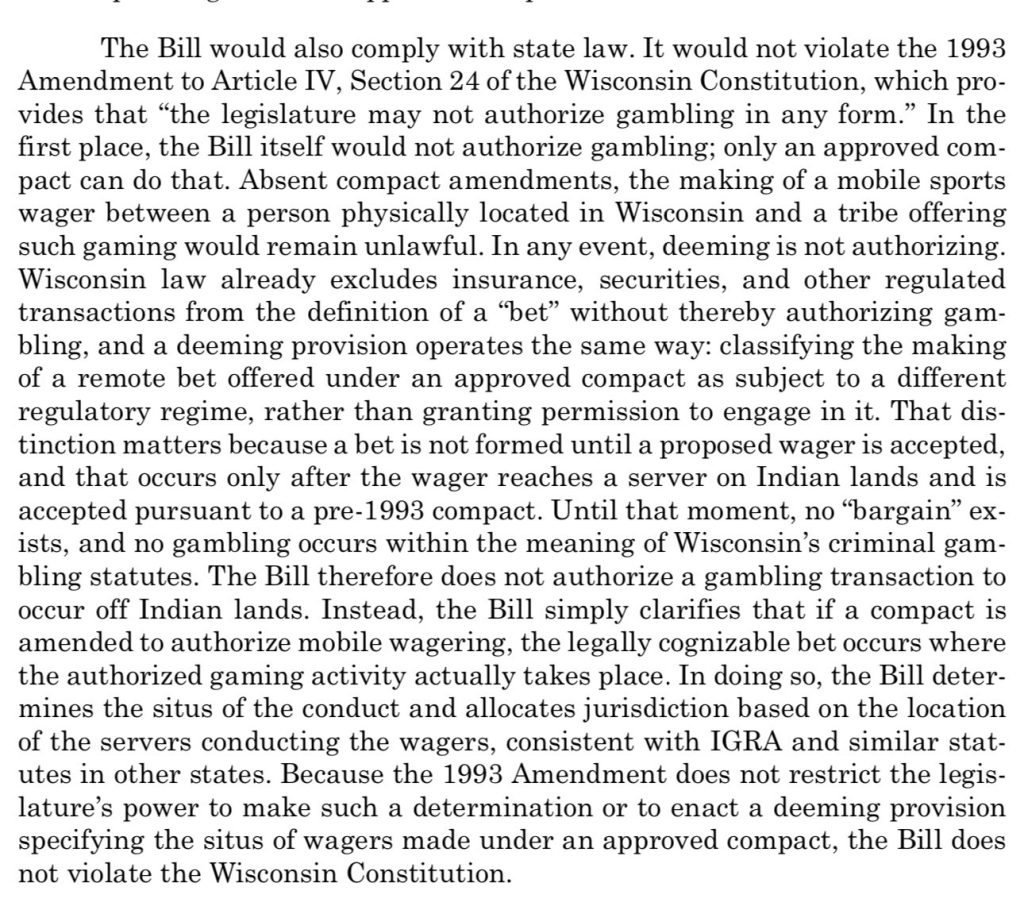
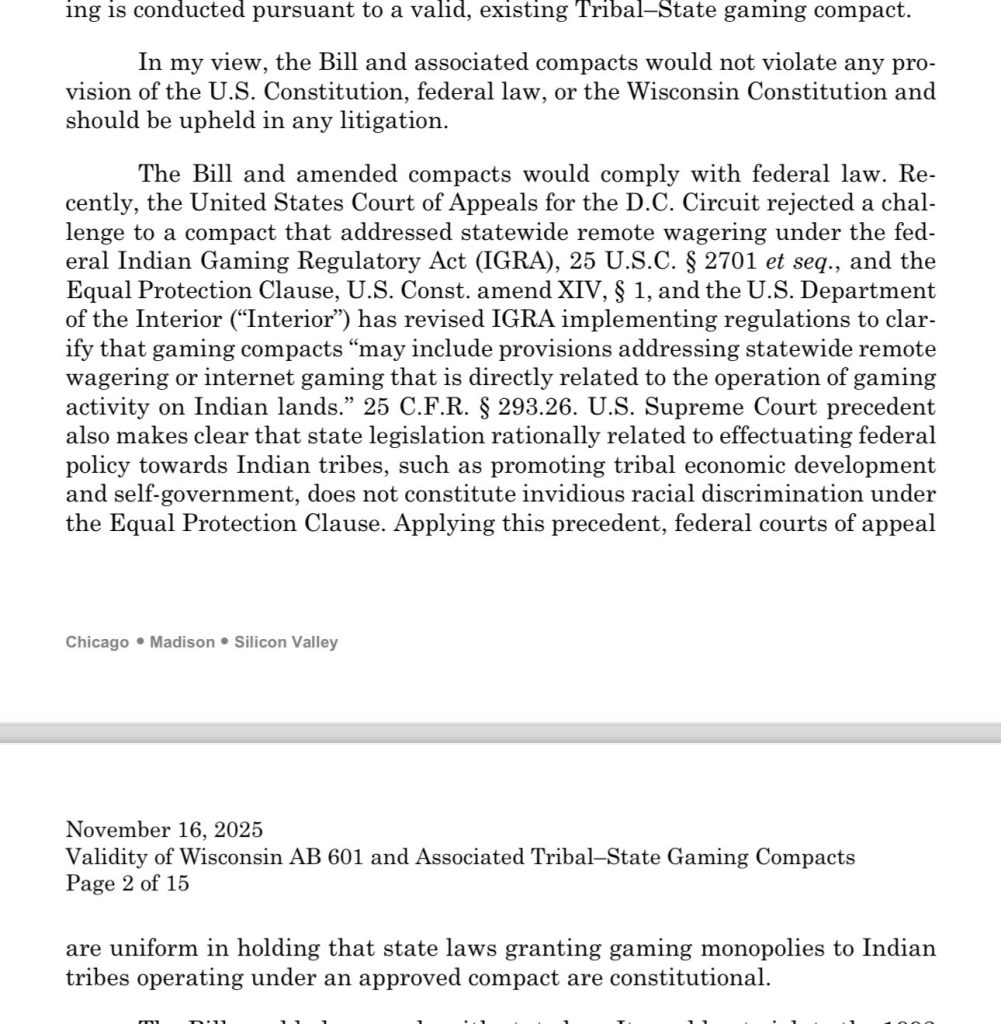
He argues that the Indian Gaming Regulatory Act changed regulations to allow for compacts between tribes and states to address remote wagering. He also cites the federal court decision that upheld the Florida version. He argues that the bill complies with state law because it doesn’t explicitly allow the tribes to conduct remote sports betting; it just decriminalizes a portion of statutes relating to the definition of an illegal bet. Only a compact between the state and tribes could authorize the new gaming, he wrote, alleging that this means the bill would not run afoul of the state Constitution.
Opponents make a free market argument, as well as raising addiction concerns. The state constitution does not currently allow a free market approach. Were voters to change that, the market would likely be dominated by two large out-of-state commercial bettors, FanDuel and DraftKings, which were previously accused of anti-competitive behavior by bipartisan U.S. senators (they deny it.) Supporters of the current bill argue that it would allow the state to get additional revenue, as well as regulate an existing illegal market.