

Milwaukee Police Chief Jeffrey Norman issued a new 11-page policy restricting foot pursuits on Thursday, prompting backlash from the association representing rank-and-file officers.
“There were some legalities with it that we could not really argue with,” Milwaukee Police Association President Alex Ayala told Wisconsin Right Now. “But we did not agree with it and told the chief that. We also wanted clear language for our officers to follow. It was not clear and concise.”
Some officers also expressed concern. “This is just another way to defund the police,” said one frustrated officer, whose name can’t be printed because he fears retaliation. “No one is going to want to do this job in Milwaukee. Such a shame. The department is a shell of what it once was.”
 Wisconsin Right Now asked for the previous policy to compare.
“As mentioned, this is new; therefore, there is no old one,” MPD responded. “Also, this is a new policy that went through the meet conferral process with the unions.”
You can read the new policy here. Among other provisions, it bans officers from chasing people solely based on them running from police.
“It is the policy of the Milwaukee Police Department that members may engage in foot pursuits with suspects only when there is an articulable reasonable suspicion to believe that the suspect has committed, is committing, or is about to commit a crime,” the policy says. “It is the policy of the Milwaukee Police Department that officer and public safety shall be the overriding consideration in determining whether a foot pursuit will be initiated or continued.”
MPD then sent an updated response, “This SOP is meant to codify our existing training while incorporating national best practices. This new policy creates guidelines regarding the use of foot pursuits as foot pursuits are inherently dangerous. The Milwaukee Police Department must establish a balance between protecting the safety of the public and officers during pursuits on foot and law enforcement’s duty to enforce the law and apprehend suspects.”
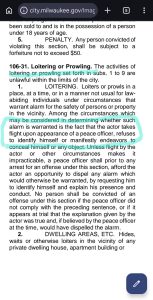
Response was swift online. “Literally Milwaukee City Ordinance for loitering/prowling,” wrote one person.
“That’s not a policy, that’s a training document. 11 pages is unworkable as day to day policy guidance. Field ops policies sound be no more than 2 pages. A lot of what they are defining here is redundant to other policies they should have,” wrote another person.
“Well it took awhile ever since the end of 2003 but they’ve finally turned MPD into the law enforcement version of the Fire Department. Individual initiative has morphed into ‘reactive policing.’ Might as well just adopt a policy that has Officers only responding to calls from their District stations,” former MPD Capt. Glenn Frankovis wrote.
According to Harvard Law Review, in a November 2025 article, the U.S. Supreme Court “has deemed flight on foot legally significant when it is headlong and evasive, and/or done in a populous or high-crime area. In Illinois v. Wardlow, an officer stopped and frisked an individual who, after seeing the police, absconded in an area known for narcotics trafficking. The Court noted his “[h]eadlong flight” — characterized as “the consummate act of evasion” — as justification for the officers to conduct a stop. Similarly, in California v. Hodari D., an individual fled through a dense urban area after seeing the police. The ensuing pursuit spanned several blocks. Wardlow and Hodari D. suggested that when someone flees headlong in a high-crime area, their flight may give rise to reasonable suspicion.”
The article noted an underlying case of Barnes v. Felix, explaining, “While the Court has not precisely defined the lower bounds of flight, it is clear that brief, gradual movement does not qualify as such. In the context of Wardlow and Hodari D., the behavior the Court labeled ‘flight’ was protracted. That the defendants absconded in a populous or high-crime area heightened the concern that they intended to evade detection. In contrast, Barnes did not dart off in an urban area; his few seconds of movement did not take him far, and his actions were gradual enough for Felix to jump on the doorsill. Thus, Barnes did not ‘flee’ within the Court’s traditional understanding of flight.”