

Wisconsin Right Now, with a project-specific grant from No Better Friend Corp., Kevin Nicholson’s non-profit organization, is investigating the Milwaukee County Museum’s rhetoric, cost estimates and plans for a new museum. Read the entire series here.
Is the museum misleading the public about deferred maintenance costs to justify a new $240 million building project?
We took a deep dive into the “deferred maintenance” numbers the Milwaukee Public Museum is using to justify its claim that building a new $240 million facility is the only option. We found a troubling lack of transparency, and numbers that have constantly shifted.
We also found that, if the museum simply fixed its maintenance needs, staying in the current building would be cheaper to county taxpayers than building a new museum, even though the museum’s CEO and the county executive have claimed the opposite.
 To put it simply, the museum has used ballooning numbers for deferred maintenance – their estimate increased from $30 million in 2015 to $100 million on its website today – to drive a narrative in Milwaukee’s indifferent media that backlogged maintenance costs make staying in the current facility unfeasible.
However, we’ve been able to document using public records that the museum’s so-called “deferred” maintenance costs appear to actually extend 20 years into the future; in other words, it’s the equivalent of you saying something like, “well, 18 years down the road, I’ll probably need a new roof, so I better tear down my entire current house and build a smaller one right now even though it will cost more. Even though I could just choose to budget responsibly instead, set money aside, and be fine when the repair comes.”
This all raises the legitimate question of why the county doesn’t just pay for the maintenance annually and stay in the current building, perhaps building off-site storage to better protect the collections. Off-site storage will be needed in the new building anyway, which is half the size. Building an off-site storage warehouse is estimated to only cost $2.3 million.
 Wisconsin Right Now put the shifting estimates for deferred maintenance in a timeline based on county documents and news articles. You can see it at the end of this story. The timeline shows how Milwaukee’s media outlets have functioned as stenographers for museum officials, reporting shifting amounts without pressing museum and county leaders on how the estimates were reached, what they really mean, or why they were constantly changing.
The Museum’s Estimate Jumped $50 Million in Less Than a Year
What museum officials are telling the public now on their website – a claim parroted in a January 2023 Milwaukee Journal Sentinel story – is not what they told the county less than a year ago. In less than one year’s time, the museum’s deferred maintenance estimate jumped by $50 million without detailed explanation.
Museum officials have refused to explain their deferred maintenance numbers to Wisconsin Right Now, and museum CEO Ellen Censky has refused to sit down for an interview. That’s despite pledging transparency and $85 million in public funding from the state and county.
This is a pattern. They’ve also refused to explain which exhibits will be featured in the new museum, including being specific about what will happen to the popular Streets of Old Milwaukee exhibit, although they do promise to have a “green roof” and “bird friendly glass.” Groundbreaking is scheduled for December 2023 on the new $240 million project.
Today, the museum claims on its website that it “has approximately $100 million deferred capital maintenance” as justification for needing the new $240 million museum project, funded in part by taxpayers. “Milwaukee County, despite its best efforts, simply does not have funds available to maintain the building,” they tell taxpayers.
 Why this matters: The museum claims it would cost $250 million to stay in the old building, in part due to deferred maintenance; conveniently, the figure is $10 million more than building a new facility, strengthening officials’ public argument for a new museum.
We did what other media have not. We have tried to pin down exactly how the museum is reaching that $250 million estimate, which ballooned from $131 million in a 2015 consultants’ report. A key part of it is the deferred maintenance claim.
Just three years ago, Censky told BizTimes that the museum didn’t even have $100 million in deferred maintenance costs projected “over the next 20 years.”
On the website, taxpayers are not told about the 20-year context.
“In all, the museum faces an estimated $87 million in deferred maintenance projected over the next 20 years,” the BizTimes reported that Censky told them in 2019.
In addition, We’ve previously revealed that top museum officials admit that $80-90 million of the $250 million cost for renovating the old museum comes from what they believe is a pressing need to update exhibits for racial and equity concerns, although, yet again, they won’t say which ones or why it’s needed.
Tracing the Museum’s ‘Fuzzy Math’
Tracing the museum’s deferred maintenance numbers is not easy since they won’t cooperate.
Through public records, we unearthed a document for the $87 million number that comes close to the $100 million deferred maintenance claim on the museum’s website if you take a lot of liberties in rounding it up. This is the estimate that is spread over the next 20 years.
 In February 2019, an appraisal report sent to Milwaukee County’s Department of Administrative Services by The Nicholson Group Inc. found that the “building and its mechanical systems are in deferred condition with a Facility Condition Assessment Report estimating $86.45 million for necessary replacements and capital needs over the next 20 years.” Read it here.
However, in a March 2022 meeting before a county committee that approved $45 million in public funding for the new project, Katie Sanders, the chief planning officer for the museum, told supervisors that a 2015 study put the museum’s deferred maintenance at $30 million and underestimated it by “at least $20 million.”
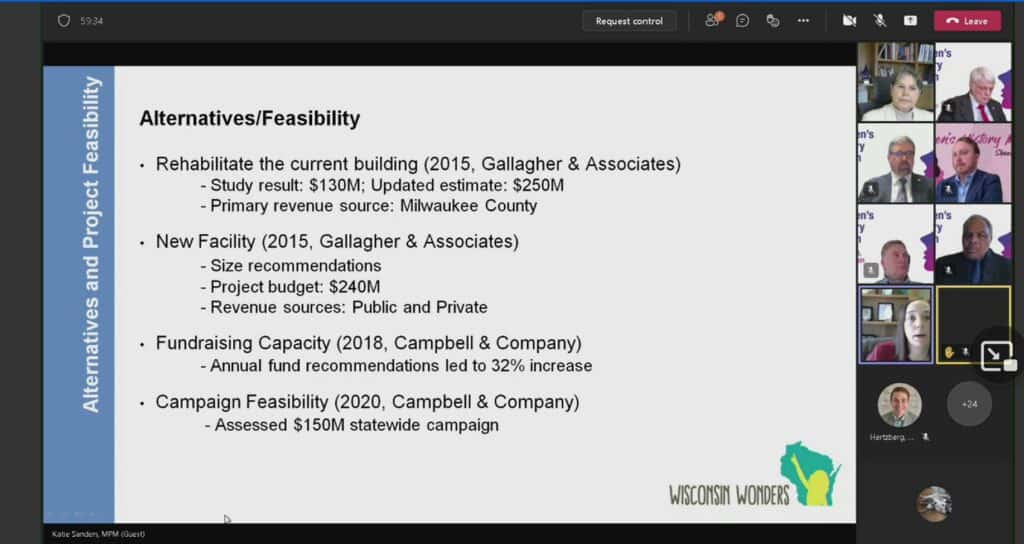
That would bring her estimate for deferred maintenance to at least $50 million. She used the estimate to help convince supervisors to approve the funding.
In late 2021, a Milwaukee interoffice communication written by Aaron Hertzberg, Director, Department of Administrative Services, and Dr. Ellen Censky, President & CEO, Milwaukee Public Museum, to Marcelia Nicholson, Chairwoman, Milwaukee County Board of Supervisors, also suddenly used the more than $50 million figure.
“Overall high-level estimated deferred capital costs associated with the current building are in excess of $50,000,000,” it says.
It notes that a 2015 Gallagher and Associates report “underestimated the deferred maintenance of the building (at the time noting only $30,000,000) and did not account for the full cost of storage equipment.” The report then states that the Gallagher report only discussed updating two exhibits, which the memo says means the “concept of remaining in the building fails to achieve racial equity outcomes.” The document does not list the specific deferred maintenance needs.
It’s unclear why the museum is currently telling the public the deferred maintenance number has jumped to more than $100 million.
 Using Sanders’ number and the number in the memo, that would make the annual cost about $2.5 million a year over 20 years to clear up the deferred maintenance projects in the old building, although the amounts aren’t all spread evenly over each year. The county currently pays $3.5 million in operating costs to the museum each year. So that’s a grand total of $6 million per year to stay in the old museum, presuming the county couldn’t use some of the $3.5 million toward the deferred maintenance bills (or convince the county or state to use the public money they’ve already approved toward it).
We obtained a county document that shows the annual cost of moving to the new museum would cost the county $6.2 million a year – more than staying in the old facility. That figure counts the costs of maintaining the old building, which couldn’t simply be abandoned.
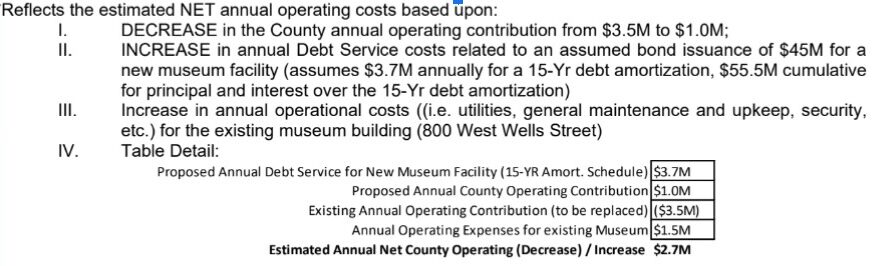
The state has already committed $40 million, and Milwaukee County has committed $45 million for a new building, ironically totaling almost the same amount as the Nicholson Group estimate – $85 million. [Note: The Nicholson Group is not tied to Kevin Nicholson.]
Could those funds instead be put towards the anticipated replacements and capital needs over the next 20 years, renovating the current building instead and saving beloved exhibits like the Streets of Old Milwaukee and the intricate artistic dioramas?
 The museum officials would likely argue that, in addition to deferred maintenance and racial/equity updates, renovating the old museum instead would accrue other costs. They’ve been vague about what however.
Concerns have been raised by an accreditation committee about the impact on collections from a supposedly deteriorating building.
However, as noted, a new off-site storage warehouse would only cost $2.3 million, according to Urban Milwaukee.
Sanders told a county committee it would also cost $20 million for moving the collections and storage equipment. In addition, in the $250 million cost for staying in the old building, she appears to have included the 2015 estimate of $131 million. That estimate included things some people might consider wants, like a new facade, and Vivarium (butterfly exhibit), a rooftop glass pavilion and patio, and a student lunchroom “connector.”
 The rest of the $240 million for the new museum is supposed to come from private donors. However, the new project has only raised $32 million from private donors – leaving it $118 million short with groundbreaking set for December, according to the Milwaukee Journal Sentinel (the museum has refused to give us the total amount of private donations raised so far). There has been no explanation of an alternative plan, should that figure not be met.
“The total cost of the project is $240 million—$90 million dollars in public funds ($45M from Milwaukee County, $40M from the State, $5M in other government funds); $150 million in private funding. We have raised more than half of the funds so far,” was all Madeline Anderson, the museum’s Earned Media director, would tell us.
Furthermore, the museum has received ongoing money for maintenance costs from the county over the years. In March 2022, Sanders told supervisors that the county had spent $15 million “in capital support in last 10 years” for the current building. That money would go down the drain with a move.
We asked the museum’s earned media director Madeline Anderson, and its public relations firm, Mueller Communications, to detail specifically what the deferred maintenance needs are. We sent a list of written questions, but most have gone unanswered. We have not received a detailed breakdown.
However, turning again toward public records, we unearthed the museum’s capital requests from 2019 through 2023. The total is only just over $21 million.
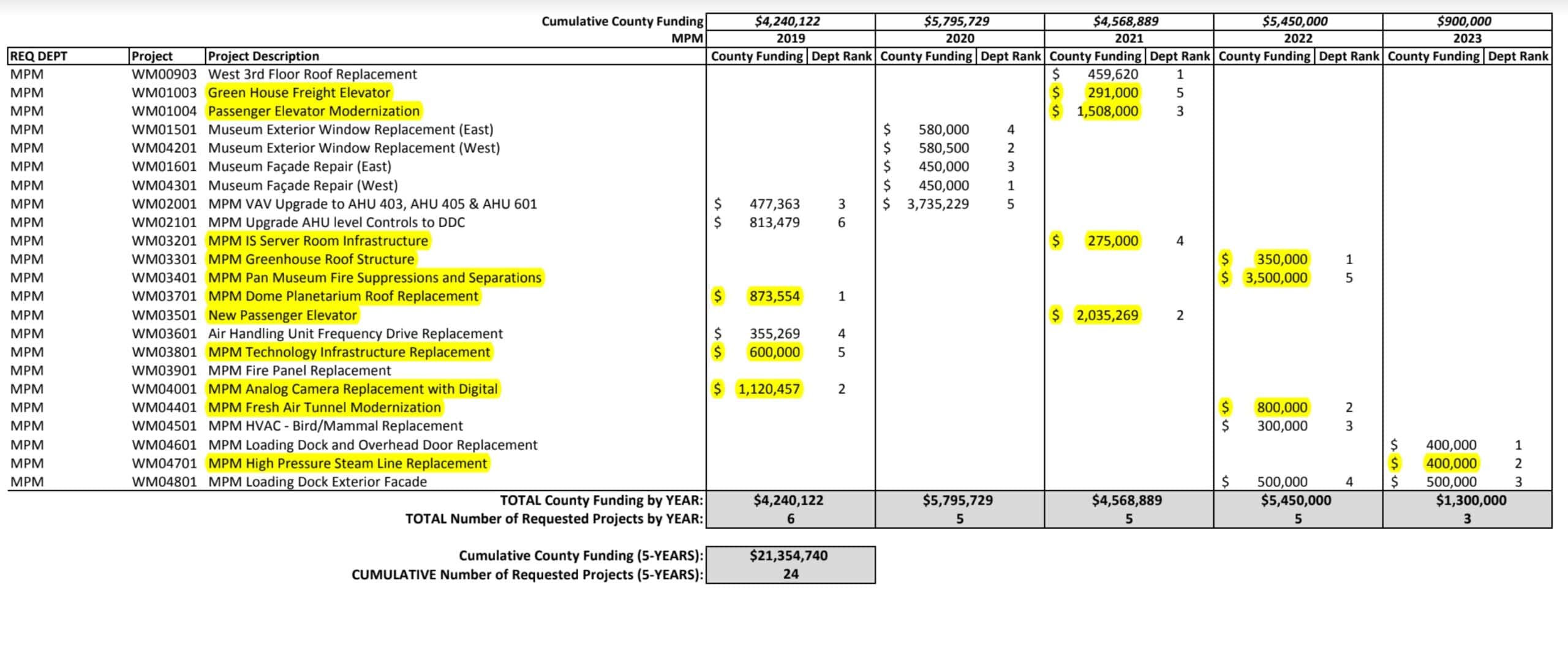
We found documents that break the maintenance needs down by year in county records. These documents show specifics for the $87 million in projected maintenance costs from 2018 to 2037; the figure is only $64 million from 2023 to 2037. That’s roughly close to Sanders’ estimate of “at least $50 million.”
The items are for capital improvements like stairs, roofs, HVAC, and electrical. Some years, very little money would be needed. In a couple years, large expenditures are budgeted.
See:
18-650 FUNDING NEEDS REPORT ALL REQUIREMENTS
18-650 FUNDING NEEDS REPORT BY SYSTEM
 We wrote Milwaukee County Comptroller Scott Manske, asking him to detail the museum’s deferred maintenance needs from the county’s perspective. He didn’t respond, continuing the culture of non-transparency.
Shifting Deferred Maintenance Costs Timeline
2012
$30 million. The museum’s deferred maintenance needs were estimated by the museum’s chief financial officer at $30 million, according to The Milwaukee Journal Sentinel.
2013
A county document says the county agreed to provide $4 million from 2014-2017 in capital project funding for deferred maintenance costs.
2015
$30 million.
Gallagher and Associates, the consulting firm hired by the museum to investigate the feasibility of staying in the current building, gave this number for its deferred maintenance needs. We have asked the museum for the full Gallagher report, but they have not provided it. We have also asked Gallagher whether they dispute the museum’s claims that they underestimated the museum’s true deferred maintenance needs in this report by $20 million, as stated by Sanders in March 2022. They have not responded.
The Milwaukee Journal Sentinel reported that, in 2015, Milwaukee County “estimated that repairs and upgrades alone would cost $89 million in the coming 20 years.”
2018
$40 million.
The Milwaukee Journal Sentinel reported that the current building had “about $40 million in deferred maintenance,” according to then museum President Dennis Kois.
2018
Nearly $100 million.
In 2019, a Strategic Plan 2018 – 2022 for the museum noted that “a study done in 2015 and then updated in 2018 reported nearly $100M in deferred maintenance on the Museum building.”
September 2018
$30 Million
A major report by the Wisconsin Policy Forum into Milwaukee cultural institutions noted, “Despite receiving nearly $10 million for repairs and updates in the past five years, the MPM building faces $30 million in deferred maintenance.”
2019
$30 million.
A 2019 feasibility study conducted by Gallagher and Associates on combining the museum with the Domes listed “repairs and maintenance” as $747,560 for the Milwaukee Public Museum for that year.
Urban Milwaukee reported that the museum had “approximately $30 million in deferred maintenance.”
In 2019, Ryan O’Desky, the museum’s chief operating officer and chief financial officer, told the county that the two largest issues “facing the museum are an aging air conditioning system and water leaks throughout the building.” He said that a chiller needed to be replaced that cools people in the summer as well as the museum’s collections. The cost was estimated at $850,000. The other issue cited was a fourth-floor roof with a price tag at $750,000.
April 2019
BizTimes reported that “the museum faces an estimated $87 million in deferred maintenance projected over the next 20 years,” according to museum CEO Censky.
February 2021
$30 million.
The Milwaukee Journal Sentinel notes in an article about state funding that the current museum was “in need of $30 million in deferred maintenance projects.”
March 2021
$30 million.
The Journal Sentinel repeats the $30 million deferred maintenance claim.
June 2021 – $40 million in state funding is approved
November 2021
More than $50 Million.
A Milwaukee interoffice communication written by Aaron Hertzberg, Director, Department of Administrative Services, and Dr. Ellen Censky, President & CEO, Milwaukee Public Museum, to Marcelia Nicholson, Chairwoman, Milwaukee County Board of Supervisors, suddenly uses the more than $50 million figure.
“Overall high-level estimated deferred capital costs associated with the current building are in excess of $50,000,000,” it says.
It notes that the Gallagher report “underestimated the deferred maintenance of the building (at the time noting only $30,000,000) and did not account for the full cost of storage equipment.” The report then states that the Gallagher report only discussed updating two exhibits, which the memo says means the “concept of remaining in the building fails to achieve racial equity outcomes.” The document does not list the specific deferred maintenance needs.
March 2022 – $45 million in county funding is approved
March 2022
More than $50 million.
WTMJ-TV reported that museum CEO “Censky says there is more than $50 million in deferred maintenance.”
Katie Sanders tells a county committee that the museum has at least $50 million in deferred maintenance.
March 2022
$70 million.
The Milwaukee Journal Sentinel, in a story on the Milwaukee County Board approving $45 million in funding for the new museum, reports that the museum is “in need of $70 million in deferred maintenance projects.”
March 2022
WTMJ 620 AM reported “Since its construction in the 1960s, the museum has gained approximately $100 million in deferred capital maintenance.”
July 2022
$100 million.
BizTimes reported that the museum has $100 million in deferred maintenance.
January 2023
$100 million. The museum’s website currently claims that the museum “has approximately $100 million deferred capital maintenance.”
Table of Contents