
This is the first in a four-part series exploring the various issues in the Waukesha County Sheriff’s race. The primary is Aug. 11.
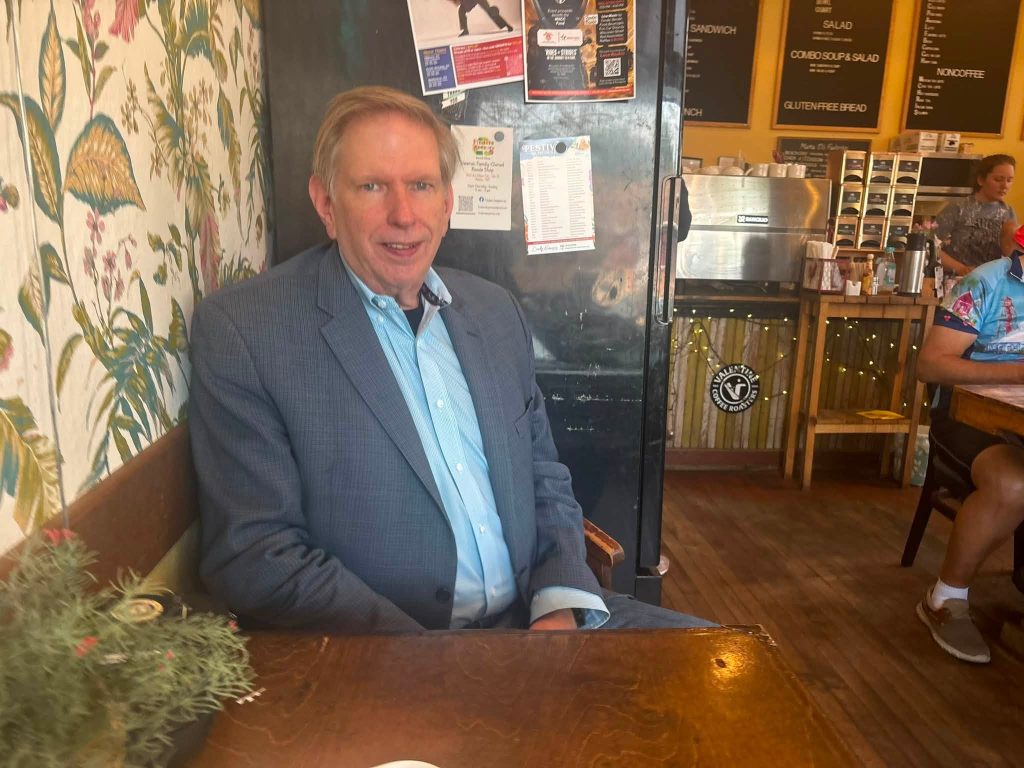
It’s 8 a.m., and Waukesha County Sheriff Eric Severson is already at Mama D’s, a coffee shop in Wales that is his usual haunt and, today, he’s almost a haunted man. Or maybe a hunted one. He was there by 6 a.m., sternly checking emails and legislative updates.
The sheriff, who is wearing a suit jacket, jeans and cowboy boots on a sweltering July day, is a taciturn person; he’s an analytical man who “tends to overthink things,” not a jovial one, the kind of hard-edged person who wouldn’t get a joke. His introversion has served him well at times; like most introverts, he prefers philosophical conversations. He agrees he’s an introvert (“totally.”)
Most people want a serious sheriff, and he’s won by astonishing, albeit eroding, margins. Who wants a weak sheriff? Well, criminals probably do. He tells me his definition of courage is doing the right thing even though it will cost you something. He paints himself as a disciplinarian who won’t look the other way just because law enforcement is a brotherhood, and, yes, that’s cost him something.
Inside the agency and on social media, where the hostility is shooting into public view like a geyser, there’s intense criticism over Severson’s leadership, some of it stoked by an outside candidate’s fiery primary campaign. It’s disputed how widespread the internal dissent is and, certainly, the repugnant primary is fueling the bonfire, which spills out to retired deputy networks; however, it’s obvious there’s a problem.
One of the central claims is that Severson, who is retiring, is too aloof and not connected enough to the much-younger deputies’ needs; he’s not around enough, people repeat. A woman who supports realtor John Gscheidmeier for sheriff, wrote, “95% of that place is afraid to speak up for fear of retaliation. I’m wondering if you’re truly understanding what’s at stake here?” She concluded, “Ugh. It’s just all so bad. And so sad.” It works both ways. A woman who supports Severson’s choice to replace him, Capt. Nick Ollinger, wrote, “I have been called names and rumors have been said about me.” When I endorsed Ollinger the other day (the reasons will become clear by the end of this series), she wrote, “I have tears of joy reading this!”
“My job isn’t to be tied to a desk,” Severson insists. When I press him, the sheriff says he makes an appearance in the office “every day,” and sometimes works weekends. A couple days a month, he’s out of state for national boards and conferences, such as one on border security. “There’s animosity toward me because I’m a disciplinarian,” he says, insisting that his disciplines are rarely overturned. “I work for the public. I don’t work for the union.”
Ollinger and Gcheidmeier face off on Aug. 11 in the GOP primary. There is no Democrat.
A ‘Toxic’ Work Environment?
The problem goes back farther than Gscheidmeier, the gregarious and sometimes glib realtor who is staging a bid for sheriff against an equally friendly Severson-endorsed Ollinger. If a Martian landed on Earth, they’d probably believe that Gscheidmeier, 57, was running against Severson, whose shadow over this race looms large.
As far back as 2022, the Waukesha Deputy Sheriff’s Labor Union held a no confidence vote against Severson, and they’ve endorsed Gscheidmeier now, rejecting the sheriff’s inside choice. The department has been challenged by 35% turnover in 3.5 years and claims of plummeting morale, things that both Ollinger, 41, and Gscheidmeier are pledging to fix. That’s a tougher argument for Ollinger, a captain who runs the detective bureau, since he’s already on the inside.
To put that into context, in 2022, 16.4% of non-UW state employees in Wisconsin left their jobs, and 17.7% of the total authorized positions in state government outside of the UW System, were vacant. Police, though, have faced declining morale due to the protest movement that unfairly villainized law enforcement. Wisconsin law enforcement is experiencing a recruiting crisis. By 2023, hiring was picking back up, but agencies nationwide were losing more officers than they could hire.
The social media claims are both furious and incendiary: phrases like a “toxic” work environment are easily thrown around. Others say some of the most prominent anti-Severson keyboard warriors on social media are not sharing their real agendas or their full, complicated back stories. The public would be less sympathetic to them, and their arguments, if they did. But I don’t have time to dig through the personnel files of every random Eric Severson critic on Facebook, and it’s safe to say there are more than a few. It’s also safe to say that some are expressing legitimate concerns.
Gscheidmeier, a former Glendale police officer turned County Board supervisor, has become the receptacle of, and beneficiary of, this angst, like ex-FBI supervisor Danny Day was before him. When Day suddenly quit the race for unclear reasons, Gscheidmeier positioned as the change agent, and people who were seeking that seamlessly switched from Day to him. Yet, there’s growing evidence that pretty much no one bothered to vet him. And trust me, there’s a lot there.
“I keep coming back to some of the law enforcement people supporting him,” Severson said of Gscheidmeier. “Do they know about some of the issues? Nick has actual police command experience.” Gscheidmeier was never a police supervisor (he says he didn’t want to be one), and he left the Glendale Police Department after almost 20 years in April of 2012 (that month/year will become very significant in a future story in this series, so remember it.)
Overwhelming Margins
It’s safe to say that the internal and external images of Severson don’t quite match; he remains popular with the public, even as a segment of his force mutinies. In 2022, Severson faced his own primary challenge, where he was hit with similar claims about morale and turnover. He handily won the primary with 64.8% of the vote, so his endorsement of Nick Ollinger surely means something.
That Severson is viewed one way outside the department, and the other way by some within, probably says more about the news media than the electorate. And it says something about the dynamics in this race. If you’re the outsider like Gscheidmeier, who is running against the internal guy endorsed by a Republican sheriff who still wins elections with overwhelming margins, your only play would seem to be making the race a referendum on the retiring Severson, and you can’t do that without trying to muddy him up, especially since there’s not much out there on Ollinger himself.
Gscheidmeier says he brought together 33 “retired deputies, retired supervisors, current deputies, and current supervisors” for a listening session, and he wrote, “These people agree that change is needed within the Sheriff’s Office, and they believe that I am the right candidate to make those changes.”
“The Sheriff’s Office should not operate in a silo. It must work collaboratively with local police departments, community partners, and elected officials to make our communities safer,” he adds. Ollinger disputes that the Sheriff’s Office doesn’t already do this, and he shared commendation letters from other agencies thanking him and the department for the help.
On Heroin’s Trail
I first met Severson in 2014, when I was writing a five-part series on heroin for the Waukesha Freeman newspaper. He showed up at a different breakfast cafe, armed with research that painstakingly documented the heroin epidemic’s origins as it exploded in his county. The heroin epidemic traced to an increase in opioid pill use, which traced back to a UW-Madison center that conducted pain research; that angle has been little told (you can read that investigative piece, a five-part series, here). Heroin was largely being trucked over the U.S./Mexico border. (Gscheidmeier recently wrote that he joined the county’s Heroin Task Force.)
Severson wasn’t even sheriff yet. He was an inspector who once commanded the Metro Drug Unit. “The market came to the people. There’s wealth here. It was the perfect storm,” he said then. The next year, armed with top Republican Party endorsements, he was elected Waukesha County Sheriff after Daniel Trawicki retired. Severson won with an insane margin, receiving 86% of the primary vote against Tom Alioto, a former Town of Lisbon police sergeant. In Waukesha County, sheriff’s races tend to be determined by the Republican primary. There aren’t many Democrats who want to be sheriff in a conservative place like this – or who would have a chance if they tried.
Severson was an inside candidate like Ollinger is now, and he promised to build on what already existed. “He doesn’t have any big changes planned because he has a solid organization,” WISN-TV reported in 2015. After his first four-year term ended, people were so satisfied that he didn’t even field an opponent. He is frequently sought after for endorsements from top Republican candidates.
Severson took a special interest in border enforcement, traveling to the wall and implementing a landmark program to identify illegal immigrants in the jail called 287g, which is one of his most significant accomplishments; fentanyl, an opioid, crosses the U.S.-Mexico border, and it kills Waukesha County residents. Ollinger has also been part of those efforts.
“Recently, Democrat candidates for Governor of Wisconsin have said that they would stand in the way of ICE’s efforts to deport violent illegal immigrants,” Ollinger wrote. “Let me be clear: I fully support lawful ICE operations. I sit on the National Sheriffs Association’s Border Security Committee and I’ve been to the southern border. I’ve seen firsthand the effects of unchecked illegal immigration on communities like ours here in Waukesha County. I am horrified at the prospect of a governor who doesn’t back law enforcement and the programs, like 287(g), that are needed to help protect our communities.”
Gscheidmeier also pledges to continue the illegal immigration program, which gives correctional officers the authority of ICE agents to issue detainers. That way illegal immigrants don’t bail out and disappear. “I unequivocally support all law enforcement efforts, and fully support the application of 287g as is done today within the Waukesha Sheriff’s Department,” he said.
Severson was once protested over this program; he stood strong. He was way ahead of his time. His 287g program was the first in Wisconsin, and now the ACLU has asked the liberal state Supreme Court to disallow it.
Scrutinizing Nick Ollinger
The truth is that Gscheidmeier and Ollinger don’t differ much on the issues when you sit and talk to them, as I did, for three hours each at Hartland cafes this summer. With so little daylight between the two Trump-supporting Republicans, the race is turning on acrimonious questions of character. And with so little out there on Ollinger, the race turns back to Severson as the target, or cheap shots.
I filed four open records requests for calls for service to Ollinger’s home and former homes, and turned up nothing. I requested and reviewed his personnel file, and his only discipline was running into a pole going 5-7 miles per hour. The file also contained positive letters – in one, the Village of Pewaukee police chief praised Ollinger’s “exemplary professionalism.” The only negative angles in the file were a few notations in Ollinger’s work history about improving his handling of OWI calls early on (both Ollinger’s and Gscheidmeier’s disciplinary and merit records are embedded here. We will deal with Gscheidmeier’s in another story.)
More serious is a 2021 complaint that the Waukesha Deputy Sheriff’s Labor Union, which endorsed Gscheidmeier, filed with the state. It alleges that a deputy requested a union representative when Ollinger asked him why the deputy was allegedly “not doing his job,” and then asked him about steps he took to “obtain evidence requested by the County DA.” Ollinger “angrily told (the deputy) that he did not need a union representative and that he would not be receiving discipline,” the order says.
The Wisconsin Employment Relations Commission determined that Ollinger violated the deputy’s right to union representation and ordered the county to distribute the decision and cease and desist from interfering with employees’ rights in that matter. Critics have also tried to make hay out of Ollinger recently moving from Germantown into the County, but that’s not against the rules, and he says he lives in Lisbon now. They’ve also bandied around a photo showing him standing with Kamala Harris; he countered by posting a photo showing him with Donald Trump and says he was just doing dignitary protection for each official.
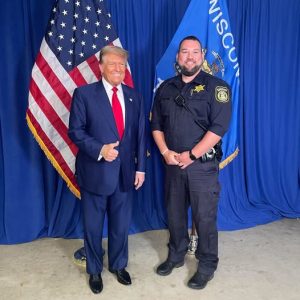
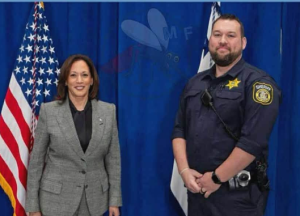 “One of the highlights of my career was working alongside the Secret Service to help secure President Trump and those attending his rally in 2024. Protecting those who lead our nation is always an honor, but it becomes especially meaningful when it’s a leader you personally support,” Ollinger wrote.
As with Gscheidmeier, Ollinger says he’s a conservative Republican who voted for Trump in every election. But that’s all they’ve got.
Severson quickly endorsed Ollinger. “Nick will lead with integrity, ensuring the highest level of safety for our community and transparency in the sheriff’s office. I have been proud to have him at our side as a senior commander and look forward to him serving as your next sheriff,” Severson said.
Perhaps Ollinger has just become a Severson effigy, of sorts. He pushes back at this, and in truth, it’s sort of unfair. “I’m not Eric Severson,” he says. Ollinger has developed his own record of leadership, it’s just a quieter one because he wasn’t the top guy. And, in a way, Gscheidmeier’s personality bears more resemblance to Severson’s. They’re both complicated personalities.
One woman who saw the candidates speak at the Waukesha County Business Alliance wrote me: “Nick is a cop. John is a politician.” Whereas the charismatic Gscheidmeier likes to name drop (“I went on a trip with X, Y, and Z”), Ollinger, a former college football player, is matter-of-fact, like he’s reading a police report. He’s not at all like Severson personality-wise, really. He’s younger, friendly, seems to connect with people, and he’s eager to reach out. He says over and over again that he wants to unify the department.
When people send negative messages about Ollinger, they quickly diverge into claims against Severson and his Inspector James Gumm. I’ve yet to receive any significant specific negative claim about Ollinger; in fact, Gscheidmeier conceded to me that Ollinger is a “nice guy,” and he said on the radio that he’d keep him on as a captain if he wins.
Ollinger, as a captain overseeing Severson’s detective bureau, is part of the command staff, though, so he’s got to own some of it. His criticism of his boss is not surprisingly tempered; the most he will concede is that Severson “isn’t around enough” and that he would be a more engaged sheriff.
The Sheriff Speaks Out
The Brookfield-raised Severson, who has been in law enforcement since 1985 (dad was a quality assurance agent, go figure, and his mom worked for JC Penneys), doesn’t offer even a hint of a smile during our Mama D’s meeting; in fact, he reveals, he’s barely been sleeping these days. “I can’t sleep. I don’t like the untruthful comments I’ve been hearing about. I’m fearful. I want to make sure the next occupant of this office is deserving of all of the responsibility.”
He’s reading the Ministry of Ungentlemanly Warfare, a book about a team that engages in irregular warfare during World War 2. What’s he watching? The Hunt for Bin Laden. He enjoys touring Gettsyburg and derives life lessons from the Civil War.
Shakespeare once wrote, “uneasy lies the head that wears a crown,” a line spoken by the ailing King Henry IV as he “struggles with sleeplessness, rebellion, and the heavy burdens of ruling.” Waukesha County’s top law enforcement official is carrying other burdens too, all officers are; for starters, there’s the anti-law enforcement rhetoric in society at large.
Severson made some bold moves as sheriff along the way, pushing back against the anti-cop narratives that have grown since Ferguson and exploded with George Floyd, notably hiring a controversial Wauwatosa police officer, Joseph Mensah, even though Mensah, who has since left the force, was the subject of intense protests for three fatal shootings ruled justified by the DA.
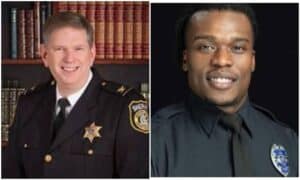 These sorts of actions endeared Severson with the conservative public. Severson made that call after a painstaking investigation into Mensah, of which Ollinger was a part. He also sent a unit to help combat the Kenosha riots after the Jacob Blake shooting, which Ollinger commanded. All of this has caused great distress on law enforcement officers, who were suddenly turned into villains overnight, and Severson believes it’s a key reason for the turnover challenges.
The Police Executive Research Foundation (PERF) “surveyed 194 departments and found an average 18 percent rise in resignations and a 45 percent increase in retirements between 2020 and 2021,” City Journal reported.
“I am proud to formally recognize Nick Ollinger’s service alongside Kenosha County during the unprecedented challenges of 2020,” wrote Kenosha County Sheriff Dave Zoerner. “As a leader of the Waukesha County Civil Disturbance Unit operating within Kenosha County, he demonstrated exceptional leadership, professionalism, and resolve during the most difficult period in our community’s history. His steady leadership and commitment to collaboration provided meaningful support to our residents at a critical time.”
Now the anti-law enforcement vitriol has escalated to the point where the Democratic frontrunner for Wisconsin governor, Francesca Hong, has advocated abolishing the police.
“I’m an old man,” Severson says, stunned that a concept as ridiculous as “abolishing the police” is provoking serious discussion on his eve of retirement. “In my day, we wouldn’t have even been talking about this.” He adds, “The typical citizen has no contact with evil or criminals on a daily basis. Law enforcement officers do. If you don’t have to face the lion, you don’t have to fear the lion.”
The sheriff’s plans were to finish building a plane in his basement upon retirement (he’s an aviation buff). Now he’s watching his legacy being torched. It’s almost like he’s the other candidate in the race, but because he’s actually not, he has to just sit and take it. That’s got to be hard.
Nothing Was Off Limits
At Mama D’s, I threw every criticism at the sheriff that I could think of, and he ruled nothing off limits.
“What does that mean?” the sheriff challenged, when I ask him about persistent claims that morale inside his agency has bottomed out. “Tell us what that is. Tell us what you want to do different. It’s easy to throw around.”
He added, “I’ve been hearing that (about morale) since Ray Klink,” a sheriff who retired in 1992. I told him that many critics single out controversial Inspector James Gumm. A reader advised me that Gumm is Ollinger’s campaign treasurer, which Ollinger confirms. Critics point to Gumm’s security company, questioning whether it employs deputies and accuse him of not being around enough. They say some commanders don’t live in the county.
Severson says Gumm is a “very disciplined, focused guy.” I ask him about accusations that he allows detectives and commanders to take home, and drive around, county-paid cars, and he confirms this. But he says that it would be more expensive to pay them to be on-call, and this was studied. He says it provides better, and quicker, service to the public because the detectives/commanders can just drive directly to scenes, rather than having to drive from their homes to the department’s HQ to get a car and then to scenes.
I asked about accusations that commanders use company cars to, say, tow boats up north, and he says that would be against policy, as they aren’t supposed to take them out of the county “where they live.” I asked about a commander accused of a crime in another county, and he says the man was never convicted.
Severson offered frank answers about it all: the lack of body cams, the turnover numbers, allowing detectives and commanders to take county cars home, the Huber jail closing, and more. I explore more ofissues in part 2.
Stay tuned for part 2.
Table of Contents