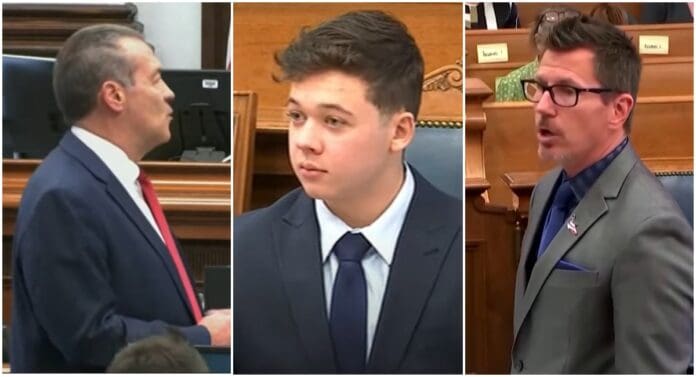


Rittenhouse trial update: In this story, we go through each witness from week 1 in the Kyle Rittenhouse trial. Our tale of the tape: Almost every single one of them was a net gain for the defense.
With the first week in the Kyle Rittenhouse trial over, we’ve decided to give you a quick summary of the key testimony each day, as well as our assessment of whether each witness was a net gain for the prosecution or the defense. The bottom line: Week 1 was not a good look for the prosecution, starting with opening statements and continuing through Friday.
Our tale of the tape for each witness and opening statements:
Net gain for the defense: 12
Net gain for the prosecution: 1 (but slight and not nullification of self-defense)
Wash: 2
Videos: All net gain for the defense
Witness after witness and video after video only served to bolster the defense argument that Rittenhouse, then 17, used self-defense when he shot and killed Joseph Rosenbaum and Anthony Huber and wounded Gaige Grosskreutz during the Kenosha riots in August 2020. Frankly, video was the star of the show, and the story it told pointed to self defense. It literally captured Rittenhouse under attack, and other video cast Rosenbaum, the first man shot, as a belligerent aggressor using a racial slur and telling another man to shoot him.
The first week ended in the midst of the prosecution’s case. We haven’t even gotten to the defense presentation yet. Wisconsin Right Now was granted a seat in the courtroom on Thursday; media seats are drawn by lottery. It’s expected the trial could take three weeks. The only real victory for the state was continuing to keep the shot men’s criminal histories from the jury, although that doesn’t nullify self-defense.
What’s expected in week 2? The testimony of the only shot man who survived, Grosskreutz; the testimony of Joshua Ziminski, who is accused of firing a gun into the air right before Rittenhouse opened fire; and, perhaps, the testimony of Rittenhouse himself and his various family members.
Here’s the first week rundown with our rulings on which witnesses and elements were net gains for the prosecution or defense:
Monday, November 1st: Jury Selection
On Monday, the jury was selected for the trial of Kyle Rittenhouse. The jury was selected much faster than most expected. In total, 20 people were selected, 11 female, 9 male. They are 19 white people and one Hispanic. We observed the jurors in court and it stood out to us that most were middle-aged to elderly; there are not many very young people on this jury. By the end of the week, two of the 20 were gone (one for telling a joke about the Jacob Blake shooting, and another because she was experiencing discomfort due to pregnancy.) Some say cases are made or broken in jury selection.
Our ruling: Net gain for the defense. Older white jurors strike us as being good potential jurors for the defense. We doubt that elderly jurors appreciate rioting in their community, so they’re less likely to be sympathetic to the behavior of the men shot that night.
Tuesday, November 2nd: Opening Statements
Kenosha County Assistant District Attorney Thomas Binger made the first opening statement. The prosecution explained the chaos on the night of the shooting, and that only one person killed anyone: Kyle Rittenhouse (the defense pointed out later that only one person was being chased by Joseph Rosenbaum: Kyle Rittenhouse). Binger acknowledged key points that help the defense self-defense argument; for example, Rosenbaum was running after Rittenhouse when Rittenhouse opened fire.
Binger made a few core arguments: He said that Rosenbaum was shot four times and made a big deal out of the fourth shot being to the back (however, that doesn’t harm the self-defense argument because the first shots came when Rosenbaum was facing and chasing Rittenhouse). He also said that video from an FBI spy plane would show Rittenhouse ran after Rosenbaum first; however, that argument evaporated once the video was played.
The defense’s opening statement made the case that Kyle Rittenhouse acted in self-defense when he shot Joseph D. Rosenbaum. The crowd then responded by chasing, then attacking Rittenhouse, including Anthony Huber. Gaige Grosskreutz moved toward Rittenhouse with gun in hand. This prompted Rittenhouse to again act in self-defense when he killed Huber and shot Grosskreutz, the defense said. The defense is relying heavily on video evidence showing the shootings. They showed a photo that they say proves Huber got a hand on Rittenhouse’s gun as he rushed him (and hit him with a skateboard). They said Grosskreutz, with a gun in hand, was moving toward Rittenhouse when shot. They said Rosenbaum was trying to disarm Rittenhouse of his gun while chasing him down.
Read our detailed summary of the first day of testimony, including opening statements, here.
Our ruling: Net gain for the defense. The prosecution’s opening statement was completely bizarre; on core facts, it actually made the case for self-defense in myriad ways, and arguments to counter it were weak and easily repudiated. The defense was better prepared, showing dramatic visuals to the jury, such as the photograph of Huber touching Rittenhouse’s gun.
Dominick Black
Dominick Black, who went with Rittenhouse to Kenosha on August 25, was called to the stand by the prosecution. Black decided to testify in the trial even though he has two felony charges of his own for allegedly buying Rittenhouse a rifle. His testimony could be used against him.
Black testified that Rittenhouse did obtain the AR-15 from his house. Black did not personally hand the gun to Rittenhouse, but he did not stop Rittenhouse from having it either, despite the fact that Rittenhouse was 17 at the time and not allowed to possess firearms. He claimed on the stand that he told Rittenhouse he would buy the gun with Rittenhouse’s money but not give it to him until he was 18, so they kept it at Black’s house in Kenosha. He admitted on the stand that he wants to cooperate with prosecutors in the hope of getting leniency on the charges he’s facing.
He described how he and Rittenhouse decided to help protect local businesses after days of arson fires in which police failed to protect them. First, Rittenhouse cleaned graffiti off a public building. Rittenhouse grabbed the rifle from Black’s house. Black said their goal was to protect a local business. The focus was a used car outlet known as Car Source; its other lot was burned to the ground earlier in the rioting.
Black said that, unlike Rittenhouse, he decided to be stationed on the company’s roof; Binger tried to make a big deal of this, contrasting it with Rittenhouse’s decision to walk around on the street. “I kind of didn’t want to be in the mix of a lot of problems. I didn’t want to get hurt. I didn’t want to cause any problems. [I] figured it would be a lot safer up on top [of the building],” said Black. He said that Rittenhouse grabbed a fire extinguisher at one point after they heard another Car Source outlet was being vandalized.
Under cross-examination by defense attorney Richards, Black said one of the leaders of their group had other plans for Rittenhouse. “Nick Smith said no, he wanted Kyle on the ground because he’s a medic and can provide services, correct?” Richards asked. “Yes,” Black responded. “You saw Kyle fix somebody’s hand who had a big gash in it?” Richards asked. “Yes,” Black said.
Black said he did not witness the shooting, but gave Rittenhouse a ride back to Antioch, Illinois. They agreed that Rittenhouse would turn himself in once they arrived in Antioch because they could not get to the police department in Kenosha because of tight security.
Our ruling: Net gain for defense, but marginally. Black tried to muddy the gun charge by saying he didn’t give it to Rittenhouse until he was 18, but that just arguably helps Black. We can see on the video that Rittenhouse possessed a gun that night, and it’s quite possible he ends up only convicted of the misdemeanor firearm charge he’s facing because, at 17, he was too young to lawfully possess the weapon. But when it comes to the homicide and shooting charges, Black did nothing to move the needle very far in either direction. His testimony arguably helped the defense, though, by showing that Rittenhouse had a reason to be in Kenosha (he had a friend there and was a lifeguard), as opposed to the false media narrative implying he was part of an organized white supremacist militia, and that his intent was to protect people and property that day.
Wednesday, November 3rd: Witness Testimony
Koerri Washington
Koerri Washington is a Kenosha resident and social media influencer and an active member of the community. He witnessed events unfold. He eventually found himself in a position to witness Rosenbaum’s behavior that night. He described the encounter. He primarily served as a narrator of lengthy live stream videos he took that night. They showed chaos and rioting. He recorded a video showing Rittenhouse running with a fire extinguisher before the shootings.
Washington then spoke to the media after his testimony.
Our ruling: Slight net gain for the defense. Washington did nothing to move the needle on the self-defense arguments. However, the endless depictions of riot videos show jurors this was no peaceful protest, and they underscore why men with guns felt they needed to go there to protect businesses: The government had failed to do so. The video snippet of Rittenhouse with the fire extinguisher again underscored to the jury that Rittenhouse’s intent that night was to help and protect, not cause harm (even though he, at 17, shouldn’t have been there at all. But that’s not relevant to homicide charges.)
Kenosha Detective Martin Howard
Detective Martin Howard testified that he was assigned to shut down gas stations to prevent arson as a result of rioting. Martin talked about groups of cars arriving in Kenosha with license plates removed, which led police to believe there may be problems later.
Detective Martin’s assignment changed to investigating the shooting in which Kyle Rittenhouse was involved. At the time the investigation started, it was not known by police that Rittenhouse was the shooter.
Much of Howard’s testimony revolved around narrating and answering questions about various videos played by the state.
Howard testified that a video showed protester Joshua Ziminski allegedly firing his first shot in the air. Howard used a stopwatch to time five to six videos and confirmed that 2.5 seconds later Rittenhouse began firing at Rosenbaum.
Upon cross-examination, Detective Martin admitted that it was not an usual investigation and admitted to missing two shell casings that were sitting in plain sight under a car that would have been found in a normal investigation. The defense seemed to insinuate the investigation was not thoroughly conducted (Wisconsin Right Now’s Jim Piwowarczyk found the casings and called police to recover them). In addition, Martin explained that police policy was not to intervene to protect only property during the riots, so the first Car Source was left to burn. And he admitted that police did not search the phone of Grosskreutz, even though they had a warrant to do so, because they were worried about victims’ rights legislation called Marsy’s law.
Howard did help the prosecution establish that Rosenbaum was unarmed (although it’s not necessary to be armed to establish a self-defense claim.)
In one key moment, Howard testified that Rittenhouse yelled, “friendly, friendly, friendly,” at approximately the start of Rosenbaum chasing him.
“That didn’t dissuade Mr. Rosenbaum from continuing to attempt to attack my client right?” defense attorney Mark Richards asked Detective Martin Howard. “Correct,” said Howard, admitting that Rosenbaum was “gradually gaining ground on Mr. Rittenhouse” when shot. Again, this came from a witness the prosecutor called.
Richards also asked Howard a series of questions about whether it’s dangerous for a person to be disarmed of a weapon (which is the defense theory on behalf of Rittenhouse). “Correct,” he said.
Rittenhouse said in one video played by Binger that he didn’t have “non-lethal” rounds, and was prepared to protect businesses. He then called for medical and said someone had been pepper-sprayed.
“People are getting injured and our job is to protect this business,” Rittenhouse said in another video played by the prosecutor. He said he had a rifle to protect himself, and that he was there to help people as a medic. “We’re running medical, and we’re going in and getting people,” Rittenhouse said. He said he wanted to “provide medical attention” to injured people. “That’s about it.” He said rioters started a fire and deescalated a situation at a church, saying that he thought that EMS was unwilling to come in, and things would be more dangerous if the police tried to engage the rioters. He said that, as a result, citizens needed to help each other.
Our ruling: Net gain for the defense. Howard’s testimony about the friendly comment, and his establishing that Rosenbaum was chasing Rittenhouse and gaining ground on him, goes a long way to helping the defense establish its self-defense claims in that shooting. He also did a good job explaining why being disarmed of a gun could be dangerous (that’s what the defense is arguing in the shootings of Huber and Rosenbaum). Further, this is on video, which Howard was asked to basically narrate. This testimony did raise questions about the police investigation and whether officials rushed to judgment in their determination that Rittenhouse, not the three men shot, was the aggressor and the three shot men the victims. The fact about Ziminski firing a gun in the air so close to Rittenhouse’s first shot could help the defense if jurors believe Rittenhouse may have mistakenly thought that shot came from Rosenbaum and it left him feeling more under attack. Remember it’s Rittenhouse’s state of mind that dictates self-defense – whether he reasonably believed that his life or that of another was in jeopardy or whether they were subject to imminent great bodily harm. The detective’s testimony again showed Rittenhouse was there to help. The detective’s testimony may help convict Rittenhouse of the misdemeanor illegal gun charge, but it didn’t help the prosecution on the homicides.
FBI Thermal Image Video Testimony
Courtroom cameras were turned off when the prosecutor called FBI agent Brandon Cramin to the stand, and the agent’s testimony was cut off before anyone even established who the infrared figures were in the video. This is apparently so top secret that the judge cut off the audio and video to the FBI agent’s testimony. However, a pool report from a journalist in the courtroom gave the following bizarre account (in the pool reporter’s words):
Prosecutors said they were done questioning the agent before they ever identified anyone in the grainy footage of the FBI thermal image video or explaining the significance of it to the Rittenhouse case.
During cross-examination, the defense asked for the tail number of the two-man plane, the prosecutors objected. The judge then asked the attorneys to step forward for a sidebar on the issue.
The judge asked jurors to leave the courtroom as they continued to discuss the FBI thermal image video taken by the FBI agent in the surveillance plane. Defense lawyer Mark Richards told the judge he believes there was other video taken by the FBI that’s no longer available.
Richards said he was incredulous that the FBI could take video that captured alleged homicides and then got rid of that video.
“That is preposterous,” Richards added. The judge balked when prosecutor Binger told him regarding footage from the plane that “the federal government is not under our control.”
“I beg your pardon,” the judge said, interrupting Binger.
“I don’t get this,” the judge said. “This is a criminal prosecution … if there is going to be cloak and dagger stuff. What’s going on?”
He later said prosecutors should skip the FBI agent for now, call a different witness, and come back to the issue of the plane later.
The FBI video was later played in court, but it didn’t back up what the prosecutor claimed in opening statements. It just shows Rosenbaum chasing Rittenhouse at the critical moment. The prosecutor claimed in opening statements that the video showed Rittenhouse running after Rosenbaum first, but it’s hard to tell from the video he played on Wednesday; it’s possible Rittenhouse was just moving down the street in the direction of Rosenbaum, who was near several cars, but wasn’t targeting or chasing Rosenbaum.
Howard told Richards that it appeared Rosenbaum was hiding at first, and then right after was the time when Rittenhouse said the “friendly, friendly, friendly” phrase, but it didn’t stop Rosenbaum from chasing him.
Our ruling: Net gain for the defense. This video just ended up being another video that establishes that Rosenbaum was chasing Rittenhouse at the key moment.
Thursday, November 4th, 2021: Juror Dismissed and Witness Testimony
Thursday began with Juror #7 being struck from the jury for a joke he made about the Jacob Blake shooting to a court security officer. The man declined to repeat the joke but said it had nothing to do “with Kyle,” but Judge Bruce Schroeder said he wanted to make sure the public trusts the proceedings.
Testimony resumed with the continued testimony of Detective Martin Howard. After a few questions to the detective, he was dismissed from the stand.
Richie McGinniss: Reporter and Witness
Richie McGinniss, the Daily Caller video editor who was running behind Joseph Rosenbaum when Kyle Rittenhouse shot Rosenbaum, testified in court on Nov. 4, 2021, that Rosenbaum “lunged” for Rittenhouse’s gun and “threw his momentum toward the weapon,” bolstering the defendant’s self-defense argument and blowing a major hole in the state’s case.
“It was very clear to me that he (Rosenbaum) was reaching specifically for the weapon because that’s where his hands went,” McGinniss testified. He then stood up in the courtroom, putting both of his hands out, and demonstrated the lunge. He said Rosenbaum was in an “athletic position” as if he was “running as fast as he could.” The rifle was aimed lower than Rosenbaum’s hands, which were also going lower. Rittenhouse “dodged around it,” and then leveled the weapon and fired, he testified.
“It appeared he was lunging for the front portion of the weapon,” McGinniss said, adding that Rosenbaum yelled fuck you, sounding “very angry.”
“He said f*** you, and then he reached for the weapon,” insisted McGinniss as the prosecutor questioned him on redirect. Prosecutor Thomas Binger asked whether there could be various reasons Rosenbaum would reach for a gun pointed at him, but McGinniss insisted that, no, rather than being pointed, the gun was at a 45-degree angle when Rosenbaum lunged, reaching about six inches up the barrel. He said Rosenbaum was in a low position running.
McGinniss, who was probably the witness closest to the shooting and who was positioned to see more than even the dramatic videos in the case show, was called to the witness stand by the prosecutor, Thomas Binger, but his testimony turned into a likely cornerstone for the defense team’s self-defense argument. It’s early, but McGinniss’ testimony is shaping up to potentially be THE key witness testimony in a trial in which the prosecutor has offered little evidence to counter a claim of self-defense.
However, none of this was a surprise; it’s consistent with what McGinniss told police at the time. Still, it was a dramatic moment.
“As Rosenbaum was lunging forward, my eyes were on the gun,” Richie McGinniss said many times. He said he believed that Rosenbaum was trying to get Rittenhouse’s gun. “He was going for the barrel of the gun?” asked defense attorney Mark Richards. “Correct,” said McGinniss, who is the video editor of Daily Caller, who had gone around the country to riots to chronicle what he believed the “corporate media” would not.
But the star witness was McGinniss because of his proximity to the first shooting, the video of which is farther away and grainier than the later shootings of Huber and Grosskreutz.
“I realized that Mr. Rosenbaum was continuing to advance, and Mr. Rittenhouse was standing still, and based on the way Rosenbaum was running and lunging for the portion of the rifle, it was clear to me that something with the weapon was going to happen,” Richie McGinniss said. On cross-examination, he confirmed he told police that Rittenhouse was “trying to evade these individuals,” including Rosenbaum.
He said that he later discovered he wasn’t recording video when the shooting occurred. He did record a gruesome video after the shooting of CPR efforts to save Rosenbaum’s life, which failed. The prosecutor admitted while questioning McGinniss that a large crowd was “bashing the crap out of those cars” in the gas station parking lot where Rittenhouse ran.
McGinniss testified that he wasn’t sure what would happen – Rosenbaum grabbing the weapon or Rittenhouse shooting it – so he changed his trajectory. His eyes were focused on the barrel of the weapon. It was angled 45 degrees to the ground when Rittenhouse first stopped. “When Mr. Rosenbaum lunged…that’s when it was leveled at Mr. Rosenbaum and fired,” said McGinniss. He felt Rittenhouse had stopped because he reached a “dead end” with nowhere else to go (video shows he was cornered back among cars, and there were a lot of people clustered in the area on the other side of him.)
Binger played a previous television interview with McGinniss in which McGinniss said that Rittenhouse was “falling forward.” The prosecutor was trying to see if McGinniss would clarify that Rosenbaum’s forward motion was due to him being shot versus it being a lunge right before he was shot. That’s a critical difference because the defense’s self-defense argument in the Rosenbaum shooting hinges on convincing the jury that Rittenhouse feared Rosenbaum would disarm him of his gun and use it against him.
But McGinniss rejected Binger’s implication that his comments now and then are contradictory.
“He was lunging, falling,” he said of Rosenbaum. “He threw his momentum toward the weapon and when the weapon wasn’t there, his momentum was still there. His momentum was going forward and that’s at the point he (Rittenhouse) was firing the shots.”
McGinniss said that, as the shots were fired, he looked down at his own legs. He felt a sound or sensation like something went past his legs. He looked down and then back up. He said that he did feel he was in danger from Rittenhouse discharging the gun. Rittenhouse is also charged with endangering McGinniss’s safety, but, again, a finding of self-defense would nullify that charge too.
McGinniss did say he couldn’t tell whether Rosenbaum actually made contact with Rittenhouse’s gun.
“At any point did you see Mr. Rosenbaum touch the defendant’s gun?” Binger asked.
“It’s hard for me to say whether he made contact with the gun, but what I can say is they were extremely close, and if he did, it didn’t alter the trajectory of the weapon,” said McGinniss, adding, of Rosenbaum, it wasn’t like he “got a hand on it” but, if anything, he would have grazed Rittenhouse’s weapon. But he said Rosenbaum’s body was partially obstructing the barrel of the gun. “It was hard for me to say definitively that he (Rosenbaum) actually made contact. I couldn’t say definitively whether or not there was contact made,” said McGinniss.
McGinniss told Binger, “If shots had not been fired, it’s not clear to me if he (Rosenbaum) would have fallen.”
Binger asked whether Rosenbaum was already falling forward. “Momentum was going forward. This term falling, I’m not going to say that,” McGinniss responded.
“Mr. Rosenbaum fell forward. It was as if if you were to lunge at somebody… shots were fired at the exact moment his momentum was going forward,” he said, saying that he didn’t find the terms to be contradictory.
Our ruling: This was a HUGE gain for the defense. McGinniss establishes that Rosenbaum was a threat to Rittenhouse and was lunging for and trying to get his gun. He couldn’t prove he touched it, but he didn’t establish that he did not, and that’s not necessary for the threat to be reasonably perceived.
Ryan Balch: Witness
Ryan Balch, a combat veteran from Afghanistan and Iraq, who hung out with Rittenhouse that night once Black went on the roof, said he came with a couple of Wisconsin friends to serve as a “deterrent” to rioters causing arson fires and looting. “He seemed to be a young and impressionable kid,” Balch testified of Rittenhouse, whom he didn’t know before that night, adding that Rittenhouse said he was 19 and a lifeguard. “He seemed under-equipped and under-experienced.” He believed the protesters would “see that as a weakness and try to exploit that,” so he stayed close to Rittenhouse.
“It was like a war zone,” said Balch.
Balch testified to seeing Rosenbaum before the shooting and described him as “hyper-aggressive”, and that he was trying to instigate armed people. Balch said Rosenbaum was “hyperaggressive and acting out in a violent manner,” including trying to set fires and throwing rocks.
Balch testified that Rausenbaum had been yelling at them, including Rittenhouse, “‘If I catch you guys alone tonight, I’m going to fucking kill you.’”
Our ruling: Net gain for the defense. Many videos and witnesses, including Balch, are painting the picture to the jury of Joseph Rosenbaum as an agitated, violent, confrontational individual in the hours leading up to the shooting. Some of this behavior was witnessed by Rittenhouse. It all adds up to increasing the reasonableness of Rittenhouse perceiving him as a threat when Rosenbaum chased him into a corner.
Friday, November 5th: Juror Dismissed and Witness Testimony
2nd Juror Dismissed
Judge Schoeder granted the request of a pregnant juror to be dismissed because she was experiencing discomfort. She was the second juror dismissed. The jury is now made of up eight men and 10 women.
Jason Lackowski
The day began with the testimony of Lackowski a former Marine, who described what he saw that night. Lackoski said he was in Kenosha to help protect property. During the night Lackoski witnessed Rausenbaum acting “belligerently”. And at one point Rosenbaum even asked the witness to shoot him, referring to him as the N-word, and took a few “false steppings … to entice someone to do something.” Lackowski viewed Rosenbaum as a “babbling idiot” and turned his back and ignored him.
He said he didn’t think Rosenbaum was a threat, though. However, the defense mitigated this comment on cross, by getting Lackowski to admit that he would consider it more of a threat if someone did what Rosenbaum did to Rittenhouse: Allegedly threaten to kill him, chase after him, and reach for his gun. None of those things happened to Lackowski.
Lackowski stood from the witness stand and showed what he called “false stepping” by Rosenbaum. He took a small step and slight lurch forward, then stopped.
Our ruling: Slight net gain for the defense. Although Lackowski didn’t perceive Rosenbaum as a personal threat, he, a combat veteran, was not the younger more inexperienced teenage Rittenhouse and he was also not being chased into a corner by Rosenbaum. Lackowski, like other witnesses and videos before him, is establishing that it was Rosenbaum, not Rittenhouse, who was acting belligerently and aggressively that night in the lead up to the shootings. He also continues to build the narrative that Rittenhouse didn’t know the other men who came to Kenosha to protect businesses (it wasn’t an organized armed militia as the media makes it sound) and that they weren’t there to cause trouble but rather to stop it. It’s also been well established through such witnesses that the arson fires continued through the night, and that Rosenbaum was part of starting some of them.
Amber Rasmussen: DNA Expert
Wisconsin State Crime Laboratory DNA analyst Amber Rasmussen testified that DNA lab results showed that the only DNA on the trigger was Kyle Rittenhouse’s. The barrel guard had DNA from 2 individuals, the one likely Rittenhouse. She stated that the evidence did not show DNA of Anthony Huber, or Joseph Rosenbaum.
Upon cross-examination, by Rittenhouse attorney Corey Chirafasi, she admitted she had not received any swabs of the barrel of the gun, and, thus, she could not determine if either of the two men shot and killed had touched the barrel. Rasmussen was shown two photos of Anthony Huber grabbing Rittenhouse’s gun. Rasmussen acknowledged that the absence of Huber’s DNA on the gun doesn’t mean he didn’t touch it.
Our ruling: Net gain for the defense. Although the DNA didn’t establish the shot men touched the gun, it also didn’t rule it out. That helps the defense because it remains possible that the men touched the gun.
Susan Hughes: Anthony Huber’s Great Aunt
Hughes testified to the character of Anthony Huber. Huber’s great-aunt, Susan Hughes, was testifying about their relationship, how he ended up at the riot and how he always had his skateboard. Testimony stopped after the prosecution and defense clashed as defense attorney Chirafisi argued that if prosecutors were allowed to present evidence that characterizes Huber as a peaceful man, then the defense should be allowed to show evidence from Huber’s past that would show a different picture including criminal cases involving alleged violence Huber committed against his own family, with the defense citing the accounts of those allegations.
“I would normally not move to admit those,” Chirafisi said. “However, if they’re saying that this is a peaceful man… .”
Judge Schroeder agreed, and the prosecution withdrew the line of questioning, which ended Hughes’ testimony.
The prosecutors wanted to argue that Huber was a “hero” who thought he was stopping an active shooter but didn’t go there because it would have opened the door to Huber’s past.
Our ruling: A slight net gain for the prosecution. The testimony helps the prosecution by helping humanize Huber to the jury (although that doesn’t nullify self-defense, it could play on jurors’ emotions.) However, the gain was reduced because the testimony was truncated and hero line wasn’t embraced. Still, prosecutors have succeeded in keeping Huber’s violent past from jurors, so that’s a net gain for them.
Kariann Swart: Fiance of Rosenbaum
Kariann Swart, Rosenbaum’s fiancée, testified that when they first started dating, they were homeless and lived in a tent. She said Rosenbaum moved from Texas to Kenosha for his daughter. She said the day of the shooting, he got out of a hospital in Milwaukee. She testified that Rosenbaum was on medications for bipolar disorder. Rosenbaum went to fill his prescription that day, but Walgreens was closed due to the riots. She testified the plastic bag Rosenbaum had contained toothpaste, a toothbrush, paperwork, socks and deodorant.
However, this testimony, solicited by the prosecution, opened the door and the defense was allowed to tell the jury that Rosenbaum was released from a hospital on the day of the shooting.
Our ruling: A wash. As with Huber’s relative, any testimony humanizing the shot men helps the prosecutor theoretically by playing on jurors’ emotions. However, in this case, the prosecution ended up opening the door to testimony about Rosenbaum’s hospital stay. This, again, helps paint the picture of Rosenbaum as the unstable instigator that day. But the prosecution has still succeeded in keeping Rosenbaum’s violent past from jurors: He was a child molester who was out on bail for battery at the time and had a serious assaultive history in prison. That the jury hasn’t learned this helps the state.
Sahil “Sal” Khindri: Family Owns Car Source
Khindri testified to meeting Rittenhouse and several others on the day of the shooting. In his testimony Khindri told jurors he had no conversations with Rittenhouse or others to guard their property. Assistant District Attorney Thomas Binger asked, “So, all these guys are on your family’s property and you don’t ask them to leave?” “Not when they’re dressed like that,” Khindri said. Khindri posed for a picture with the group, though. “They were saying that they were here to protect Kenosha,” he testified.
Anmol “Sam” Khindri: Family Owns Car Source
Anmo, the brother of Sahil followed. Anmol Khindri said his father, who owned Car Source and managed its finances, spoke only limited English. He said he had never spoken to, or knew who Rittenhouse was personally. He also said that he did not arrange for Rittenhouse or others to guard their property. He said he did not know and was not aware of the arrangements. But he was very evasive to the line of questioning overall. He later admitted to meeting Kyle Rittenhouse but seemed to not understand questions.
Our ruling: A wash. The brothers didn’t establish that they asked Rittenhouse to guard their business, but their vague and strange testimony didn’t do much to convince jurors that they were being forthcoming as opposed to, say, avoiding liability concerns. They also did not testify to the key moments, so their testimony does nothing to establish or debunk self-defense.
Kenosha Police Officer Erich Weidner
The next witness Officer Erich Weidner is an evidence technician. He was on duty the night of the Kenosha shootings and responded to the Joseph Rosenbaum shooting to process the scene. Weidner described the shooting scene and described the evidence.
Jeffrey Van Wie processed evidence from the shootings. He took swabs from Rittenhouse’s gun but said not from the barrel because he said that’s not typically where people grab or where they could collect DNA. It’s usually on the trigger or pistol grip.
Our testimony: Net gain for the defense. The failure to swab the barrel again establishes that the prosecution can’t prove the two deceased men did NOT Rittenhouse’s gun. (And remember that self-defense can ignite even if they were just reaching for it. It obviously makes the defense case even stronger, though, if the jury thinks it’s possible Huber and Rosenbaum made contact with the gun. And, again, a photo shows Huber touching Rittenhouse’s gun.)
Kenosha Police Officer Pep Moretti
Moretti said that he and his partner were originally on foot near 60th Street and 11th Avenue when they heard gunfire and then heard dispatch reports of injured people on the 6300 block of Sheridan Road. Moretti said they got in their squad and eventually began heading south, but then stopped to let police in armored Bearcats pass them. “At that time an unknown white male (Rittenhouse) was approaching us toward the front of our patrol vehicle,” Moretti said. Moretti said he and his partner were yelling at Rittenhouse to get out of the road, but he continued to toward them. Moretti said, when Rittenhouse did not stop, he pulled his weapon and pointed it at Rittenhouse. His partner sprayed pepper spray toward Rittenhouse.
A prosecutor asked, “Did you think he might be the shooter?” The officer responded, “At that point no. In my prior experience in law enforcement, when someone surrenders to us they will put their hands up but then they will take a further step and generally drop to their knees.”
“They’ll usually follow commands. I’ve never in my career had someone put their hands up and continue to advance and disobey orders to not advance on us.”, Moretti said.
Moretti said that they saw so many people that day with rifles, many of whom approached police with hands up, that it did not seem to him that Rittenhouse was involved in the shooting. Moretti talked about hearing constant gunfire and the fact Rittenhouse didn’t set off any alarms as a potential active shooter because they were still hearing active gunfire and thought there was an active threat.
“At that point in time that night, no, at that point throughout that entire shift — I probably spoke to more people who had pistols and rifles and baseball bats, and you name it, than not,” Moretti said.
Our ruling: Slight gain for the defense. Although police have been hotly criticized by some for this moment, the testimony does explain the chaos at the scene and what police were facing. However, it’s a slight gain for the defense because the image of Rittenhouse trying to surrender to the police doesn’t fit the depiction of the classic active shooter/aggressor. Furthermore, another witness had testified that he told Rittenhouse to run toward the police after Rittenhouse shot Rosenbaum and said he needed help. He wasn’t trying to avoid the police. He was trying to get to safety (he later turned himself in quickly to police in Antioch, Illinois.)
Table of Contents