
Wisconsin Right Now is exploring the backgrounds of the two major online gaming companies trying to kill the online gaming bill here. This is part of a series exploring angles that receive little media scrutiny. Sunday, WRN will take a look at Florida’s similar experience.
The online gaming bill pending in the Wisconsin state Legislature is a rarely seen bipartisan effort; its co-sponsors include some of the most conservative and liberal legislators. Republican leaders have indicated support; Gov. Tony Evers has too.
How often does that happen? Not often.
Prominent Wisconsin-based interests have voiced support for the bill as well: The Milwaukee Brewers, Green Bay Packers, Milwaukee Bucks, Milwaukee Metropolitan Chamber of Commerce, the Association of Wisconsin Tourism Attractions, the North Central States Regional Council of Carpenters, and Wisconsin’s Indian tribes, which have repeatedly asked the state to pass it (most recently at the state of the tribes event).
With all of that Wisconsin-based support, you’d think the online gaming bill would be a sure thing. Supporters argue that allowing the state to amend its compacts with Indian tribes to offer online gaming statewide would help state taxpayers (who get a big cut); would help impoverished Wisconsin tribes gain self-sufficiency (which helps the state); and would regulate an existing black market.
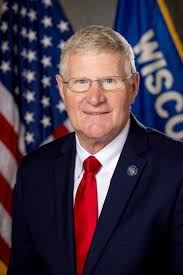
In testimony supporting the bill, state Sen. Howard Marklein, a Republican from Spring Green, argued that the bill:
1. “Protects Wisconsin consumers by bringing hundreds of millions of dollars in illegal offshore betting into a transparent, regulated system.”
2. “Ensures the state captures valuable tax revenue currently lost to illegal sites that can be used for education and healthcare.”
3. “Legalizes an activity that is already occurring, allowing both the state and tribes to benefit.”
Sounds persuasive.
Yet, it’s still far from certain. That’s in part due to lobbying from a very powerful interest. Positioned against Wisconsin’s tribes, bipartisan political leadership, and perhaps the interest of state taxpayers stands the Sports Betting Alliance. And behind it are two multi-billion-dollar companies, FanDuel and DraftKings. The former is owned by a company launched in Ireland; the latter was formed in Massachusetts.
SBA’s lobbying hours on the Senate and Assembly sports wager bills are only exceeded by the Wisconsin tribes, yet somehow SBA has almost entirely escaped the public discussion; to plead its case behind the scenes with lawmakers, SBA is using a local lobbying firm called the Hamilton Consulting Group.
That group’s owner, Andy Engel, a registered lobbyist for SBA, is a connected guy; he was the Executive Director of the State Senate Democratic Committee in 2002 and 2006, Political Director at the State Democratic Party in 2003, and Deputy Director of John Kerry’s field campaign in Wisconsin in 2004, according to his bio. (two other lobbyists listed on the project have GOP ties.)
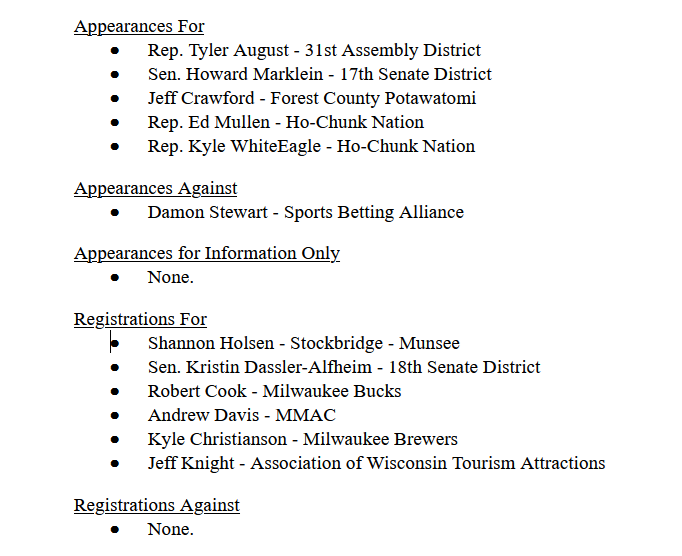
The SBA was the only group to appear at a key legislative public hearing late last year to oppose the bill. But what is SBA, and why does it care so much about stopping this effort?
FanDuel: Foreign Roots
“The SBA is a national trade association for leading online sportsbook operators. Members are FanDuel, DraftKings, BetMGM, Fanatics and Bet365. Between them SBA members represent about 90% of all online gaming in legal and regulated states,” SBA’s Damon Stewart told the Legislature.
FanDuel and DraftKings, the giants on that list, have faced a series of controversies nationwide, including class-action lawsuits and accusations from government regulators in multiple states.
“…National brands who are members of the SBA, cannot operate in Wisconsin under this bill. If passed as is, Wisconsin adults who want to bet online on sports will not be able to use sites like DraftKings and FanDuel – chosen by the vast majority of consumers in other states with legal online sports betting,” Stewart said. “Instead, they will only be able to use a small number of Wisconsin specific online sportsbooks offered by the tribes themselves.”
In Florida, under a similar hub-and-spoke model, Republican Gov. Ron DeSantis chose his state’s tribes over commercial betting interests from out of state (with Florida’s state government getting a cut, of course). FanDuel and DraftKings spent $20 million trying to get gaming legalized in that state.
As in Florida, the online gaming titans decidedly do NOT want state-based tribes in Wisconsin to corner a market they wish to play in, either. And it’s worth big bucks.
FanDuel’s parent company emerged from Irish sportsbooks in Dublin.
The role of FanDuel and DraftKings in attempting to kill the Wisconsin online gaming bill – at the expense of state taxpayers and Indian tribes – has been little explored. WRN previously took a closer look at DraftKings. WRN found a series of concerns dating back years, including lawsuits, bipartisan accusations of anti-competitive behavior, and a trail of Democratic campaign donations.
Some of the same concerns exist with FanDuel. FanDuel, in contrast to the state’s tribes (which struggle with deep social ills), is an extremely lucrative company that has been accused of operating as an anti-competitive “duopoly over the sports gambling and daily fantasy markets,” a charge it denies.
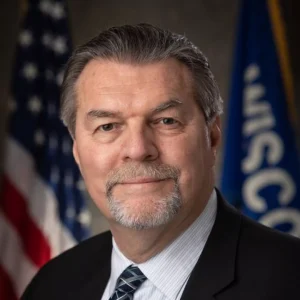
“We heard from a gentleman that was representing all of these national brands and so on. I had asked for some marketing information, which I have not received yet,” state Rep. Bob Wittke (R-Caledonia), said during a legislative hearing, according to the video on Wisconsin Eye. “But I think our citizens of Wisconsin are better served by keeping this new platform within our current structure. I will be a resounding yes on this bill.”
The question before legislators is whether to give Wisconsin’s tribes the market, as DeSantis did in Florida and Wittke wants, through a hub-and-spoke model that allows statewide online gaming only if the servers are on reservations. If the bill is killed, though, that doesn’t mean FanDuel and DraftKings get to move in; in Wisconsin, the Constitution bans the Legislature from expanding gaming. That could be changed, but it would have to go before the voters.
By the current structure, Wittke means the state’s compacts with its Indian tribes, which already allow casinos and in-person sports wagering at them. Supporters of the bill argue that the bill doesn’t run afoul of the constitutional ban (a contested point). Rather, the bill just redefines a bet under criminal statutes to allow the state to amend the tribal compacts to allow online sports wagering statewide, for a cut, if the state chooses, they say.
“Why would I want to disadvantage tribes in Wisconsin that pay Wisconsin income taxes when we’re already allowing people in other states and other countries to have the same online betting?” Assembly Speaker Robin Vos told WISN, while indicating that, in a perfect world, he wouldn’t want it at all.
Taking a closer look at the gaming behemoths
The question for lawmakers is: Would Wisconsin benefit from opening the door to national/international commercial gaming operators, knowing these companies would swoop in (presuming the voters signed off)? Or should it keep online gaming more limited and within the compact structure that already exists, benefitting Wisconsin taxpayers and Indian tribes? Or should it do neither and remain one of the 20 states currently banning online sports betting?
Let’s explore FanDuel.
- FanDuel spent more than $1.1 million on lobbying in 2025 throughout the U.S.
- Last year, FanDuel “was valued at $31 billion.”
- FanDuel (along with DraftKings) was accused by two bipartisan U.S. Senators, in a letter to the Federal Trade Commission and Justice Department, of allegedly “conspiring to maintain a duopoly over the sports gambling and daily fantasy markets.”
- The letter came after a law school professor named Salil Mehra argued that “these two companies now appear to be behaving as an anti-competitive duopoly,” according to Front Office Sports.
- Mehra alleged: “Recent bans against other daily fantasy companies in several states began with a lobbyist in Wyoming who had ties to the Sports Betting Alliance, a lobbying group that lists FanDuel, DraftKings, BetMGM, and Fanatics Sportsbook as its only four members on its website.” That’s the same group urging the state Legislature to reject the bill that would put online gaming in the hands of Wisconsin Indian tribes.
- Who owns FanDuel? Flutter Entertainment, which originated in Ireland. “Flutter Entertainment’s origins date back to 1988 in Ireland, with the founding of the gambling powerhouse Paddy Power, the result of the merger of three Irish bookmakers: Stewart Kenny, David Power, and John Corcoran,” Gambling Insider reports.
- “Flutter would become a multi-national presence, with headquarters in both Dublin and New York,” according to Gambling Insider.
- Over the last decade, FanDuel’s parent company, Flutter Entertainment, “has transformed from a regional Irish bookmaker into the world’s largest online sports betting and iGaming operator. With FanDuel leading the U.S. market with a commanding 43% market share, Flutter has positioned itself as the dominant force in the rapidly growing online sports betting industry — and investors have taken notice,” Flutter says.
- “High-profile investors including Dan Loeb have flocked to Flutter Entertainment, the Irish gambling company that is the main owner of FanDuel and made the New York Stock Exchange its primary listing in May,” according to a 2024 Market Watch article. “Makaira Partners’ Tom Bancroft, Tiger Global Management’s Chase Coleman and Viking Global Investors joined Third Point’s Loeb in adding Flutter to their portfolio, while Cantillion Capital Management’s William Von Mueffling, Maverick Capital’s Lee Ainslie and Egerton Capital’s John Armitage.”
- “We have the #1 brand in the world’s largest market – FanDuel in the US,” FanDuel says. “Our portfolio of leading global brands also holds the top spot in many core markets – SkyBet in the UK and Ireland, Sisal in Italy, and Sportsbet in Australia – alongside other brands competing for #1 positions worldwide.”
- Some media companies have partnered with FanDuel. For example, according to The Guardian, “The Associated Press, a wire service that touts its independence, signed a deal in 2021 to make FanDuel its exclusive provider of sports odds.”
In addition, FanDuel has faced a series of regulatory actions over the years. Among them:
- The city of Baltimore sued DraftKings and Flutter Entertainment, the parent company of FanDuel, in April 2025, “accusing the sportsbooks of engaging in deceptive and unfair practices to target and exploit vulnerable gamblers,” ESPN reported.
- The city “alleges that the companies use misleading promotions to attract bettors and then leverage data and analytics to keep problem gamblers betting, practices it says are in violation of the city’s Consumer Protection Ordinance.” FanDuel responded to ESPN: “We are confident the company operates in accordance with all laws, including those established and enforced by the State of Maryland’s Lottery and Gaming Control Commission.”
- The Internet is replete with law firms seeking to file class-action lawsuits against FanDuel. A class action lawsuit “claims that FanDuel knowingly runs FanDuel Fantasy contests in California despite state laws prohibiting gambling,” for example.
- In 2016, FanDuel and DraftKings each agreed to pay “$6 million in penalties and fees to the state of New York, in order to settle alleged false advertising violations.”
- Accusations were lodged against FanDuel in a 2023 article in The Guardian. “One of the United States’ largest online gambling operators tried to water down rules designed to help problem gamblers and protect young and vulnerable people,” alleged documents seen by the Guardian. “FanDuel lobbied for New York to rethink a proposed ban on gambling platforms from using certain words and phrases to attract people ‘who are or may be’ problem gamblers to their websites,” alleged The Guardian.
- The company, “which is owned by the Dublin-based gambling giant Flutter Entertainment, also opposed a rule prohibiting sports-betting advertisements near college campuses,” The Guardian noted. What is FanDuel’s side? FanDuel “has said it is ‘committed to protecting our players,'” the publication added.
- In 2018, New Jersey gambling regulators investigated “whether FanDuel’s sports book should pay out more than $82,000 to a man who was given exorbitant odds for the Denver Broncos to win Sunday against the Oakland Raiders.”
- In 2025, the state of New Jersey socked FanDuel with a small penalty after accusing the company of failing “to address the regulatory violations pertaining to FanDuel’s failure to receive the necessary Division approval prior to activating promotional spins, which resulted in inaccurate revenue reporting.”
- Also in 2025, the Pennsylvania Gaming Control Board (PGCB) “sanctioned FanDuel and Rivers Casino Philadelphia with fines for regulatory breaches. It also banned seven individuals from entering and playing at legal casinos in the state for various offenses,” according to Casino Beats.
- The Massachusetts Gaming Commission “agreed to levy a $15,000 civil administrative penalty to FanDuel for thousands of improperly accepted bets on the LPGA from March 2023 through June 2024,” according to Sports Betting Dime.
- In 2025, the Iowa State Racing and Gaming Commission fined FanDuel $125,000 “for violations in the state,” according to the Des Moines Register, which along with Radio Iowa reported that the accusations “included allowing illegal bets in Iowa on the Super Bowl, golf matches and soccer matches,” as well as allegedly “not having working options for responsible gambling.”
- FanDuel also ran afoul of regulators in Massachusetts, who alleged: “Two incidents stemmed from FanDuel and Fanatics Sportsbook accepting bets on Belarusian soccer, both of which were discussed by the commission this past January. The commission has instituted a prohibition on sports bets on Belarus or Russian teams or athletes.”
- FanDuel was accused by New Jersey regulators of “accepting wagers on mixed martial arts events that had already taken place.”
- FanDuel was accused by Indiana regulators of letting a fraud prevention manager’s and other licenses expire.
- In 2024, Odds Trader reported: “FanDuel, DraftKings, and Maryland’s own Crab Sports agreed to pay fines for a variety of infractions ranging from player deposits to a lack of responsible gambling messages. The violations all occurred last year and it is not the first time the Maryland Lottery and Gaming Control Agency has cracked down on operators’ transgressions.”
- Louisiana regulators made allegations of non-compliant advertising.
- Those are just some of the accusations.
Democratic state Sen. Kristin Dassler-Alfheim wrote, “A tribe interested in offering mobile sports betting would be required to work with the state of Wisconsin to amend their existing gaming contract, which would then have to be reviewed and approved by the Federal Bureau of Indian Affairs.”
She added: “There are already thirty-one states that have legalized mobile sports betting statewide. The legality of the ‘hub-and-spoke ’ model has been validated by the court case West Flagler Associates v. Haaland, in which a D.C. Court of Appeals found the model to be in compliance with federal law, a decision which the U.S. Supreme Court left standing.”
The bill’s opponents (and there are some outside the Capitol doors as well) divide into three camps: Those who don’t want online gaming in the state ever, largely due to addiction concerns; those who think the bill doesn’t pass legal muster (mostly WILL); and those who prefer a constitutional amendment that could, if passed, open the door to everyone, which would mean FanDuel and DraftKings comes to Wisconsin, which currently dominate the market. SBA argues that the online gaming titans are willing to partner with tribes but says it wouldn’t get a big enough cut under the current bill to make it feasible.
It should be noted that the reason only tribes are allowed to offer legal gambling in the state now is because federal court decisions said the state opened the door when it authorized a lottery.
Table of Contents