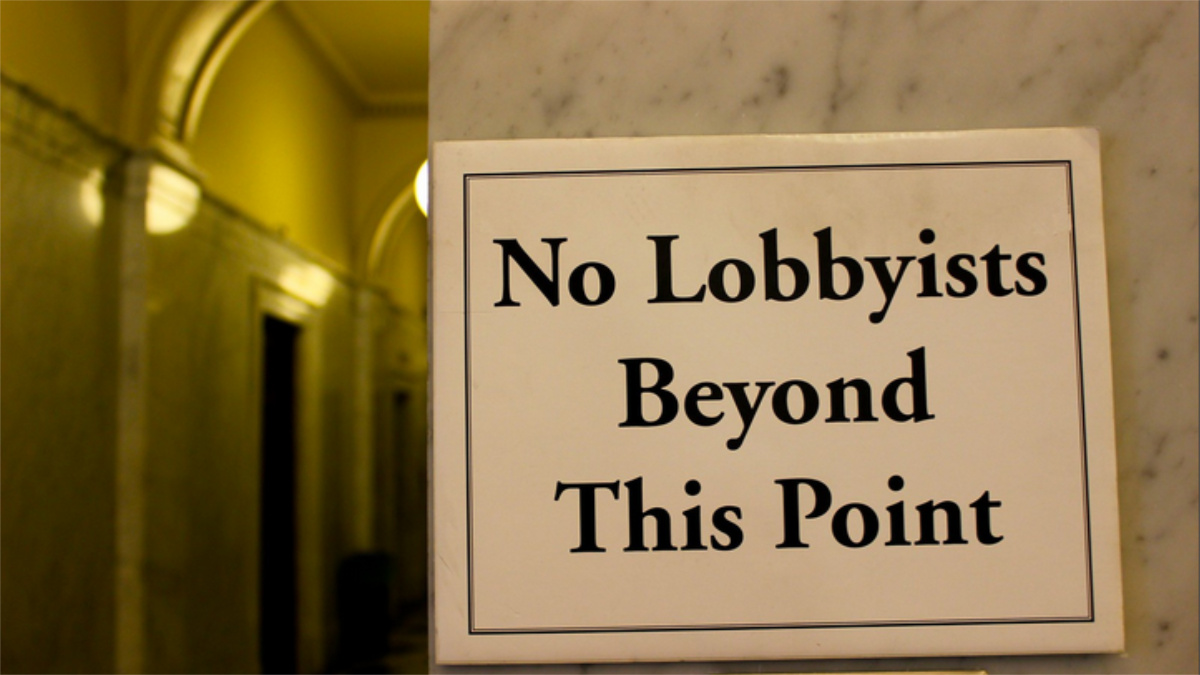

A lobbyist for the group representing controversial out-of-state online betting giants DraftKings and FanDuel is turning up the pressure on “key Senate Republican staff” to kill an online betting bill that could come to the floor this week. Supporters of the bipartisan bill say it would bring Wisconsin taxpayers and tribes hundreds of millions of dollars in revenue while regulating an already existing illegal market.
If the out-of-state companies (one with foreign ties) succeed in killing Assembly Bill 601 and its companion piece in the state Senate, SB 592, state taxpayers would get nothing. Yet the betting giants are pressuring the state Senate to kill it anyway, and the lobbyist, R.J. Pirlot, threaded what might be construed as several warnings into the email he wrote on March 10 to “key” Senate Republican staff.
Pirlot is no stranger to controversy. He is also a registered lobbyist for a company trying to build data centers in Wisconsin; for the American Petroleum Institute; for roadbuilders; and for energy companies, among other controversial clients. The four lobbyists authorized to represent the Sports Betting Alliance (made up of the companies like DraftKings and FanDuel) all work for Hamilton Consulting Group. From July to December, more than $262,000 was spent by SBA lobbying legislators to kill the bill to allow the state to amend compacts with Wisconsin tribes to allow them to offer online sports betting, with taxpayers getting a big cut.
According to Channel 3000, online sports betting “is already legal in nearby states including Illinois, Iowa and Michigan, creating competitive pressure for Wisconsin to establish its own framework.” In Florida, Republican Gov. Ron DeSantis championed the same model that the lobbyist wants the state Senate to kill this week. DeSantis touted the so-called hub-and-spoke model, saying it would bring Florida “a guaranteed $2.5 billion in revenue over the next five years.”
The Lobbyist Issued Several Warnings to Legislators
In the email obtained by Wisconsin Right Now, the lobbyist warned that, if the state Senate doesn’t kill the bill, “national” companies (presumably like DraftKings and FanDuel) will likely pursue “prediction markets” instead. “We should not anticipate national entities will fold up their tents and ‘go home’ if AB 601 is signed into law; rather, no one should be surprised if they pursue prediction markets as an alternative,” he wrote.
According to Wired, critics have derided prediction markets as “exploitative,” with one state attorney general calling them “unregulated, untaxed, unsupervised.” In Wisconsin, the Ho-Chunk Nation has already sued a prediction market company called Kalshi, accusing it of false advertising. Kalshi denies the claims.
“Loss of revenue has a direct impact on tribal governmental functions and has a tangible effect on the services and programs the tribal governments provide to their members and all persons who live, work, and visit the Nation’s Indian Lands,” the lawsuit alleges.
But the lobbyist wasn’t done issuing warnings.
The SBA lobbyist warned that state lawmakers could face “years” of lawsuits. “If passed, AB 601 will almost certainly be extensively litigated, in both federal and state courts,” Pirlot wrote, adding, “…rest assured, we can expect this to be litigated for years.”
He also warned that, if FanDuel and DraftKings don’t get their way, people might use illegal markets instead.
The lobbyist made it clear that DraftKings and FanDuel share the goal of coming into Wisconsin. He wrote that the bill “effectively excludes legal participants like DraftKings and FanDuel from entering the Wisconsin market.”
Most Organizations Registered for the Bill Are Wisconsin-Based
In contrast, most of the organizations supporting the bills are Wisconsin-based, including the Milwaukee Brewers, Milwaukee Bucks, Milwaukee Metropolitan Chamber of Commerce, the Green Bay Packers, the Association of Wisconsin Tourism Attractions, the North Central States Regional Council of Carpenters, and, of course, the state’s tribes. At a recent public hearing, a representative of the Sports Betting Alliance was the only speaker opposed, although others have voiced opposition outside the Capitol.
“It may seem odd for the Sports Betting Alliance to highlight voter opposition, but they believe amending the constitution makes more sense for Wisconsin and this approach would appeal more strongly to voters,” Pirlot admitted.
Doing so would be no easy task, but the online betting behemoths essentially want in.
But would that be good for the state?
Anti-Competitive & Other Concerns Were Lodged Against DraftKings & FanDuel
Wisconsin Right Now previously took a closer look at both companies because that angle wasn’t being explored by anyone in the media.
Wisconsin Right Now found a series of concerns dating back years relating to DraftKings, including lawsuits, bipartisan accusations of anti-competitive behavior, and a trail of Democratic campaign donations.
Who owns DraftKings? “Headquartered in Boston, and launched in 2012 by Jason Robins, Matt Kalish, and Paul Liberman, DraftKings is the only U.S.-based vertically integrated sports betting operator,” DraftKings says. Robins became a billionaire in 2021; he once rented the New England Patriots stadium for his wife’s birthday.
The Wisconsin tribes have different realities; the tribes say gaming proceeds help them become more self-sufficient and less reliant on state services.
The bill passed the state Assembly, and it’s expected to be signed by Gov. Evers, if it passes the state Senate. However, that is far from certain, and DraftKings and FanDuel want to keep it that way. The bill would open the door for the state to enter compacts to allow tribes to offer the online gaming, for a cut.
FanDuel, in contrast to the state’s tribes (which struggle with deep social ills), is an extremely lucrative company that has been accused of operating as an anti-competitive “duopoly over the sports gambling and daily fantasy markets,” a charge it denies.
Pirlot’s email also discusses a Marquette poll showing more than 60% of voters opposing legalizing online sports betting. However, there are some issues with the poll. For one, the poll question did not inform voters being polled that the bill would bring taxpayers hundreds of millions of dollars. It also showed that Republicans were more open to legalization than people with other political backgrounds. Some groups supported legalizing the online sports betting. For example, Hispanic voters overwhelmingly support legalizing online sports betting and black voters were almost evenly split, as were young voters. People in the City of Milwaukee were also supportive of legalization.
The lobbyist urged the Legislature to amend the Constitution, arguing it would “preserve tribal sovereignty over gambling,” even though the tribes support the current bill instead. The lobbyist also argued that a constitutional amendment would “include potentially hundreds of millions of dollars in revenue to the state similar to that which online betting companies in other states pay.” However, there is no guarantee that, if the bill is killed, a constitutional amendment would ever pass the legislature or the voters. The lobbyist also criticized the compact process, whereby tribes enter into agreements with state government and the governor.
State Sen. Howard Marklein, a Republican from Spring Green, is a proponent of the bill’s passage. He has argued that the bill:
1. “Protects Wisconsin consumers by bringing hundreds of millions of dollars in illegal offshore betting into a transparent, regulated system.”
2. “Ensures the state captures valuable tax revenue currently lost to illegal sites that can be used for education and healthcare.”
3. “Legalizes an activity that is already occurring, allowing both the state and tribes to benefit.”
Table of Contents