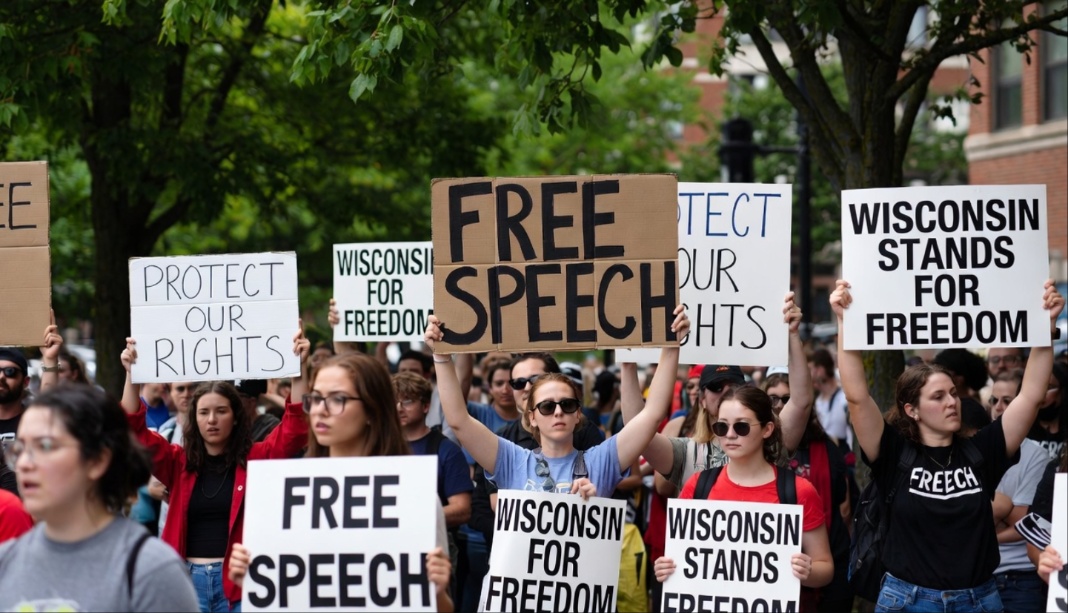

Protect Free Speech From Frivolous Lawsuits in Wisconsin

spot_img

By David Keating

Imagine spending years in court because a powerful individual didn’t like what you wrote about them and filed a meritless lawsuit against you. Even if you ultimately win, you still lose—because the costly, time-consuming litigation effectively silenced you and chilled others into not speaking in the first place.

The right to speak freely on matters of public concern is a core First Amendment freedom. Yet baseless lawsuits filed by unscrupulous plaintiffs can severely undermine this right.

Thirty-nine states already provide protections against this form of lawfare. Sadly, Wisconsin isn’t one of them. Here, citizens are defenseless against such frivolous suits, called SLAPPs—Strategic Lawsuits Against Public Participation. SLAPPs usually are meritless defamation suits that aren’t about winning in court. They’re about punishing critics and making journalists, activists, or ordinary citizens think twice before speaking up again.

Plaintiffs can weaponize SLAPPs to shut down all kinds of speech on matters of public concern, whether it’s criticism of a politician, reporting on a local employer’s business practices, a negative online review, or anything else.

Wisconsin is one of just 11 states that offer citizens no legal protection against SLAPPs. That’s why my organization, the Institute for Free Speech, awards the Badger State a grade of “F”—zero out of 100 points—in our national Anti-SLAPP Report Card, which rates anti-SLAPP protections in all 50 states and the District of Columbia.

The good news is that Wisconsin may be on the verge of fixing this problem. Assembly Bill 701 / Senate Bill 666, the Wisconsin Public Expression Protection Act, has now passed the state Assembly. The bill is based on the Uniform Public Expression Protection Act (UPEPA), a model law crafted by the nonpartisan Uniform Law Commission and adopted by a growing number of states.

Crucially, the Wisconsin bill includes the provisions that make anti-SLAPP laws effective. It requires plaintiffs to show they have a legitimate claim before dragging defendants through a costly discovery process, such as turning over records and being interrogated by a lawyer. If they can’t, a judge must promptly dismiss the case. Defendants also get the right to an immediate appeal if an anti-SLAPP motion is wrongly denied—a critical safeguard, since prolonged litigation is often the whole point of a SLAPP. And courts would be required to award attorney’s fees to prevailing defendants, shifting costs back onto those who abuse the legal system to silence critics.

Passing this bill would allow Wisconsin to catch up with the overall anti-SLAPP trend, especially in this region. Neighboring Minnesota and Iowa already have “A-minus” and “A+” anti-SLAPP laws, respectively. Michigan just adopted a UPEPA-based law last December, bumping it from an “F” to an “A+” as well. Ohio enacted its version of UPEPA in January 2025, likewise earning an “A+.”

In both Michigan and Ohio, UPEPA passed without a single “nay” vote in either chamber, speaking to the widespread, cross-ideological appeal of protecting free speech rights against weaponized lawsuits. Indeed, Wisconsin’s Assembly also passed the bill unanimously, and it enjoys bipartisan support, with Republican sponsorship and Democratic Governor Tony Evers signaling that he would sign it into law if it reaches his desk.Yet UPEPA now faces an uncertain future in the Senate.

The Senate meets in mid-March. If Wisconsin’s lawmakers want to protect journalists, advocacy groups, whistleblowers, and everyday citizens from being legally bullied into silence, they should pass this bill.

Wisconsin prides itself on its tradition of open democratic participation. Passing UPEPA would instantly move the state from the dwindling ranks of the unprotected to among the nation’s most vigorous defenders of free speech against frivolous lawsuits. That’s an achievement the entire Wisconsin Legislature—and the whole state—should be able to celebrate.

David Keating is the President of the Institute for Free Speech and a co-author of the Institute’s Anti-SLAPP Report Card.

This piece originally appeared at the Wisconsin State Journal on March 3, 2026. It has been re-published with permission. Representative Jim Piwowarczyk is the author of AB701 and the co-founder of Wisconsin Right Now.

spot_img

Pressure Movie Review: ‘We Had Better Meteorologists Than the Germans’

I like World War 2 movies. Hollywood doesn’t generally mess this genre up by filling WW2 movies with woke BS, as we are all...
disclosure day movie

Disclosure Day Movie Review: This Is Probably Steven Spielberg’s Worst Film

Disclosure Day was good in concept but was failed by its script. It’s a Steven Spielberg movie about extra-terrestrials! I’m a child of the...
scottish highlands

The Death of Robin Hood Movie Review: Hugh Jackman Is No Errol Flynn, and That’s the Point

The Death of Robin Hood Movie Review: Short version Interminably boring for at least 40 minutes, this is a revisionist, dark take on Robin Hood...
ron johnson

Ron Johnson: The Story the Media — and the Government — Don’t Want You to Hear

Read about the biggest government scandal that legacy newspapers won’t touch. By U.S. Sen. Ron Johnson (R-Wisconsin) On April 29, 2026, as Chairman of the Senate...
will martin

Will Martin: Celebrating Freedom & the Republican Party’s Fight to End Slavery

Will Martin is the Republican Party-endorsed candidate for Wisconsin lieutenant governor. The primary is in August. Wisconsin, the Republican Party, and Juneteenth hold a special...
terri koschnick

Wisconsin Counselors Ask Courts to Protect Their Right to Offer Christ-Centered Therapy After Evers’ Admin Ignores Law

“Government officials should not be allowed to police the private conversations I have with my clients who voluntarily seek out my advice as a...
Citizen Vote Protection Act Fentanyl Overdose Link derrick van orden

Derrick Van Orden Helped Deliver More Rural Health Care Investment – Tony Evers Falsely Tries to Take Credit

"Republicans fought to deliver meaningful investments in rural health care, and I'm proud to have helped make it happen" - U.S. Rep. Derrick Van...
tom tiffany

Father’s Day Wisdom From ‘State Dad,’ Tom Tiffany

It's Father's Day, and Tom Tiffany is a father of three. We've previously opined that he's basically the "state dad," a common sense figure...
will martin

No, Tom Tiffany and Will Martin Did NOT Split Over Juneteenth Day

Contrary to the media’s outraged reporting, Tom Tiffany and likely Republican lieutenant governor candidate Will Martin did NOT split over Juneteenth Day, which honors...
josh kaul

Josh Kaul Emerges From Hibernation, Refuses to Oppose Abolishing the Police

Josh Kaul, the laziest attorney general Wisconsin ever had (which is saying a lot since JB Van Hollen was hardly a firestorm of ambition),...
tom tiffany

Tom Tiffany Is the State Dad, Kelda Roys Is the Crazy Aunt, and Herb Kohl Did the Milk Thing First

I went for a five-mile walk inside Brookfield Square Mall today because it was raining, and, wow, has that place gone downhill. It’s a...

D-Day: 82 Years Later, I Stood on Omaha Beach, Remembering the Young Men Who Died for Liberty

'The Normandy-area folks are deeply aware of the fact that if not for the 2,500 brave young men who stormed those beaches on June...
menominee county

The Wildly Blue Wisconsin County and It’s Not Milwaukee or Dane: Menominee County’s Unusual Democrat Tilt

In a state where elections turn on 10,000-30,000 votes, every vote really matters. One county stands out dramatically in Wisconsin vote totals, wildly swinging toward...

Mandela Barnes Doesn’t Know What a Musky Looks Like, Fishing Bobbers, and the Rural Vote

Advice for Democrats. Stop posting about fish, talking about fish, and holding fish on camera if you don’t really know anything about fish and...
michael alfonso

Mike Alfonso, George Washington, Jessi Ebben’s Signature Gambit, and the Audacity of Duffy Inc.

Youthful Wisconsin congressional candidate Mike Alfonso’s online buddies have started comparing him to the Founding Fathers. It’s bad enough that they think the Marathon...

Old McDonald Had a Farm, But Tom Tiffany Really Grew Up on One

Farming is starting to define the Wisconsin governor’s race. That’s probably a good thing for Tom Tiffany because he actually grew up on one,...
sylvia ortiz-velez

Sylvia Ortiz-Velez’s Lawyer Blasts Democrat Insider Effort to Kick Her Off Ballot

Michael Chernin, the lawyer for Democrat state Rep. Sylvia Ortiz-Velez (D-Milwaukee), is blasting a new filing by the Assembly Democratic Campaign Committee seeking to...
francesca hong

Sylvia Ortiz-Velez & Francesca Hong: Democrats Go WILD on Free-Thinking Minority Women. It’s a Political ‘Witch Burning’

What do state Rep. Sylvia Ortiz-Velez and upstart gubernatorial candidate Francesca Hong have in common? They’re both outspoken anti-establishment Democrat minority women who are...
Wisconsin Supreme Court Redistricting Hearing Wisconsin should soon have an answer about ballot drop boxes and just who can return absentee ballots. wisconsin supreme court

Justice Rebecca Bradley Calls Courts’ Map Review Doing ‘Bidding of political masters’

(The Center Square) – A conservative Wisconsin Supreme Court justice called the courts’ decision to hear a case challenging the state’s congressional maps doing the “bidding of its political masters” rather than a proper decision.

The court sent an order stating that it would hear an appeal of a three-judge panel’s ruling not to hear the case but said that it would not hear the case on a requested expedited schedule.

“The Democratic Party bought multiple seats on this court to achieve yet another outcome unobtainable democratically,” Justice Rebecca Bradley wrote in dissent.

Bradley joined Justice Annette Ziegler in dissent against hear the case from the Wisconsin Business Leaders for Democracy that a three-judge panel dismissed on April 28.

“It is indeed rare that I feel compelled to object to hearing a case,” Ziegler wrote. “But here, I have concluded this is too important to stand silent. The public should be informed of the requests afoot and it should have the opportunity to stay abreast of these proceedings.

“And, of course, the briefing and arguments could cause me to conclude that this appeal was proper and relief should be granted. We shall see.”

The majority of judges took offense at Bradley’s insinuation that the decision to hear the case was politically motivated, calling the dissent “false, inappropriate, and disingenuous charges.”

“Deciding to hear a case does not reflect any weighing of the merits of any party’s claims, let alone prejudgment about who will prevail and why,” Justice Rebecca Dallet wrote. “We do not prejudge cases, and for that reason, we do not comment at this early stage on the parties’ legal theories, or try to develop arguments in favor of one side or another.”

Ziegler wrote that it was “shocking” the case would be reviewed without analysis of the jurisdiction of the case, if there is a proper claim or if there is even a right to appeal the ruling of a three-judge panel. She pointed to four other times that the Wisconsin Supreme Court had determined that the current congressional map would not be reviewed.

uw-madison Administrators at UW Schools

Republicans Push Back Against UW System Tuition Increase Proposal

(The Center Square) – Several Republican lawmakers are upset with the University of Wisconsin System’s proposal to increase tuition by 2% a year after a 5% increase.

Sen. Patrick Testin, R-Stevens Point, went as far as saying that a pair of trustees “lied to all our faces” in committee testimony when they said that tuition would not be raised again this soon.

“Unfortunately, students and their families are the ones who will be paying the price for this dishonesty,” Testin said in a statement. “At least we now know that we can no longer take the UW Board of Regents at their word.

“My Joint Finance Committee colleagues and I certainly will not forget this betrayal when the regents and UW officials come begging to us for more money during next year’s state budget deliberations. This is simply unacceptable.”

The 2% increase for resident undergraduate tuition would be effective this fall. The university said in a press release that the increase is below the current inflation rate. The increase also includes a 3.5% increase in segregated fees, which are for student services, activities, programs, and facilities. In all, it would be a 2.5% average increase across tuition, segregated fees and room and board.

“We recognize Wisconsin families are managing rising costs in every part of their lives, and that reality informed this proposal,” Universities of Wisconsin Interim President Renée Wachter said in a statement. “This is a measured increase that helps our universities continue providing strong student support and high-quality academic experiences while keeping a UW education among the most affordable in the Midwest.”

Sen. Eric Wimberger, R-Gillett, pointed out that, over the past 10 years, the system has added 2,400 non-faculty staff positions while educating 16,000 fewer students.

Wimberger said that, if the system would “eliminate their administrative bloat,” it would free up $750 million.

“UW’s leadership is continuing to pass its payroll expenses onto students and their families, when it should be cutting its massive bureaucracy and reinvesting its funds to create a more valuable student experience,” Wimberger said in a statement. “No amount of money will ever be enough for satisfy these bureaucrats, and the bright students who attend our universities are only left with a worse education.”