
This is the second in a multi-part series on the Waukesha County Sheriff’s Primary. You can read part 1 here: “Eric Severson Ponders His Legacy, as the Primary Rages,” part 3: “John Gscheidmeier, Nick Ollinger Discuss the Issues, From Body Cams to Flock” here. And part 4: “The Deputy Union Endorses, and Baseball Caps Emerge as a Bone of Contention”The election is Aug. 11.
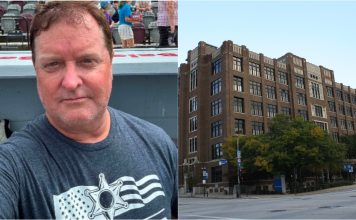
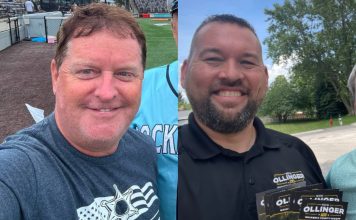
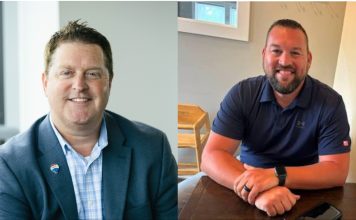
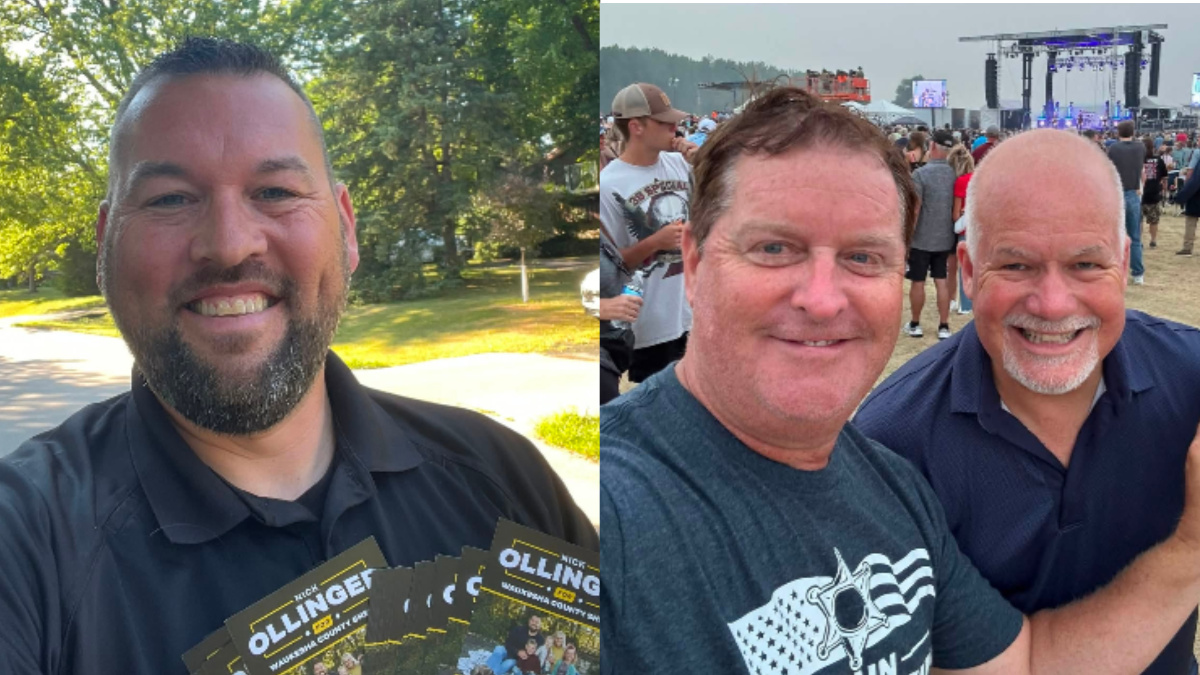
Waukesha County Sheriff’s Candidates John Gscheidmeier and Nick Ollinger are different personalities. The hulking Ollinger, a 6-foot-4-inch former college football player at Concordia, is a captain in the Sheriff’s Department who runs its detective bureau. He is outgoing, easy-to-reach, positive, and friendly, but, when he speaks, he’s more matter-of-fact. Simply put: 41-year-old Nick Ollinger talks and carries himself more like a cop. However, he’s a good communicator.
In fact, Ollinger used to be the Department’s public information officer, and he assertively defended the Madison police officer who shot a man who injured him with a knife (statements which Gscheidmeier criticized him for). The two men are competing to replace retiring Sheriff Eric Severson, whose shadow over this race looms large.
“I’m different from (Sheriff) Eric (Severson),” Ollinger says now, when I meet him for an interview at Hartland’s Birch & Banyon Cafe in late July, in the midst of an ugly primary. He believes that some people “are not bothering to get to know who I am. They are attaching me to Eric. Eric is his own person. I have a college football background. I come from a team-oriented mentality.” At 41, he’s also a different generation and, he says, able to relate to the younger deputies; Gscheidmeier, 57, is closer to Severson’s generation.
But he says, “I am extremely loyal. I wouldn’t be sitting here without Eric. He saw the good in what I bring.” For example, Severson brought him onto a national sheriff’s border security committee; illegal immigration is also a local issue. The Waukesha County Sheriff’s Department had 16 people in the jail on ICE detainers as we were speaking.
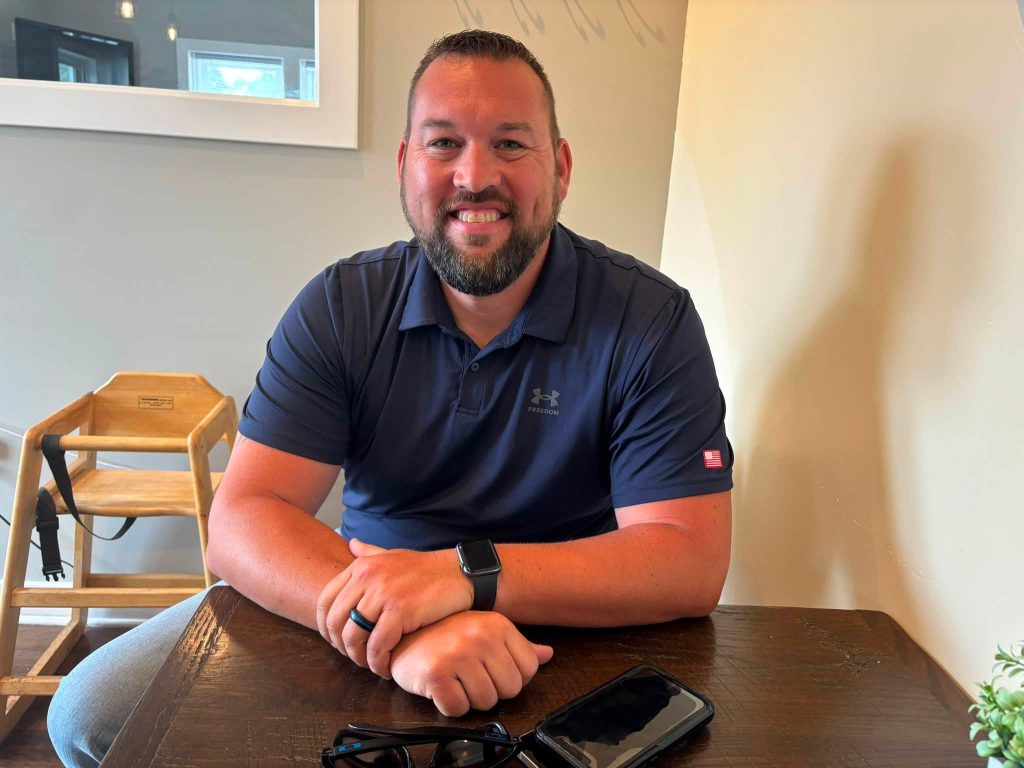
“Everyone is yearning for change. I will hold people accountable, but I bring a personal interaction with the deputies,” Ollinger says. He calls Severson a “great mentor, teacher.” But Ollinger wants to “cultivate new relationships.” He says that he is “absolutely not Eric Severson 2.0. I am not a rubber stamp. I want to continue things that work, and bring improvements where they need to be made. To be frank, he (Severson) has been distant from the deputies.” Ollinger, who was a football coach for Wauwatosa West High School, says he would bring a coaching style to the Sheriff’s office.
Gscheidmeier left the Glendale Police Department, where he was an officer for nearly 20 years, in 2012; since that time, he’s been a realtor, although he sold his business just weeks before the Aug. 11 primary, and he’s a County Supervisor. Gscheidmeier spent the last 14 years selling houses. Now, he’s selling himself, and he’s found a ready-made audience from the portion of the Waukesha County Sheriff’s Department that is itching for an outsider, although it doesn’t appear that they vetted him very well.

Gscheidmeier is very charismatic when you first meet him, a talker, perhaps bordering on facile. But he’s got good ideas, and he presents as a creative, out-of-the box thinker with a flexible mind. He comes armed with statistics and persuasive arguments, is easy to talk to, tempers the criticism with praise, and it’s easy to see why people are falling for his candidacy. People’s desire for change should never be underestimated, and he’s saying exactly what they want to hear. Even I left the interview and called a friend to say, “He has some really good ideas. I liked him a lot.”
While we’re sitting at HB, a burly man with tattoos comes up to Gscheidmeier on his way out the door, says he’s a sheriff’s deputy, and comments, “I’m on the job. I hope you win.” Gscheidmeier laughs when he leaves and promises me that was organic.
In fact, Gscheidmeier is so charismatic, that, by the end of this story, you’ll probably end up having a positive opinion of him. That’s one side of him, and it’s a real one. The problem is that there is another side to Gscheidmeier, and after I first started writing about him, the concerns began absolutely flooding in. The volume was head-spinning. The stories were consistent, and they came out of different worlds: the law enforcement community, the real estate community, MATC, a female deputy in the department he wants to run. Of course, most won’t put their names to it, claiming they’re too afraid to do so, but two men did, and I tell that story later in the series. They paint a very different picture of the man who wants to run the top law enforcement agency in Waukesha County than he does.
As an aside, Ollinger says his hobby is weightlifting, and Gscheidmeier mentions golf, which kind of sums it up.
‘They Hate Working There’
“They hate working there,” Gscheidmeier insists of Sheriff’s deputies when I meet him for an interview at Hartland’s HB Cafe; the breadth of this internal dissent is disputed, but it’s clear there’s some. After all, the Waukesha County Deputy Sheriff’s Labor Union endorsed Gscheidmeier after endorsing another candidate who later dropped out. “They don’t feel valued. It’s run by intimidation.”
Gscheidmeier claims he entered the race because “multiple people came to me and said we need help.” He says he met Ollinger at a Starbucks for a conversation early on. “He’s a nice guy,” he volunteers.
Gscheidmeier has big plans for the department; he confirms that he wants to hire former Milwaukee Police Chief Alfonso Morales as a “consultant,” saying, “It’s like hiring a coach.” (I haven’t been able to reach Morales.)
He throws Severson a bone, saying, “He’s done some really good things,” citing his championing of the 287g program to identify illegal immigrants in the jail. Both Gscheidmeier and Ollinger want to continue that.
“I like Eric a lot. I have known him 30 years. I sold his parents’ house in Brookfield. I met him in Wales at Mama Ds. Eric is a smart guy,” reveals Gscheidmeier, offering a more nuanced perspective of the 12-year taciturn sheriff than the angry keyboard warriors supporting Gscheidmeier online do. “He’s (Severson’s) a quirky dude,” he adds.
“He’s not good at the interpersonal stuff. Eric doesn’t work good with other county department heads. It’s sad to see.”
Even Ollinger says that the union perceives Severson “as not being present. He’s in his office, but that’s where he stays.” Ollinger says he wants to “bring in robust mental health services for deputies,” which is also an issue Gscheidmeier stresses. He claims that “John asked Eric to endorse him.” Severson endorsed Ollinger; Gscheidmeier has a lengthy list of prominent endorsements of his own.
Severson points to a 2023 accreditation document in which the union vice-president, now its president, said the union had a “good” relationship with Severson, and that there were few grievances. You can read more about the sheriff’s perspective in our first story in this series. Some of the same issues were raised in 2022, when a former union president ran against Severson in a primary, and was overwhelmingly defeated by the Republican sheriff.
Who Is John Gscheidmeier?
Gscheidmeier, 57, tells me that he grew up in Pewaukee. His mom was a stay-at-home mom, and his dad worked as a district manager for the White Hen Pantry and Pick ‘n Save. “We didn’t have much money growing up,” he said. “We ate a lot of hot dogs.” Still, his parents worked hard and managed to send him to Waukesha Catholic Memorial High School. He clearly inherited this work ethic.
By 16, he was working at McDonald’s; soon, he was managing it. He “learned business” there, he says. By 18, he was a part-time dispatcher for the Waukesha County Sheriff’s Department (“as a kid, I was fascinated with police/fire”). By 19, he had joined the Pewaukee Fire Department as a volunteer firefighter. By 22, he had a marketing degree at UW-Whitewater (he later got a master’s degree from Cardinal Stritch.)
By 23, he was a member of the Glendale Police Department, spending more than 19 years on the force, and leaving in 2012 to build his own real estate company. He was a DARE officer and a school resource officer. He never became a supervisor.
Glendale wasn’t just a leafy suburb. It bordered Milwaukee, with its high violent crime rate, which was exploding in that era, so the guys at Glendale saw real crime, foot chases, and the loss of a beloved officer at the hands of a bank robber.
Gscheidmeier described another scary incident: “The bank robber pointed a gun at the teller inside the bank. We found him in a back yard of a home. He put his hand in his jacket pocket, raised his hand toward us officers, and we were forced to assume he was armed and pointing a gun at us. My partner shot the suspect. I could see blood pooling below his leg in the snow, but he appeared unconscious. At the time, I felt he was not unconscious and instead was ‘playing possum.'” I decided to taser the suspect numerous times to safely get him into custody, and it worked.” There were a lot of “chases into Milwaukee.” In Waukesha County, he’s concerned about “auto thefts. We have some not so great people coming from Milwaukee.” (Both candidates stress tackling Milwaukee’s spill-over crime.)
Around the time he left the Police Department (Gscheidmeier says he wanted a normal life in real estate), he was training future cops at MATC, but that’s a complicated story that is coming in part four. “I will give anyone the shirt off my back,” he says. “I have this desire to serve.” In June 2025, he was appointed to the Waukesha County Board; he was elected to the position in April.
Gscheidmeier is very candid about his life. He made officer mental health one of his “5 pillars” – his plan for the Sheriff’s Department, which is available on his website. His brother, Josh, who saw combat in the military, took his own life. “Josh was the life of the party. You would never know he was struggling with demons,” he says. His mother was an alcoholic. “Something is missing in the relationship that supervisors have with deputies,” he says, of the need for more mental health support.
He says he has “always been a Republican. I’ve never voted for a Democrat.” He joined the Republican Party “a year ago.”
He was walking in the Waukesha Christmas Parade when Darrell Brooks’ car barrelled toward his group. “I saw Brooks coming right at me,” he says. “I look over and see my wife and 4-year-old falling on the sidewalk.” He yelled at Brooks to stop but wasn’t armed. They weren’t seriously injured, but many others were (and died.) “Why did we get spared?” he asks now. “God said, ‘I’m not done with that guy. There’s more to do.'”
Who Is Nick Ollinger?
Nick Ollinger was born in Menomonee Falls. His mom worked as a surgical technician at Community Memorial Hospital and is now retired. His dad works at Pomp’s Tire Service in New Berlin.
Ollinger’s parents went through a divorce his sophomore year, so he moved to Ladysmith, up north, to see his dad. After high school, he attended a junior college in North Dakota and then played college football for Concordia. After graduating college, he worked as a substitute teacher for Wauwatosa West, serving as a football coach and running the weight room. He also worked as a personal trainer for a Snap Fitness owned by state Rep. Jim Piwowarczyk (R-Hubertus), who is staying neutral in this race (Piwowarczyk is a former Glendale police officer who also worked with Gscheidmeier; he is the co-founder of Wisconsin Right Not but is not involved in this series.)
Ollinger’s godfather was a well-known former cop named Bob Kraemer, who started a foundation to bring cops and kids together. “My dad and him were best friends growing up. We talked. He said to me, ‘What about law enforcement?’ He helped me get into the recruit academy.” Kraemer’s father was a heroic Milwaukee police officer who died in the line of duty.
Ollinger started his law enforcement career at the Winnebago County Sheriff’s Department. While at Winnebago County, he was injured going through the door of a house. He spent two years there, but heard Waukesha County was hiring and wanted to come back home. The line at the Expo Center was “out of the door. Five got the job out of hundreds,” and he was one of them. These days, Wisconsin law enforcement is struggling with a recruit crisis, and he believes that’s contributing to the turnover problems on the force, with some officers retiring and others being lured by bonuses to other agencies. Gscheidmeier thinks the turnover is also indicative of problems in the department and low morale.
Ollinger started as a deputy at the Waukesha County Sheriff’s Department in 2014, and he was assigned to patrol Sussex, Pewaukee, and Lisbon. By 2019, he was a lieutenant of patrol. He worked all three shift levels and served on the tactical enforcement unit. In 2020, he commanded a civil disturbance unit to help with the Kenosha riots. “I was standing there protecting Kenosha as people were throwing stuff at us,” he said, calling it “utter chaos.” He stresses his “command leadership,” especially since Gscheidmeier has never been a police supervisor. By 2022, Ollinger was promoted captain. Today he runs the detective bureau.
He was also part of the unified command that responded to the Waukesha Christmas Parade tragedy and “helped out with the investigative part.”
Asked about the Democratic frontrunner for governor writing that she wants to abolish the police, he responded, “That’s an insane thing to even think about. People who don’t know right or wrong would take advantage of it. I want to stand with my brothers and sisters in law enforcement, and show the good things we do.”
As with Gscheidmeier, Ollinger is married. Ollinger’s wife is a Froedtert nurse; they have three kids. Ollinger has been involved in the Young Republicans for a couple of years, and they endorsed him, saying, “Nick’s proven dedication to his career and community is exactly what Waukesha County needs in their top law enforcement officer.” His favorite movie is “Gladiator.”
“It starts with positive engagement with the deputies,” Ollinger says. “They are out there doing the jobs that need to be done.”
Table of Contents