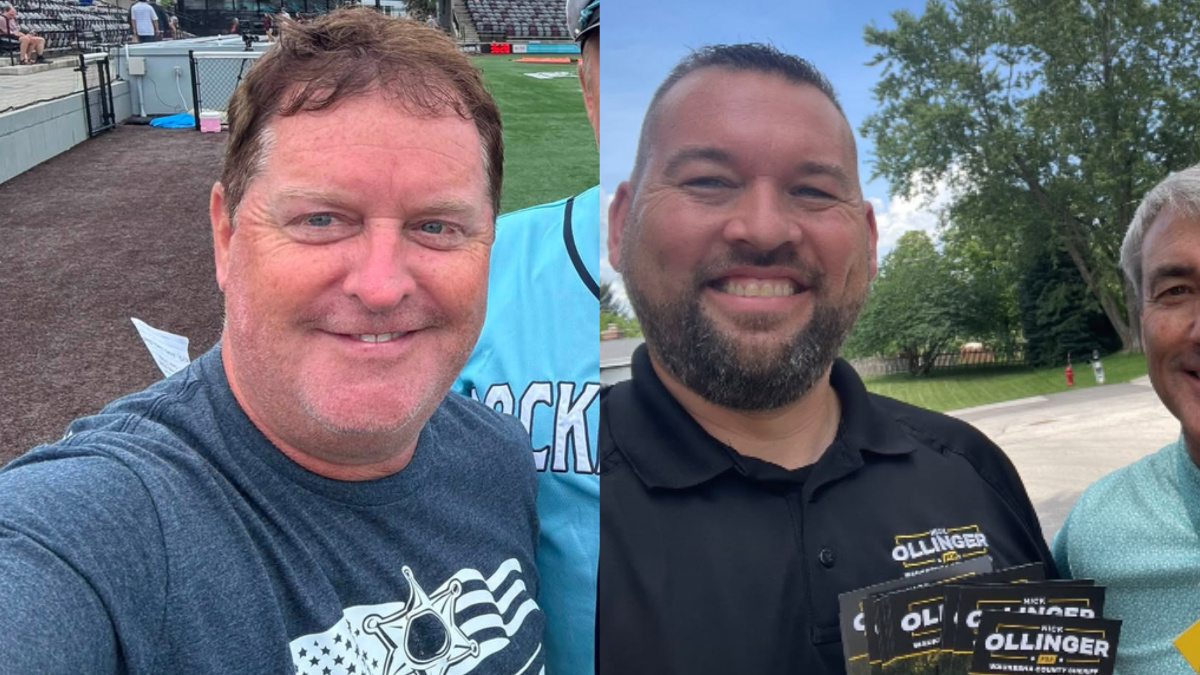

This is part 3 in a multi-part series on the Waukesha County Sheriff’s race. The primary is Aug. 11. Read part 1 here: “Eric Severson Ponders His Legacy as a Primary Rages” and part 2: “Nick Ollinger, John Gscheidmeier Open Up on Themselves-And Eric Severson”
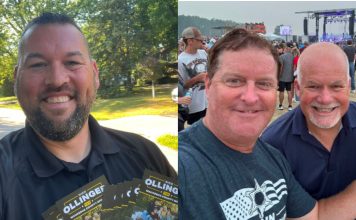
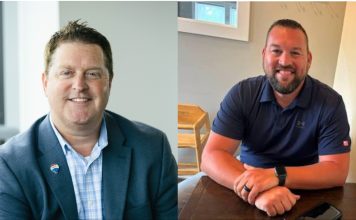
Capt. Nick Ollinger and realtor/County Supervisor John Gscheidmeier have almost no daylight between them on key law enforcement issues, which may be one reason the Waukesha County Sheriff’s primary has gotten so ugly.
“There are tremendous differences between my opponent and me in this election for Waukesha County Sheriff,” Gscheidmeier insists. “As followers, and as voters, understanding how different my opponent is from me is crucially important to your decision when you vote.”
However, in that post, Gscheidmeier, 57, was referring to the only significant difference to emerge between the two men on the issues, and it was a strange place for him to plant a flag: Ollinger publicly defended the Madison police officer who shot an absconding felon who injured that officer with a knife; Gscheidmeier argued that Ollinger should have stayed silent. Even Gscheidmeier’s supporters weren’t fully with him on that one.
“John, I support you in this campaign for Sheriff,” wrote one man on Gscheidmeier’s Facebook post. “However in complete fairness, I disagree about your assertion that your opponent may not be a use-of-force expert. I will correct you right here, sir. Every cop on the street is a use-of-force expert…The more public education for the public, the better. Who am I to judge these matters? Maybe just a nobody. But the stone you threw breaks a lot of glass brother.”
There aren’t tremendous differences between Ollinger and Gscheidmeier on much else, actually; I know because I sat down with each man for three-hour interviews this July. Their biggest differences revolve around questions of character, and Gscheidmeier positioning as an outsider who is more critical of the department and Ollinger’s boss, retiring Sheriff Eric Severson, who endorsed Ollinger. But most of the things Gscheidmeier, a former Glendale police officer, wants to change are things that Ollinger supports too or says are already being done.
‘A Pattern of Untruthfulness’
Ollinger accuses Gscheidmeier of having a “pattern of untruthfulness,” which Gscheidmeier denies, and that’s all coming at the end of this series. In contrast, Gscheidmeier has labeled Ollinger a “nice” person and says he’d keep him on as a captain if elected.
Ollinger also pushes back at Gscheidmeier’s comments that former MPD Chief Alfonso Morales might join his administration as a consultant; “I respect Al Morales, but I don’t think a sheriff needs a consultant,” Ollinger said. Gscheidmeier says Morales would “lend expertise. He’s a guy who’s done it.”
Gscheidmeier’s supporters’ criticisms of the department often revolve around questions of personality and accessibility: Whether Sheriff Eric Severson is around enough (neither candidate thinks he is) and whether Inspector James Gumm is respected (Ollinger says he will stay on until retirement, which is just months away).
Gscheidmeier’s supporters persistently raise concerns about low morale (which can be a nebulous term, but you know it when you see it), and they’re upset detectives and commanders take departmental cars home (Severson says that practice allows them to respond more quickly to scenes and is cheaper for taxpayers than putting detectives on-call. Ollinger agrees, saying the practice gets more deputies to contracted communities sooner.) Gscheidmeier and Ollinger both say they will work to fix the morale issues by connecting more with deputies; Ollinger wants to create a Sheriff’s advisory committee.
However, on major law enforcement issues, the men largely agree.
Little Disagreement on Important Issues
They agree on body cameras (both say the department needs them – only Gscheidmeier says that should have already happened, and Ollinger says they’re already underway); Flock cameras (both men support them with guardrails and limitations); 287g authority so correctional officers can screen inmates for illegal immigration status in the jail (both men want to keep it); the “Broken Windows” theory of law enforcement (they both like it. “That’s my philosophy; hold criminals accountable,” says Ollinger.); the need to keep Milwaukee crime from spilling into Waukesha County (they both want to stop it, of course).
Both men are conservative Republicans who say they voted for Donald Trump every time he was on the ballot. Neither is a socialist who would be weak on criminals, to state the obvious. Both are concerned about a rash of auto thefts and break-ins. There is no Democrat running, so the primary will determine the election.
On other topics, they also agree, but Ollinger, 41, challenges some of Gscheidmeier’s statements, saying he’s ignoring efforts already being done. Both men stress the need to boost mental health support for deputies; they both want to collaborate with other law enforcement agencies; they both think staffing numbers and turnover are issues that need solving; and both want to work more closely to meet the needs of contracted communities (“They need better value for their current contracts. They’re not happy,” Gscheidmeier says).
However, Ollinger pushes back at Gscheidmeier’s contention that the department has failed; he mentions the mental health support services already in place, insists the department already collaborates and shares data with other agencies, stresses his support for body cams (“It helps DAs, it protects deputies, it helps everybody”), and is more likely to paint turnover as part of an industry-wide trend (it is, but still seems high; 35% in the last 3.5 years.)
Gscheidmeier who has a five-pillar plan on his website, has some new ideas. He believes the department should publicize more crime data online, saying that people “can’t find the crime stats.” Ollinger says that will take money and staff resources, but he’s fine with crime data being “more forward facing.”
Gscheidmeier wants all municipal police agencies to have “county-wide” jurisdiction, like the Sheriff’s Department does now (to pursue suspects across jurisdictional lines), comparing this idea to when Glendale officers were allowed to continue pursuits into Milwaukee, so people didn’t get away. Ollinger says he’s “open to sitting down” to look into that, but notes that a major law enforcement association has opposed statewide jurisdictional authority.
Gscheidmeier wants more squad sectors covering the contracted communities. He wants to “get more people back on the road” and have fewer supervisors. He wants to change the release procedures in the jail so inmates don’t end up wandering around homeless.
Ollinger says he wants to explore how AI can improve departmental efficiency, such as with report writing, to “get more deputies out on patrol.”
Defending the Madison Cop Becomes Controversial
What did the men say about the Madison police officer specifically? Video clearly showed the absconding felon possessed a knife, and Madison’s chief said the officer was injured with it. An investigative review is pending.
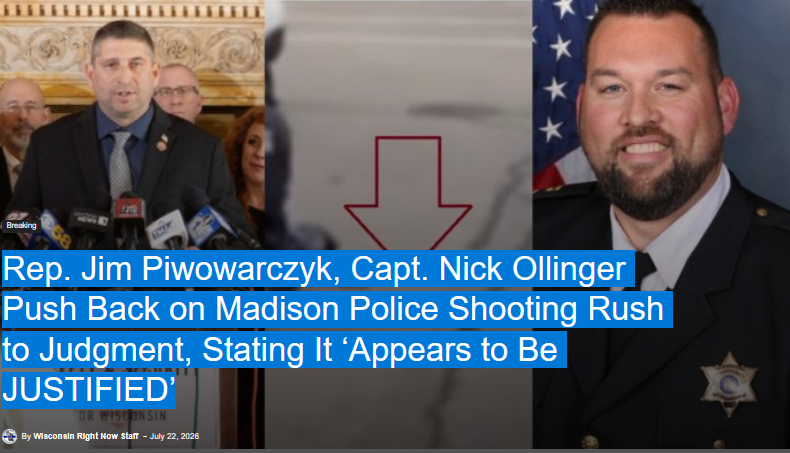
“They’re (the media/police critics) condemning the officer before knowing the facts,” Ollinger told Wisconsin Right Now shortly after the shooting. “Based on the video evidence that we can see, based on my training and experience, based on what the chief has said, this appears to be justified. But we have to gather all of the facts. But what we are presented with today, it appears to be justified.”
Ollinger and former police Sgt. and state Rep. Jim Piwowarczyk (R-Hubertus), who also spoke out, said it is important for people trained in use-of-force to push back earlier when cops are being trashed by misleading narratives in the media/protest class.
But Gscheidmeier strongly disagreed, saying that Ollinger was wrong to publicly defend the officer at that point. “Even though his incident occurred three counties away, it didn’t stop my opponent – never a Use of Force or Firearms expert, to toss his opinion out there when he felt there could be a political gain,” he wrote.
 Reader response was mixed on his comment thread.
“Everything you posted is for political gain is it not?!?!? Nick at least was also showing support for the officer involved where as you just bashed Nick for political gain,” a woman wrote.
“The Union is endorsing an outside candidate for a reason. They Sheriff’s Department is so toxic, they are begging for help. Do them a solid and vote for John,” another woman responded, switching the topic back to Gscheidmeier’s endorsement from the Waukesha County Sheriff’s Deputy Labor Union (Ollinger was endorsed by the Waukesha County Chiefs of Police Association).
Severson said that he might have a problem with a detective or other personnel weighing in on another agency’s incident. They’re not the sheriff. However, as a candidate, the public expects Ollinger to speak out on a wide array of issues, so it’s different, Severson said.
Lack of Body Cameras
One of Gscheidmeier’s major claims relates to the department not having body cameras or dash cams yet. This is actually a pretty stunning revelation, although he’s not the first person to raise it.
Gscheidmeier comments, “We have to make it happen.” He says the department should have gotten body cameras long ago. “I want to modernize the department. The systems are antiquated.” But Ollinger says he supports body cams, and the plan is already underway to get them in 2027, if the County Board, on which Gscheidmeier sits, approves the budgeted item.
Severson says the County Board and Executive set his budget, which many forget. Every year, he’s received an increase, but, due to inflation, in reality this is “less than cost to cost. Every year, we have to make cuts in services and programs. We’ve had to cut 20-25 positions since (former Sheriff Dan) Trawicki. Where were we going to get half a million to start a body camera program?”
He calls body cameras a great tool, but says that, for years, “The money wasn’t there.” Severson says the Huber jail also closed because of its cost (people are put on electronic monitoring instead). That wasn’t his preference, either, but, he says, the money just wasn’t there. In addition, more than 80% of the Sheriff’s Department budget is salaries and benefits. He can’t make money grow on trees.
The late Waukesha County Executive Paul Farrow was constantly trying to make this same point, that Waukesha contributes a lot of revenue to the state but doesn’t get enough back. He proposed a sales tax in 2024, but it quickly ran into major headwinds from conservatives who don’t actually have to run the Sheriff’s Department or the County, like former Gov. Scott Walker, who lives in Delafield and declared himself “shocked” about the sales tax proposal on X.
After such outcry, Farrow withdrew the proposal, which Severson told the media was necessary to “stop the deep cuts in the sheriff’s office.” Of course, the social media critics like Walker got the easy applause, but Farrow and Severson had to figure out what to do next, and body cams fell by the wayside.
To Severson, the question was simple: His choice was saving deputy positions or getting body cams, so he chose the former. He says getting a body camera program is expensive and also necessitates extra staff to review the videos and to deal with the likely deluge of public records requests. “I fought very hard to preserve positions,” he says. All the same, he’s on board now and believes the cameras will be approved next year.
Gscheidmeier also says he wants to “add more deputies,” which everyone wants in a perfect world, and he calls the staffing issues “a massive problem,” but it’s not clear where he will get the money.
Flock Cameras
The candidates are constantly asked for their position on Flock cameras, and residents are raising increasing concern about them. Gscheidmeier and Ollinger both support Flock cameras as critical law enforcement tools, but they want guardrails and oversight.
“In my time leading the Waukesha County Detective Bureau, I’ve had the opportunity to see Flock cameras in action,” Ollinger says. “When used with proper guardrails in place, I believe they can be an important tool to locate missing and endangered individuals through Silver Alerts, recover stolen vehicles, and ultimately help solve crimes.” According to Ollinger, who admits Flock cameras have become a “hot button issue,” a Flock camera helped deputies stop a stolen vehicle out of Madison recently, and they “help with silver alerts.”
“Let me be clear: I do not support and will not stand for the creation of a surveillance state in Waukesha County. I support the automatic deletion of Flock footage after 30 days, clear policies governing when and how the system may be accessed, regular audits to ensure compliance, and meaningful consequences for anyone who misuses it,” added Ollinger.
But Gscheidmeier’s position isn’t much different. “I support the responsible use of Flock Safety cameras and other ALPR technology because they are proven tools that help protect our communities, solve crimes, and save lives. However, public trust is just as important as public safety,” he said.
“If elected Sheriff, I will conduct a comprehensive review of the Sheriff’s Office ALPR and FLOCK policies and compare them with best practices from agencies throughout Wisconsin and nationally. My goal will be to ensure that our policies protect both public safety and the constitutional rights of every citizen,” Gscheidmeier added.
Read their full statements here.
Stay tuned for part 4.
Table of Contents