
I like World War 2 movies. Hollywood doesn’t generally mess this genre up by filling WW2 movies with woke BS, as we are all unified in our perceptions of this war (Nazis were evil, the Allies good.)
What a refreshing concept in a world today where people bend their morality based on team loyalties. There’s no objective truth anymore. Just spin. If WW2 happened today, the left would oppose our intervention because it is Trump (or vice versa, if the war effort was led by, say, Biden.) We have lost the ability as a society to unify even around objective truth.
I also enjoy watching non-American takes on World War 2 because the films tend to be more psychologically complex and unique in milieu – Das Boot and Generation War (German but unflinching about the horrors of war), Stalingrad (Russian, an incredible film), Number 24 (Norwegian), some Danish movies etc. But Hollywood can still make a good World War 2 movie, and Pressure is one.
It tells the story of the days leading up to D-Day as General Eisenhower (and a host of other famous American and British military leaders, like an agitating for the fight Bernard Montgomery and Omar Bradley) plan the Normandy landings. I like World War 2 movies that tell the real side stories that haven’t been told before. The WW2 genre has not exhausted them. This story focuses on Eisenhower’s monumentally important decision that would change the fate of the world: which date to go and how weather impacted that call.
Great decisions only seem obvious in hindsight.
The protagonist of the movie is the British meteorologist James Stagg, who is certain that the date chosen for the landing is a mistake because he’s predicting a severe storm. The problem is that the Allied meteorologist, Irving Krick, is using a different method – he’s basing his forecast on past forecasts, a method that worked in North Africa but less so with the unpredictable weather patterns of Northern Europe. He’s predicting sunny weather.
Who Should Eisenhower Trust More?
Meteorology is, of course, an inexact science back then especially, and so Eisenhower must wrestle with the decision of whom to believe – Stagg (a meteorologist recommended as a “genius” by Churchill) or Krick, the Allied weatherman who has never served him wrong.
This is based on real events albeit dramatized – for example, there was less friction between Eisenhower and Stagg in real life.
Obviously, if you remember the D-Day date, you know how this ends, but the “Pressure” comes from watching the characters wrestle with a decision that, if chosen wrong, would alter the fate of history. And how narrowly they almost turned the wrong way.
Stagg, played by the Irish actor Andrew Scott, demonstrates an impressive singular focus, absolute confidence through expertise and mastery of one’s professional realm. It’s not hubris and never arrogance because it’s not about him – it’s about the science and that he knows he knows. The problem is that, back then, the science can’t bring absolute certainty. It’s an educated guess based on the evidence. Inductive logic. Competence not ego drives his decision-making in contrast to the charismatic but rash Krick.
And then the rain comes, and then the anomaly, an opening.
It sometimes seems like only Stagg has a wormhole through which to see through time, a steely knowledge that, if he can’t get everyone to see what he sees, the fate of the world will go a very dark way, and we’d all be speaking German today.
There’s a spiritual overlay to the movie through the descriptions of the weather, which has the power to destroy and to provide. Stagg can predict it but never with certainty; the weather was outside of man’s complete control. I couldn’t help but think of how far we’ve technologically advanced since then. D-Day wouldn’t happen today because there would be no way to keep it secret from the Germans, but I’m not sure we’re better off getting closer to men playing God. Although obviously it’s a great thing that we defeated Nazi Germany.
3 People Get the Stakes
As other soldiers play piano, laugh, clutter Stagg’s office, hammer away at carpentry and other distractions, there appear to be only three people who fully grasp the stakes: Stagg, Eisenhower, and Ike’s loyal and very observant aide.
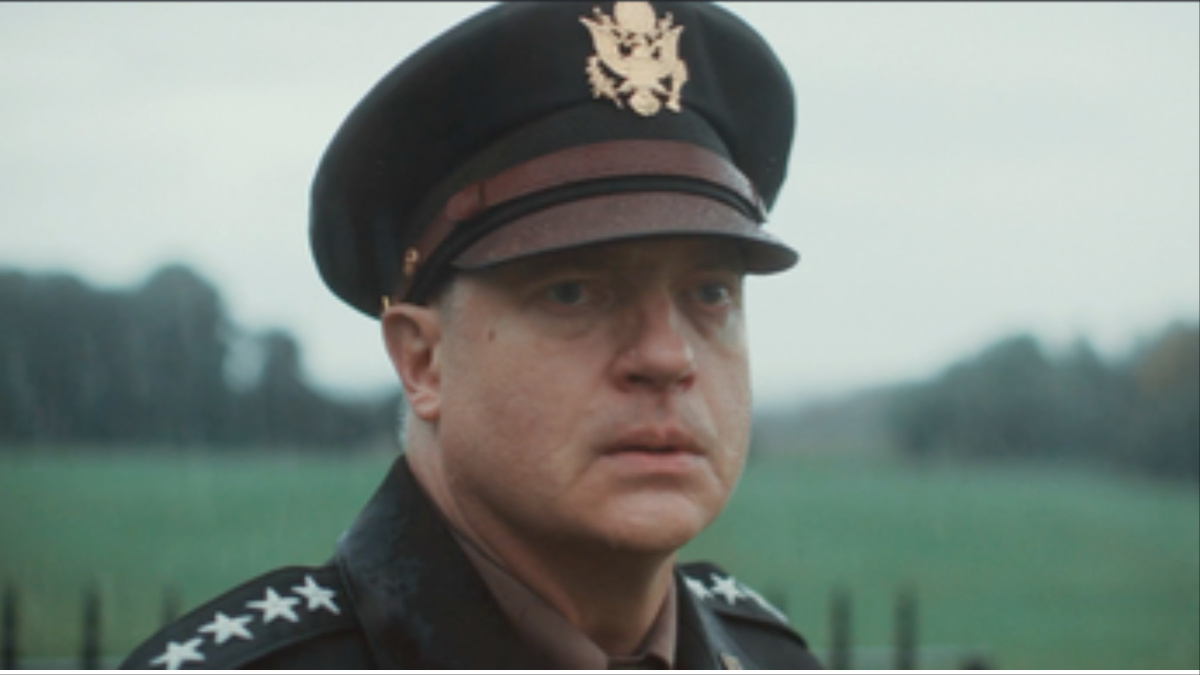
Eisenhower is played by Brendan Fraser. For those who remember him as a handsome Indiana Jones-esque action hero in 1999’s The Mummy, this might seem like a reach. But I admire his seamless embracing of character actor status rather than turning himself into a plastic-surgery grotesque caricature of his former self, Mickey Rourke style. We all age.
It’s very difficult to play a person so well-known, and it’s tougher yet for a well-known person to play a well-known person because they’re asking us to suspend belief twice. Some actors have done this very well (like Austin Butler as Elvis, although Butler was kind of an unknown, and Gary Oldman as Churchill in the Darkest Hour, which this movie reminded me of). In other cases, I can’t stop thinking that it’s just, say, Dennis Quaid playing Ronald Reagan with some distracting prosthetics (and I enjoyed that movie, but I never stopped thinking that I was watching Dennis Quaid trying to make me think he was Reagan.)
Fraser fell somewhere in between. There were times I started thinking I was watching Eisenhower, and other times when I thought, “I’m watching Brendan Fraser doing a good job playing Eisenhower.”
As for Eisenhower, he carried the weight of the world on his shoulders.
Uneasy lies the head that wears the crown.
The movie did a good job splicing in scenes of the soldiers who landed on the beaches of Normandy. Knowing that so many of them had only hours or moments to live brought a heartbreaking poignancy to the scenes of them in the boats, having a final dance or turn at the piano, and lining up and telling Ike their home states.
I know a young person who just returned from Normandy (Jenna Piwowarczyk) and she commented how much they love America there to this day, and how carefully they preserve the memory of the young men who died on Omaha Beach, taking painstaking care of their graves and even flying American flags on their homes. They remember.
JFK asked Eisenhower once how we were able to succeed on D-Day, and then turn the fate of the world and war, and he answered, “We had better meteorologists than the Germans.”
Thank goodness for that.
This movie is a very good one. Highly recommend.
Table of Contents